
6-million-year-old ice unearthed in Antarctica shatters records — ancient air offers fresh view of Pliocene climate
Scientists in East Antarctica’s Allan Hills recovered 6-million-year-old ice and trapped air, the oldest directly dated ice, offering a unique Pliocene climate record that reveals major Antarctic cooling and informs future climate and sea‑level projections.
Key takeaways
- Oldest directly dated ice: Cores from Allan Hills contain ~6-million-year-old ice and trapped air bubbles, extending ice‑core records by millions of years.
- New dating method: Argon isotope measurements in the ice itself provided the direct age control — a first for ice this old.
- Major cooling result: Oxygen isotopes indicate ~12°C (22°F) Antarctic cooling over six million years.
- Policy-relevant: Ancient greenhouse-gas measurements improve climate models used for sea-level, water, wildfire and infrastructure planning.
Main story
What was found and where
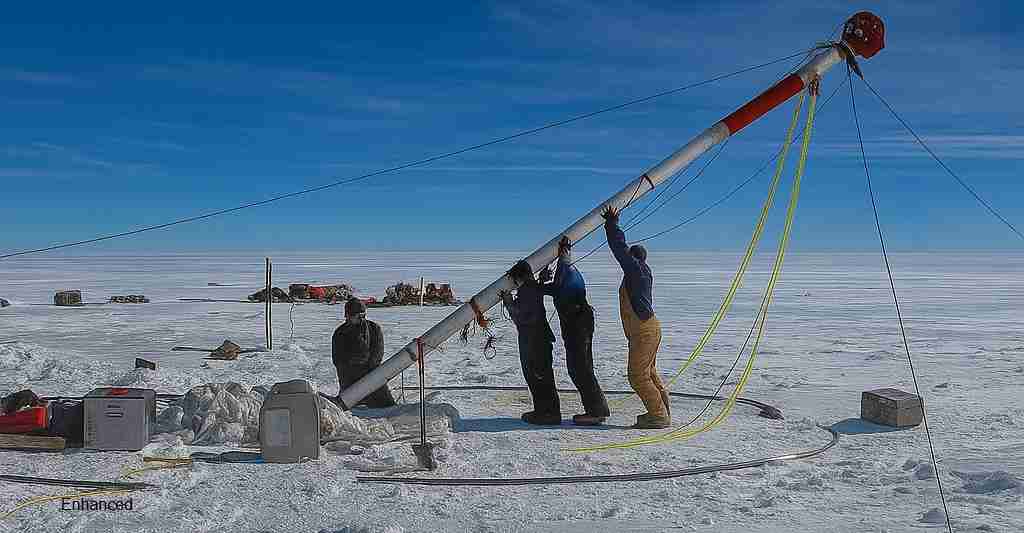
The discovery: Researchers recovered ice dated to about six million years ago from the Allan Hills blue ice area in East Antarctica. The site exposes very old ice near the surface, enabling sampling without deep central-Antarctica drilling. (WHOI press release; PNAS paper)
How it was dated
Direct dating was the breakthrough: the team measured an argon isotope trapped in the ice to obtain a direct age for this sample — the first time that technique has provided a robust date for ice of this antiquity. This avoids reliance on inferred ages from surrounding materials. (WHOI press release; PNAS paper)
Why the trapped air bubbles matter
Ice-core bubbles preserve tiny samples of ancient atmosphere. Scientists can measure greenhouse gases and isotopes inside those bubbles to reconstruct past temperatures and gas concentrations. The Allan Hills bubbles give direct access to Pliocene-era air and climate snapshots up to ~6 million years old, improving understanding of natural variability during warm intervals.
“Ice cores are time capsules — these new samples let us read chapters of Earth’s climate previously closed to us.”
New measure of Antarctic cooling: about 12°C
Key measurement: Oxygen isotope analysis of the Allan Hills ice indicates Antarctica cooled by roughly 12°C (22°F) over the last six million years. This is the first direct, long-term measurement of Antarctic cooling on this timescale and provides a quantitative benchmark for paleoclimate reconstructions. (WHOI press release; University of Maine summary)
How this extends climate records
Before this find, continuous ice-core records extended to under a million years. The Allan Hills samples push that window back by several million years, yielding new data on greenhouse‑gas levels and ice-sheet response during warm periods. Modelers gain hard constraints where they previously relied on assumptions.
Who led the work and where it was published
The research was led by an international team under the Center for Oldest Ice Exploration (COLDEX), with lead authors Sarah Shackleton (WHOI) and John Higgins (Princeton). The peer‑reviewed results were published on Oct. 28, 2025, in the Proceedings of the National Academy of Sciences. (WHOI press release)
What scientists plan next
COLDEX plans continued field campaigns from 2026–2031 to seek older ice and build longer records. The team will expand sampling at Allan Hills and other blue ice areas to better constrain ancient greenhouse-gas concentrations and ice-sheet behavior. Each new sample can sharpen model inputs.
Why conservative readers and policymakers should pay attention
This discovery emphasizes careful, repeatable science: direct dating, measurable samples, and peer review. For decision-makers seeking cost-effective, evidence-based policies, the Allan Hills data reduce uncertainty in long-range projections used to plan infrastructure, water systems and budgets.
How the new data improves climate models
Modelers can use direct air measurements from ~6-million-year-old bubbles to tune simulations of ice sheets, ocean heat uptake and sea-level response. These hard constraints help narrow error bars and make near-term planning more reliable — the sort of evidence that supports prudent fiscal decisions.
Regional implications — Redding, California
Water supply and agriculture
Relevance: Redding’s farms and orchards depend on long-term water planning. More precise paleoclimate inputs can improve models used for reservoir operations, drought planning and groundwater management. This discovery strengthens the science behind tools water managers use to set policy and budgets. (University of Maine summary; WHOI press release)
Wildfire risk and public safety
Improved understanding of long-term climate behavior informs regional risk assessment. That can help prioritize investments in forest management, fuel reduction and community hardening — practical measures with local benefits for protecting homes and businesses. (PNAS paper; WHOI press release)
State and tax policy choices
California policymakers use climate science when planning infrastructure and coastal defenses. Even for inland communities like Redding, more reliable paleoclimate data help legislators choose cost-effective measures and avoid overcommitment to unproven approaches — contributing to sound fiscal planning.
Local research and education
The discovery highlights the value of basic science and workforce development. Northern California colleges and universities can leverage this moment to strengthen earth-science training, instrumentation and data-analysis programs that support local jobs and attract federal research funding.
Practical takeaways for Redding readers
- This is fundamental science, not a weather forecast: the sample improves long-term perspective for models. (WHOI press release)
- Direct Antarctic cooling measurement: ~12°C cooling over six million years refines how scientists view past climate shifts. (PNAS paper)
- Use improved science for measured choices: local leaders should apply better data to make cost-effective decisions on water, wildfire prevention and infrastructure. (University of Maine summary)
Further reading and sources
- WHOI press release: Six-million-year-old ice discovered in Antarctica offers unprecedented window into a warmer Earth
- PNAS paper: DOI 10.1073/pnas.2502681122
- University of Maine summary: Ice-core analysis reveals cooling period 6m years ago
- Short video summary
Reporting from Allan Hills, Antarctica (Times Media Service). Primary sources: WHOI, PNAS, and related university summaries.



