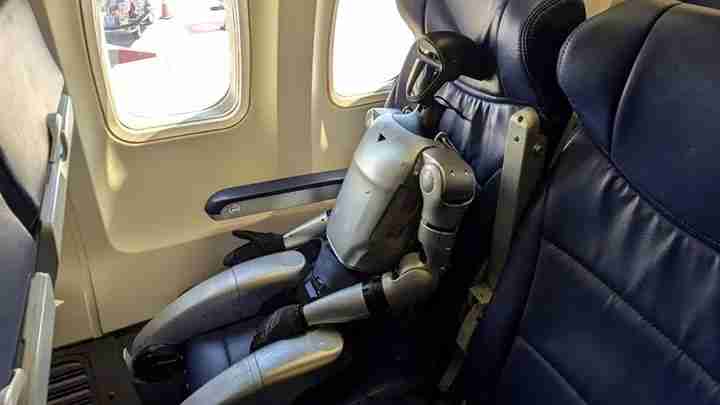
Robot Delays Southwest Flight After Lithium Battery Flagged; “Bebop” Removed and Flies Battery‑less
A Southwest Airlines flight from Oakland to San Diego was delayed about an hour on April 30, 2026, after a humanoid robot named Bebop had its lithium battery removed at the gate for exceeding airline and federal FAA/TSA travel limits.
Key takeaways
- Flight: Southwest WN 1568, Oakland (OAK) to San Diego (SAN), April 30, 2026.
- Device: “Bebop,” a ~4‑foot humanoid robot weighing roughly 70–75 pounds, rented from Elite Event Robotics (Dallas).
- Cause: Gate agents determined the robot’s lithium battery exceeded Southwest’s allowable size and it was removed, delaying departure about one hour.
- Logistics: Team purchased an extra seat and registered Bebop as an inanimate object; the robot flew without its battery while the battery was routed separately to Chicago.
Main content
Oakland, California — Dateline
Oakland, California (Times Media Service) — A Southwest Airlines flight from Oakland to San Diego experienced an approximate one‑hour delay on Thursday, April 30, 2026, when a humanoid robot traveling as a seated passenger had its lithium battery confiscated after gate agents determined it exceeded airline limits.
Flight and logistics
Bebop is a roughly 4‑foot, 70–75 pound interactive humanoid robot rented by Elite Event Robotics of Dallas for event work. The robot and its hard case exceeded Southwest’s 100‑pound carry‑on guidance, so the team purchased an extra seat and registered Bebop as an inanimate object — a procedure airlines sometimes allow for oversized items, similar to musical instruments.
What happened at the gate
According to a company employee, Eily Ben‑Abraham, Bebop drew a crowd at the gate, dancing and high‑fiving children while people filmed on their phones. Gate agents then flagged the robot’s lithium battery as exceeding allowable size. Ben‑Abraham said he was instructed to remove the battery and coordinate with the airline’s confiscation department; after removal, the aircraft departed about one hour late.
“Delayed … but worth the wait. Bebop finally made it on board, and safe to say he’s still the main attraction wherever he lands.” — Elite Event Robotics Instagram post
Battery rules and safety concerns
Airlines and federal regulators tightly control lithium batteries because of fire risk. The Federal Aviation Administration and Transportation Security Administration limit battery watt‑hour (Wh) sizes, restrict certain batteries to carry‑on carriage, and either ban or require airline approval for batteries above set thresholds. Southwest determined Bebop’s battery exceeded its allowable size and acted per safety rules. Experts note these rules exist because lithium battery fires are difficult to extinguish in flight, and cabin carriage enables quicker crew response.
Responses from the company and other travelers
Elite Event Robotics posted about the delay on Instagram and said Bebop had flown earlier that day from Dallas to Oakland without incident. Ben‑Abraham told Fox News Digital that getting the battery to Chicago — where Bebop was due for another event — became a scramble: family members drove more than five hours to pick up the battery and then overnighted it to a Chicago hotel, while the robot itself flew to San Diego without the battery.
Social media reaction was mixed: many found the scene amusing and shared videos, while others criticized the delay or labeled the episode a publicity stunt. As one commenter wrote, “That’s not a passenger, that’s freight.”
Precedent and airline policy
Airlines sometimes permit large items to occupy purchased seats if they meet size and safety rules. Purchasing an extra seat is an option, but it does not override federal regulations about hazardous materials and battery transport. This incident highlights a practical gap: buying a seat protects an item from gate‑checking, but it cannot be used to circumvent battery size limits.
Why this mattered to other passengers
A one‑hour delay can mean missed connections, lost work time, and added stress for passengers. For travelers emphasizing timeliness and fair treatment, the incident raised concerns about equity and the operational impact of oversized or nontraditional “passengers.” Southwest said safety was the first priority and praised crew professionalism in its handling of the situation.
Implications for Redding, California
Economic impact: Local planners and businesses in Redding that hire regional tech services or rent interactive robots should expect potential transport hurdles and extra costs; event timelines and budgets may need padding.
Political and regulatory consequences: For conservative audiences, the episode underscores a desire for clear, enforceable rules that protect safety while minimizing unnecessary burdens. Local leaders may press carriers and regulators for clearer guidance to reduce friction for businesses.
Social and community effects: The family‑friendly gate scene showcased public interest in robotics but also flagged the need for contingency planning by organizers hiring out‑of‑town interactive tech.
Cultural relevance: Northern California communities like Redding value practical problem‑solving; the Bebop incident demonstrates public fascination with robotics and the need for common‑sense policies balancing innovation and predictability.
Practical applications for travelers and businesses
- Confirm device battery size and transport rules with the airline well in advance.
- Consider ground transport for batteries or oversize components when air rules are restrictive.
- When purchasing an extra seat for an item, verify that the item and its battery meet FAA/TSA and carrier limits — buying a seat is not a waiver of safety rules.
- Allow extra buffer time for events; a one‑hour delay can ripple into additional costs and missed connections.
Reporting and source notes
This account is based on interviews and reporting by Fox News Digital, coverage by NDTV, and a local video clip showing the gate event and boarding sequence. See original reporting and footage: