Pulse‑Fi: How Wi‑Fi heart rate monitoring could make wearable‑free health tracking a reality
Santa Cruz — Researchers at the University of California, Santa Cruz have created Pulse‑Fi, a low‑cost system that uses standard Wi‑Fi signals and machine learning to perform accurate, contactless heart rate monitoring in seconds with near‑clinical precision.
- Pulse‑Fi uses ordinary Wi‑Fi radio waves to detect tiny chest movements and convert them into pulse readings (UCSC news).
- Machine learning boosts accuracy, producing estimates within about half a beat per minute after five seconds of monitoring (Tom’s Hardware; UCSC news).
- Low hardware cost and practical range — works up to ~10 feet and runs on $5–$30 setups, enabling affordable deployment (Tom’s Hardware; UCSC news).
How Pulse‑Fi works
Pulse‑Fi turns common home Wi‑Fi into a health sensor. Standard transmitters emit radio waves that reflect off or pass through a person; chest motion from each heartbeat creates tiny shifts in signal strength and timing. Pulse‑Fi measures those subtle fluctuations and feeds them into a trained machine‑learning model to infer beats per minute.
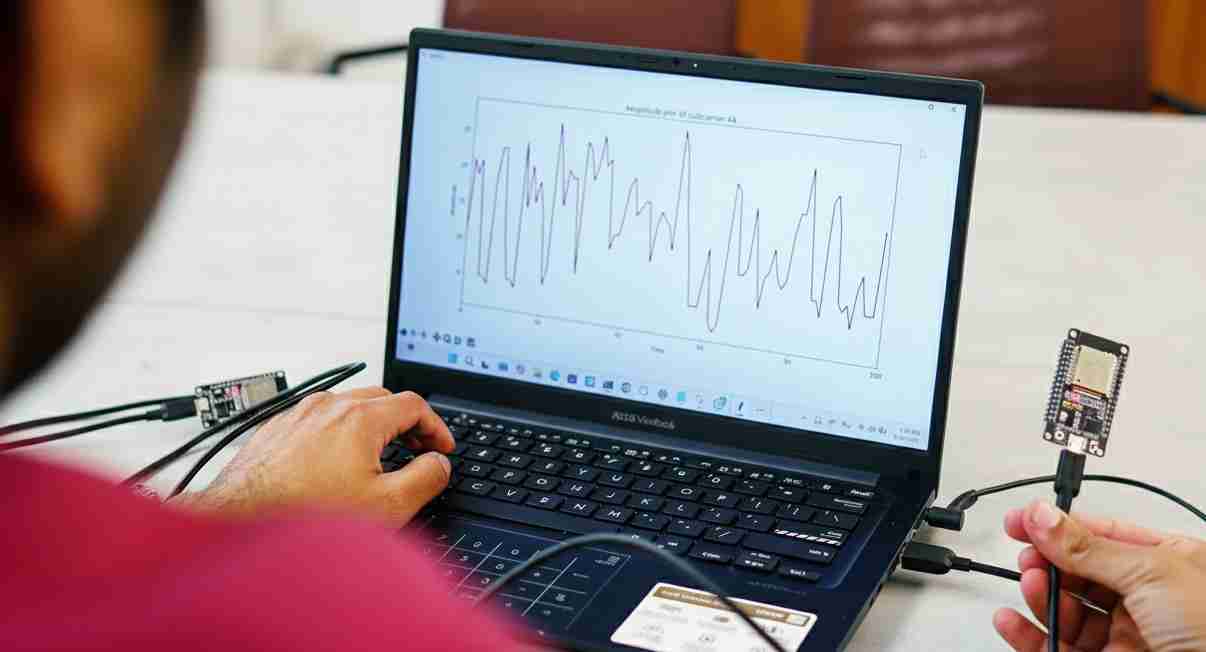
The research team collected training data from controlled experiments and public datasets using small, inexpensive hardware such as Raspberry Pi, and developed filters to remove household noise and motion. The result: a model that isolates heartbeat‑related signal fluctuations and delivers fast pulse readings. For background reporting, see UCSC news and an explainer at Earth.com.
Accuracy, testing and limits
Clinical‑level claims: In published tests the team reports that Pulse‑Fi readings compare favorably with clinical devices and consumer smartwatches, with a precision narrow enough to be described as clinical‑level by the researchers (Tom’s Hardware; UCSC news).
Pulse‑Fi is robust under different positions and clothing and operates reliably to about 10 feet. However, contactless sensing has known limits: large movements, crowded rooms or multiple people can introduce noise. The UCSC team addresses these issues with advanced filtering and targeted training, but real‑world performance will vary with placement, layout and user motion (UCSC news; Earth.com).
Cost and accessibility
Very low hardware costs enable wide deployment: the ESP32 setups used in experiments cost roughly $5–$10, while Raspberry Pi systems used for heavier processing remain under $30. That affordability suggests hospitals, clinics and private homes could add Wi‑Fi heart rate monitoring without expensive new gear (Tom’s Hardware; UCSC news).
Wearable‑free health tracking: practical uses
- Remote patient monitoring for people who dislike or cannot wear devices (Earth.com).
- Elder care and assisted living where compliance with wearables is low (ENN).
- Rapid triage and field checks in clinics, ambulance bays or staging areas where fast, contactless readings could speed care.
- Home health setups that leverage an existing router or a small module to track pulses automatically (Tom’s Hardware).
Future directions: breathing and commercial interest
UCSC researchers are extending Pulse‑Fi to detect breathing rates, which could assist screening for sleep apnea and respiratory distress. Early, unpublished results are promising, and the university reports commercial inquiries about licensing and product development for consumer and medical markets (UCSC news).
Investigative questions: privacy, security and regulation
Important ethical and policy questions accompany the technical advance. Key concerns include:
- Who owns biometric data a router could collect, and what consent is required?
- How secure is data in transit and at rest, especially on low‑cost hardware?
- Could people be monitored without their knowledge in shared spaces?
- Will regulators classify Pulse‑Fi as a medical device if used for clinical decisions?
“The research team acknowledges technical and ethical hurdles” and has focused on filters and training to reduce false readings, while urging broader discussion on governance before widespread deployment (UCSC news).
Implications for Redding, California
Redding, with a large rural hinterland and many seniors, first responders and dispersed families, could see practical benefits from affordable, contactless monitoring:
- Economic and healthcare access: Low device cost could help local clinics and home‑health programs scale remote monitoring, easing pressure on emergency services (Tom’s Hardware; UCSC news).
- Senior care and dignity: Contactless monitoring can improve oversight without forcing wearables on reluctant residents (ENN).
- Rural emergency response: Rapid, non‑contact checks for crews during wildfire season or field operations could be added to command trailers or aid stations.
- Privacy and trust: Transparent consent, signage and opt‑in policies will be important in shared local spaces to respect property rights and community values.
- Broadband readiness: Pulse‑Fi depends on reliable Wi‑Fi and modest processing; local broadband investment and tech programs could support pilots in senior centers and clinics.
Sources and further reading
- University of California, Santa Cruz news release
- Tom’s Hardware coverage
- Earth.com explainer
- ENN analysis
- PicoBricks blog overview
Report summary: This article draws on UCSC’s published research and independent coverage to examine how Pulse‑Fi may change who monitors health, where monitoring happens and at what cost. The next steps will test the system in everyday settings and address privacy, safety and regulatory questions before broad adoption.