
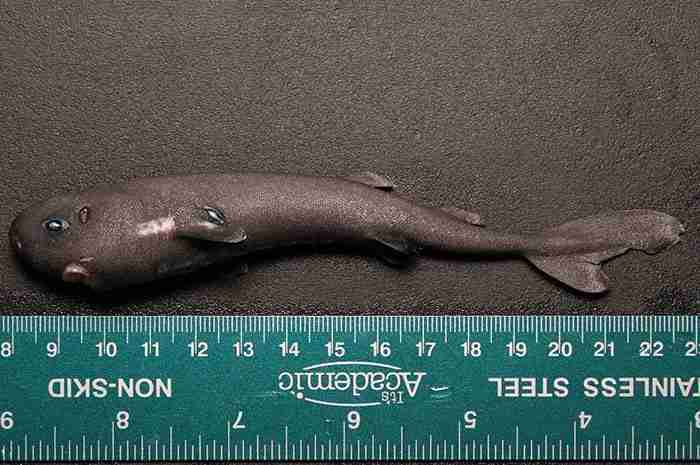
Tiny, Glowing Shark Found in Gulf of Mexico Identified as New Species — the American Pocket Shark
NOAA and Tulane scientists have identified a new miniature shark species from the Gulf of Mexico, Mollisquama mississippiensis — the American pocket shark — a 14-centimeter, bioluminescent deep-sea predator that reveals hidden ocean biodiversity and research potential.
Key takeaways
- Species: Mollisquama mississippiensis — the American pocket shark; one of only two pocket sharks ever recorded.
- Size: ~14 centimeters (5.5 inches), roughly the size of a human hand.
- Distinct traits: gland-like pockets near the gills that can secrete luminous fluid, plus skin photophores.
- Discovery: Single specimen collected in February 2010; formally described in 2019 after advanced imaging and museum comparisons.
Main content
Discovery and identification
Scientists from Tulane University first collected the specimen in February 2010 during fieldwork linked to a sperm whale study in the Gulf of Mexico. The tiny shark was caught incidentally, preserved in a collection, and later re-examined by researchers at NOAA and Tulane. Detailed anatomical comparisons with museum samples and with the only other known pocket shark, Mollisquama parini (recorded off Chile in 1979), led to the recognition of a distinct species.
High-resolution CT scans at the European Synchrotron Radiation Facility revealed internal structures — including vertebral differences and unique light organs — and five anatomical distinctions that supported the formal description published in 2019.
Sources cited in this section: Tulane University news release: Researchers identify new species of pocket shark; Wikipedia entry, Mollisquama mississippiensis.
Physical description
The American pocket shark is unusually small for a shark: about 14 cm (5.5 in), able to fit in an adult hand. It has a bulbous, wide head with a ventral mouth (lower teeth cover upper teeth when the mouth is closed). The body coloration is gray with darker fins and cream-colored patches near the gills.
Most notable are the pockets near the gills — gland-like structures that can secrete a luminous fluid — and numerous photophores embedded in the skin. Together these features enable bioluminescent displays and potential counter-illumination.
References: Tulane University news release; Wikipedia entry; The Archaeologist blog.
Unique biological features and behavior
Pocket sharks are unique among documented sharks because of the gill-adjacent pockets. Scientists hypothesize the pockets may:
- Release a glowing liquid to attract prey
- Confuse or deter predators
- Support counter-illumination — blending with faint downwelling light
The many photophores across the skin likely augment these effects. Because only a single Gulf specimen is available, these behaviors remain hypotheses pending direct observation and further specimens.
Sources: Wikipedia entry; The Archaeologist blog; Sophie Maycock, SharkSpeak.
Taxonomy and rarity
The American pocket shark belongs to the family Dalatiidae, which includes kitefin and other small deep-sea sharks. These species inhabit deep waters and are rarely encountered, explaining the limited knowledge base. To date, only two pocket shark species have been documented:
- Mollisquama parini — first recorded off Chile in 1979
- Mollisquama mississippiensis — the 2010 Gulf of Mexico specimen, described in 2019
The scarcity of specimens means the species remains effectively unstudied in situ.
Sources: Wikipedia entry; Tulane University news release.
Scientific importance and what it tells us about the ocean
Why it matters: This discovery is a clear reminder that the deep ocean still holds many undiscovered species. The American pocket shark illustrates novel evolutionary paths for surviving in darkness through chemical and anatomical adaptations for bioluminescence.
From a research perspective, the find highlights the value of basic science, museum collections, and modern imaging tools — the specimen sat in a collection for years before new analysis revealed its identity, demonstrating the payoff from investments in research infrastructure.
References: The Archaeologist blog; Tulane University news release.
Conservation status and knowledge gaps
With only one specimen known from the Gulf, there is no clear picture of population size, geographic range, or threats. The species has not been evaluated by major conservation organizations and therefore lacks a formal status, limiting management or policy responses.
To fill these gaps, targeted deep-sea surveys, improved bycatch reporting, and focused research are needed to determine where these sharks live and how common they are.
Sources: Sophie Maycock, SharkSpeak; Wikipedia entry.
Sources and further reading
- Tulane University news release: Researchers identify new species of pocket shark
- Wikipedia entry, Mollisquama mississippiensis
- The Archaeologist blog: Glow-in-the-dark and smaller than your hand — meet the newly discovered pocket shark
- Sophie Maycock, SharkSpeak: A new species of glowing pocket shark
Implications for Redding, California
Though far from the Gulf of Mexico, the discovery of the American pocket shark offers several local opportunities and lessons for Redding-area residents, institutions, and leaders.
Economic and educational opportunities
Redding universities, schools, museums, and organizations like Turtle Bay Exploration Park can use the story to boost science education. Possible actions include lectures, field trips about deep-sea biology, temporary exhibits, and STEM outreach aimed at building local career pipelines in biology and environmental science.
Conservation and resource-use messaging
For conservative audiences that value practical stewardship, the pocket shark story supports targeted, cost-effective research rather than heavy regulation. It underscores that modest investments in research vessels, imaging equipment, and museum curation can yield significant scientific returns and public awareness.
Fisheries and policy relevance
Although the American pocket shark is not a fishery target, the discovery highlights knowledge gaps near commercial fishing grounds. Better routine sampling and careful bycatch reporting can help California fishermen and regulators build accurate biodiversity baselines while supporting sustainable fisheries.
Civic pride and science literacy
The identification of a new species by U.S. institutions like NOAA and Tulane can be framed as an example of American scientific achievement. Redding schools and civic groups can leverage the story to inspire local pride and promote practical steps to boost science literacy: invite researchers, support school science projects, and create accessible exhibits.
Practical applications for daily life
Residents can take straightforward actions: support local science education, encourage anglers to report unusual bycatch, and back science-friendly school curricula. These low-cost steps help protect local economic and community interests by promoting informed stewardship of natural resources.
“The pocket shark story shows how museum collections and modern imaging can turn an incidental catch into a major discovery.”



