
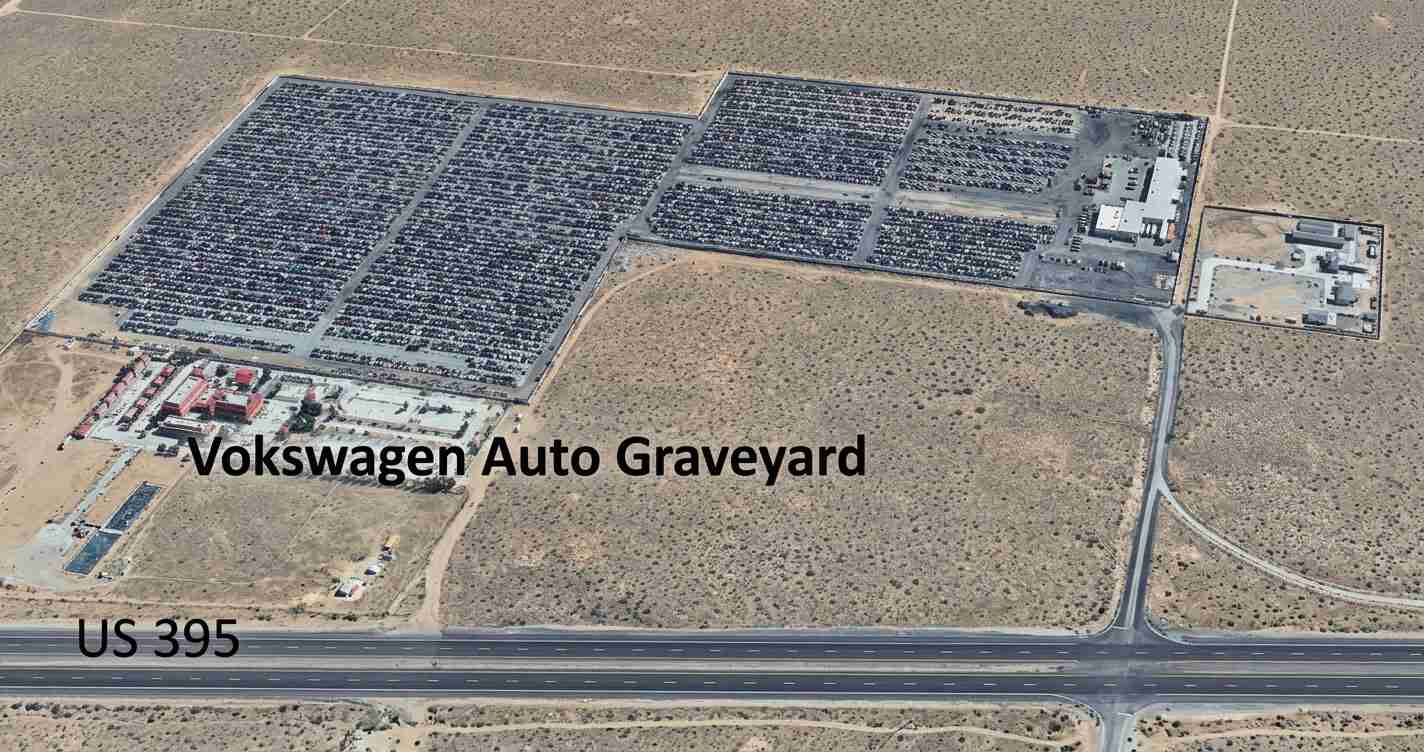
Victorville’s VW & Audi “Car Graveyard”: The Mojave Storage After Dieselgate
The Mojave Desert near Victorville stored more than 350,000 recalled Volkswagen and Audi diesel vehicles after the 2015 Dieselgate revelations, preserved in dry air while awaiting regulatory-approved fixes, resale or disposal — a stark testament to the fallout.
Key takeaways
- Mass storage: Tens of thousands of Volkswagen and Audi diesel cars were parked in a large Mojave-area storage complex after the 2015 revelations — see the Volkswagen emissions scandal for background.
- Major settlement: Volkswagen agreed to a multibillion-dollar U.S. settlement that included buybacks, repairs and an environmental trust; the U.S. component reached about $14.7 billion in 2016 per the U.S. Department of Justice.
- Choice of site: The Mojave’s dry air slowed corrosion so vehicles could be preserved pending EPA and California Air Resources Board approvals (see the Volkswagen emissions scandal page).
- Outcome: Volkswagen ran crews to maintain batteries and start engines; many cars were repaired and resold while others were scrapped, and global costs continued to mount.
How the scandal unfolded
In 2015, U.S. regulators discovered that Volkswagen installed software that could detect emissions testing conditions and activate controls only during tests. That “defeat device” meant cars met limits on a stand but on real roads could emit up to 40 times the allowed nitrogen oxides — a pollutant linked to smog and health harms. Volkswagen later admitted the deception after an EPA notice and internal reviews; the episode is documented on the Volkswagen emissions scandal page.
Regulatory and legal fallout included criminal and civil probes worldwide. The U.S. Justice Department characterized the matter as one of the largest corporate fraud cases of its kind. Under the 2016 U.S. resolution, Volkswagen agreed to spend up to $14.7 billion on consumer relief, repairs, buybacks and mitigation — covering roughly half a million U.S. vehicles, per the DOJ announcement.
The storage crisis and the Victorville Volkswagen scandal
When owners used buyback or trade-in programs, Volkswagen could not immediately resell many returned cars until fixes were approved by regulators. The automaker therefore sought large, inexpensive, open land to park vehicles. Sites included an abandoned stadium in Detroit, a closed paper mill in Minnesota, and the most visually striking location — sun-baked lots near Victorville and Adelanto in Southern California.
From above, the rows resembled a sprawling rust belt, but the choice was deliberate: the Mojave’s dry climate slows corrosion and helps preserve metal and electronics while vehicles sit idle. The exposed lots became a vivid symbol of the financial, operational and reputational costs of the scandal (see Volkswagen emissions scandal).
What happened at the Victorville site
The Victorville lots were not a simple scrapyard. Volkswagen staffed teams to start engines, charge or replace batteries, move cars into new rows, and inspect vehicles to keep them in sellable condition. The primary aim was to preserve them until EPA and California Air Resources Board-approved software — and in some cases hardware — fixes allowed resale as certified used vehicles.
“The scene became shorthand for the fallout from the VW emissions scandal — a tangible reminder that corporate deception can leave expensive physical traces.”
Over time, many of these cars were repaired and returned to market; others were deemed beyond economical repair and were scrapped. Cleanup, repairs and remediation stretched over years and contributed to Volkswagen’s multibillion-dollar global bill. The company also funded a $2.7 billion program for NOx-reduction projects as part of settlements and faced additional civil and criminal penalties (see the DOJ release and the Wikipedia summary).
Costs, corporate accountability and lasting impact
The Victorville “car graveyard” serves as a visible reminder that corporate fraud yields far-reaching costs: fines, legal fees, logistics, storage and reputational damage. U.S. settlements imposed remediation steps with deadlines and oversight to ensure vehicles were properly handled before resale.
Independent auditors, court filings and reporting tracked Volkswagen’s compliance. By the late 2010s, global lawsuits, regulatory remedies and remediation raised costs well beyond the initial U.S. settlement, with auditors and commentators noting broader implications for industry reporting and corporate governance (see commentary on accounting and legal ramifications in the CPA Journal).
The human and environmental angle
Local workers staffed Victorville and other storage sites, creating maintenance jobs that otherwise would not have existed. The larger human story centers on owners who believed they had purchased “clean diesel” vehicles and faced uncertainty, inconvenience and lengthy recall processes.
Environmentally, the scandal highlighted how emissions testing protocols can be undermined by technical deception and prompted agencies to tighten oversight and enforcement to prevent similar abuses. The remediation programs aimed to fund pollution-reduction projects to offset environmental harms (see DOJ settlement details).
Implications for Redding, California
Economic impact: Redding-area workers in logistics, repair shops and the used-car market felt indirect effects as national trade-in waves and shifting inventories influenced pricing and availability — a reminder that corporate decisions can ripple through regional markets.
Political consequences: The Victorville episode reinforced arguments favoring strict enforcement of existing laws and corporate accountability. Federal enforcement and court-supervised settlements illustrated how agencies can compel remediation and consumer relief without expanding regulation.
Social and cultural effects: For many local families, Dieselgate underscored the value of skepticism toward marketing claims and the importance of independent inspections. Redding’s community values — self-reliance and fiscal prudence — amplified local interest in the story and support for holding companies accountable.
Practical applications: Residents should demand full disclosure, independent inspections and clear recall histories when buying used cars. Local businesses may find opportunities offering trusted inspections or certified repairs, and policymakers can press for stronger consumer protections and whistleblower incentives.



