
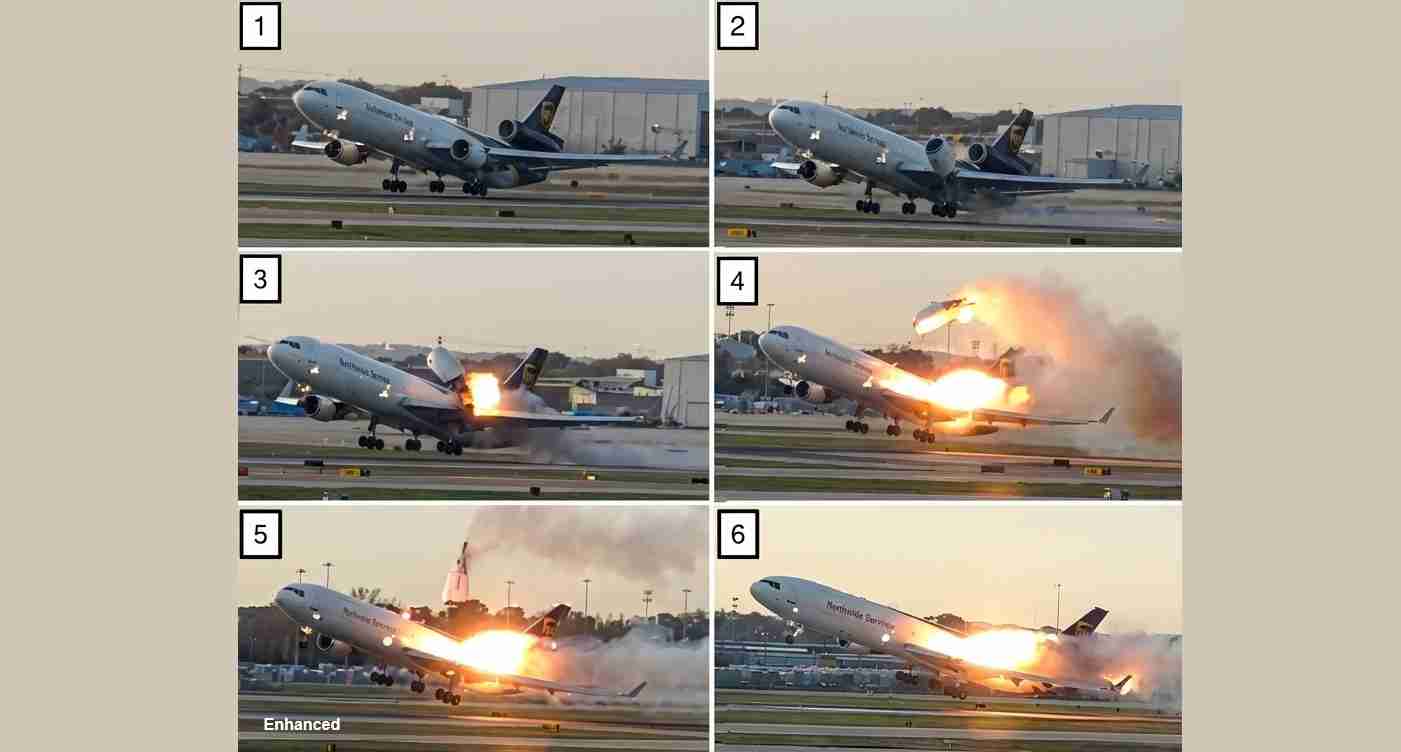
NTSB Releases Frame-by-Frame Images Showing Engine Separating in Deadly UPS MD-11 Crash in Louisville
Louisville, Kentucky (Times Media Service) — The NTSB released frame-by-frame surveillance images showing a UPS MD‑11F’s left engine and pylon separating moments after takeoff from Louisville Muhammad Ali International Airport on November 4, 2025, as investigators probe possible structural fatigue cracking.
- Key takeaway: The NTSB published still frames that show the No. 1 (left) engine and pylon detaching shortly after rotation, central to reconstructing the accident sequence.
- Focus area: Investigators are concentrating on metal fatigue cracks in the pylon that attaches the engine to the wing.
- Human toll: The accident killed 14 people — three crew members and 11 people on the ground — and damaged nearby buildings.
- Evidence use: Images are being combined with recovered parts and flight data to guide metallurgical tests and records reviews.
What the images show
The NTSB released a set of still frames taken from airport surveillance cameras that document the event visually. The sequence begins with the MD‑11 on the takeoff roll with all engines intact. As the airplane rotates, the No. 1 engine and its mounting pylon break away from the left wing and are seen vaulting up and over the wing and fuselage.
A burst of fire appears near the wing‑pylon junction in the frames, and flames are visible where the separated engine impacts the ground. Fires also burn near the left wing before the airplane veers off and crashes at about 30 feet above ground level. These frames were included in the NTSB’s preliminary materials and widely reported by news outlets such as ABC News and NBC Palm Springs.
“The images provide a crucial visual timeline that links the observed wreckage to what occurred during flight,” investigators said as they released the frames in the preliminary report.
NTSB focus: aircraft fatigue cracking
Investigators have zeroed in on metal fatigue cracking in the pylon structure that connects the engine to the wing. Preliminary analysis suggests cracks likely formed and propagated over time until the attachment failed during rotation. The NTSB’s initial findings identify fatigue cracking as a probable root cause and call for extensive metallurgical testing and a review of maintenance records to determine why the defects went undetected. Coverage on this focus appears in outlets such as Flying Magazine and FreightWaves.
The aircraft and impact
The airplane was a UPS MD‑11F freighter, a stretched derivative of the DC‑10 family, powered by GE CF6 series engines. The NTSB’s preliminary report lists the left inboard engine (No. 1) as the separating unit. The aircraft never climbed far above ground and lost control, crashing into structures near the airport. The accident resulted in the deaths of all three crew members and 11 people on the ground and caused heavy damage to nearby buildings. The board’s preliminary materials are available in the NTSB preliminary report.
How investigators are using the images
The NTSB is using the frame‑by‑frame images in conjunction with recovered components and flight data recorder information to reconstruct the sequence of events. The visual timeline helps link the physical failure modes observed in the wreckage to in‑flight behavior, guiding targeted metallurgical testing of pylon parts and focused reviews of maintenance and inspection records.
Why it matters: visual evidence can confirm the timing of failure and show whether fire or structural breakup occurred before or after separation — critical distinctions for determining root cause and any regulatory response.
Questions about inspections and aging fleets
The images and preliminary findings have raised urgent questions about inspection intervals and maintenance practices for pylons and other critical structures, especially on aging freighters. Experts note that metal fatigue is an expected risk as aircraft age, but it is typically detected through scheduled inspections. The NTSB’s emphasis on fatigue cracks has increased scrutiny of whether current inspection rules are adequate and whether carriers are following maintenance protocols.
Official statements and next steps
The NTSB’s preliminary report describes a fire igniting near the left pylon attachment continuing until ground impact. Investigators plan detailed laboratory metallurgical testing of recovered pylon components and a full review of the aircraft’s maintenance history. The board will use those results to determine if regulatory or industry changes are required. Major outlets characterized the released images as graphic and central to understanding the accident sequence; reporting examples include ABC News and NBC Palm Springs.
Public reaction and safety concerns
The release of the images prompted strong public reaction: families of victims and local residents have demanded answers, while aviation groups and safety advocates press for rapid, transparent analysis. The incident highlights the tradeoffs between operational efficiency and stringent inspection regimes, and it has fueled debate on whether inspection rules for aging cargo fleets should be tightened.
Implications for Redding, California
Economic impact: Redding residents and businesses that rely on timely shipping could face slower delivery schedules or higher costs if inspections or temporary operational changes are imposed.
Political consequences: Local leaders may call for measured, practical fixes rather than sweeping mandates; accountability and transparent federal action are likely to be demanded.
Social effects: The images may renew focus on emergency preparedness; local first responders and neighborhood groups could review disaster plans and communication systems.
Practical advice: Residents should expect possible short‑term shipping delays, keep emergency contacts and insurance documents handy, and businesses dependent on air cargo should discuss contingency plans with carriers.
Sources and further reading
- NTSB preliminary report and images
- ABC News coverage of released images
- NBC Palm Springs report on dramatic surveillance frames
- Flying Magazine on pylon fatigue-crack focus
- AVweb summary of the NTSB preliminary report
- FreightWaves on links to fatigue cracks
- Video footage referenced with frames
The NTSB investigation is ongoing. Investigators will continue metallurgical testing and records review to determine why fatigue cracking may have gone undetected and whether inspection rules should be changed to prevent a similar tragedy.



