
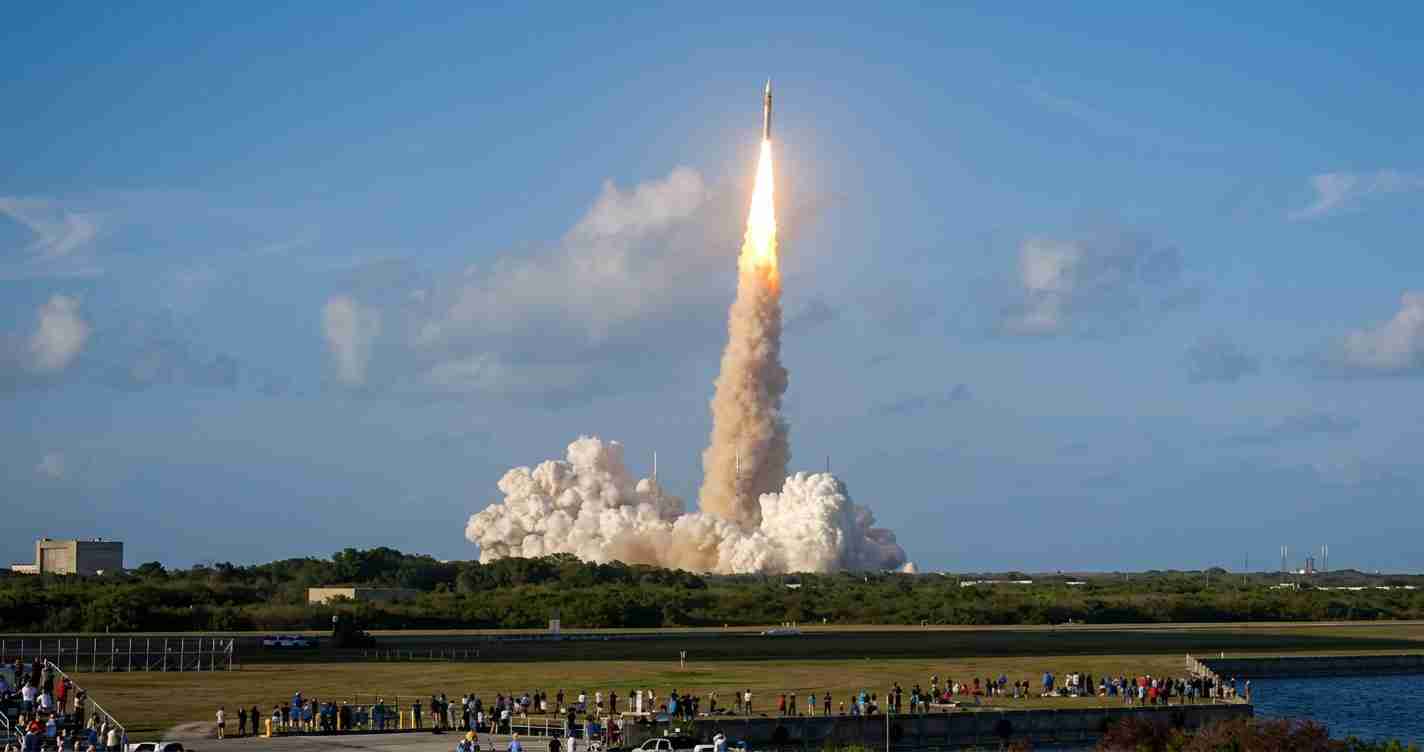
Artemis II lifts off from Kennedy Space Center, sending four astronauts on first crewed Moon voyage in more than 50 years
NASA’s Artemis II launched April 1, 2026, from Kennedy Space Center, sending four astronauts on a roughly 10-day crewed lunar flyby — the first human deep-space mission in over 50 years — testing the SLS rocket and Orion systems.
Key takeaways
- Launch: 6:35 p.m. EDT, April 1, 2026, from Launch Complex 39B at the Kennedy Space Center — see Kennedy Space Center event information.
- Crew: Commander Reid Wiseman, Pilot Victor Glover, Mission Specialist Christina Koch and Canadian Space Agency Mission Specialist Jeremy Hansen aboard Orion (Integrity).
- Mission: A ~10-day crewed lunar flyby to validate SLS and Orion deep-space life‑support, navigation and communications systems ahead of Artemis lunar landings.
Main content
Launch and early flight details
At T‑minus zero the Space Launch System thundered aloft and cleared Launch Complex 39B on schedule. The SLS core stage burned for roughly eight minutes before main engine cutoff and separation, handing the mission to the upper stage and Orion. Flight controllers reported a clean ascent, and Orion’s solar array wings deployed after separation as the spacecraft entered a temporary high Earth orbit for system checks.
Commander Reid Wiseman radioed, we have a beautiful moonrise, we’re headed right at it,
a line echoed by viewers and scientists as the rocket climbed above Florida. The public can follow the mission in near real time through NASA launch day updates and NASA’s Artemis real-time orbit tools.
Flight profile and distance
SLS reached supersonic speeds and delivered the crew to space in about eight minutes. Orion entered a high Earth orbit for system checks before heading to the Moon on a planned free‑return trajectory. The crew will travel farther from Earth than humans have in over 50 years — more than 400,000 kilometers — and will pass roughly 8,000 kilometers above the lunar surface at closest approach.
Mission goals and technical test objectives
Artemis II is explicitly not a landing attempt. Its primary purpose is to test deep‑space systems under crewed conditions: validating the SLS rocket’s performance and Orion’s life‑support, navigation and communications hardware. These results will inform crewed lunar landings planned for Artemis IV and V in 2028 and beyond. For background on expectations and future mission plans see Planetary Society coverage.
Trajectory and safety margins
Flight planners placed Orion on a free‑return trajectory so the Moon’s gravity can swing the vehicle back to Earth if propulsion is not available. Mission day 6 calls for the closest approach of about 8,000 kilometers above the surface and the maximum deep‑space distance beyond 400,000 kilometers — greater than Apollo 13’s farthest point.
Crew composition and milestones
The four-person crew blends U.S. and Canadian expertise: Commander Reid Wiseman, Pilot Victor Glover, Mission Specialist Christina Koch, and Canadian Space Agency Mission Specialist Jeremy Hansen aboard Orion (Integrity). Notable milestones include Victor Glover as the first person of color and Christina Koch as the first woman to travel beyond low Earth orbit on a crewed mission.
Scientists and observers praised the crew’s teamwork: Lindy Elkins‑Tanton said they’ve “bonded into a spectacular team,” and observers at the launch called the liftoff “historic.”
Delays, testing and prelaunch fixes
Artemis II’s launch slipped from an earlier February target after teams found hydrogen fuel leaks and a helium flow issue in the rocket’s upper stage. Engineers resolved the anomalies through inspections and repairs; NASA officials stated these fixes cleared the way for the April 1 launch window.
Tracking, public access and media coverage
NASA provided continuous live coverage and mission updates across its platforms. The agency encouraged the public to follow telemetry and orbit visualizations via its Artemis Real‑time Orbit Website and the NASA mobile app, and the launch webcast featured engineering commentary and status milestones. Watch the official mission webcast at launch webcast and mission media.
Operational risks and what to watch for
NASA describes Artemis II as a test flight with known risks. Mission teams will monitor propulsion performance, communications margins, radiation exposure levels and the integrity of Orion’s heat shield for reentry. Pre-planned contingencies — including the free‑return trajectory — exist to handle anomalies should propulsion or systems fail.
Why this mission matters to future exploration
Artemis II aims to reduce technical risk for subsequent crewed lunar landings and to build capabilities that could enable human missions to Mars. Data and crewed-system validations from this flight will shape training, hardware updates and mission rules for Artemis IV and V.
Implications for Redding, California
Though launched from Florida, Artemis II carries local implications for regions like Redding:
- Economic and educational impact: Local schools, colleges and science groups can use Artemis II as a teaching moment. NASA’s live feeds and resources support classroom use and public viewing events.
- Small-business and tourism opportunities: Northern California suppliers potentially benefit from expanded space programs; public watch parties and civic events in Redding can boost community engagement.
- Political and civic considerations: The mission offers a forum for discussion on fiscal priorities, technology returns and national leadership — topics likely to be raised by conservative constituents and local officials.
- Social and cultural effects: Watch parties, school events and local media coverage can foster community morale, cross‑generational engagement and civic conversation.
Practical applications for Redding residents
- How to follow the mission: Track Artemis II and watch live feeds through NASA launch day updates and the NASA mobile app.
- Education and volunteering: Local teachers and groups can apply NASA lesson plans and outreach materials to organize learning events and viewing parties for mission milestones such as the day‑6 lunar flyby.
Sources and further reading
- NASA Artemis II launch coverage and live updates
- Kennedy Space Center Artemis II event information
- Background and mission overview from The Planetary Society
- Launch webcast and mission media
Reporting compiled from Times Media Service coverage and NASA mission updates.



