
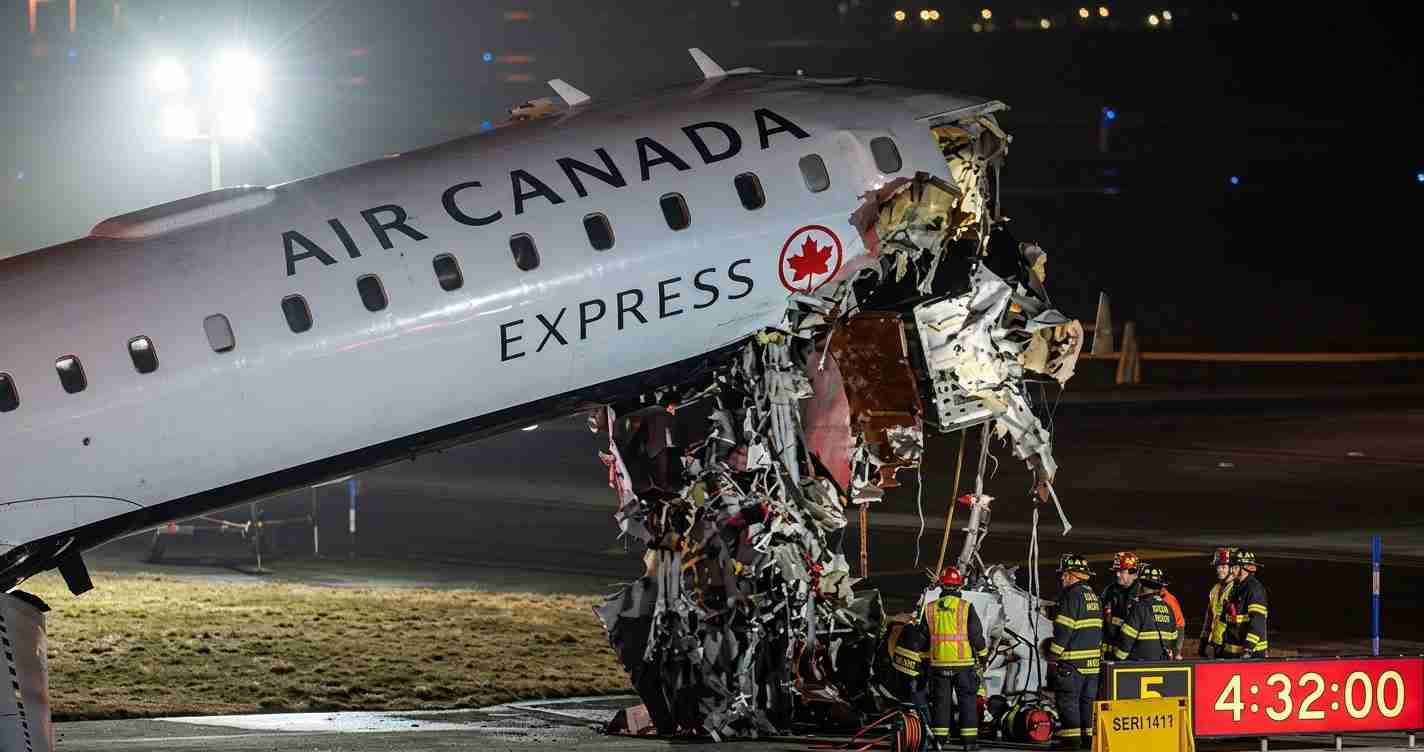
Deadly collision at LaGuardia: Air Canada Express jet strikes Port Authority fire truck on Runway 04
A Jazz Aviation-operated Air Canada Express CRJ-900 struck a Port Authority fire truck on LaGuardia’s Runway 04 late March 22, 2026, killing both pilots and injuring dozens, prompting runway closure and hundreds of flight cancellations.
Key takeaways
- Collision: Jazz Aviation-operated Air Canada Express Flight 8646 (CRJ-900, registration C-GNJZ) struck a Port Authority fire truck while landing.
- Casualties: Both pilots were killed; at least 39–43 people hospitalized with dozens injured and 32 released as of the Port Authority briefing.
- Investigations: The NTSB recovered the intact cockpit voice recorder and has begun flight data analysis.
- Operational impact: LaGuardia was placed on ground stop and closed for hours, with roughly 600 cancellations as service resumed.
Main report
What happened
At the end of a late-night flight from Montreal, the Jazz Aviation-operated CRJ-900 touched down on Runway 04. As the airliner arrived it struck a Port Authority fire truck that was crossing the runway while responding to a separate rejected takeoff incident. Air traffic control can be heard urgently radioing,
“Truck 1, stop, stop, stop!”
before the head-on impact; early coverage and briefings are summarized by Fox News.
Flight details list the aircraft as Air Canada Express Flight 8646 (CRJ-900, registration C-GNJZ) operated by Jazz Aviation.
Eyewitness and early technical reports describe the plane’s nose being ripped off and landing gear striking the truck. The aircraft then skidded roughly 130 meters and came to rest near taxiways E and F. Flightradar24 data cited a low-speed estimate of about 24 mph (39 kph) at impact while other reports listed higher speeds; investigators will reconcile speed estimates using the flight data recorder.
Casualties and rescue
The aircraft carried 72 passengers and four crew members (a captain, first officer and two flight attendants). Jazz Aviation and Port Authority briefings confirmed both pilots were killed; identities were not released at the time of the briefings. Hospitals received dozens of patients, with officials reporting between 39 and 43 people hospitalized, including two Port Authority firefighters who sustained broken bones and serious but non-life-threatening injuries.
Port Authority Executive Director Kathryn Garcia noted that some patients suffered serious trauma such as bleeding to the head; by late Monday at least 32 had been released from hospitals, according to Fox News and ABC News.
How investigators are working
The National Transportation Safety Board (NTSB) is leading the probe with assistance from the Federal Aviation Administration and the Port Authority. Investigators cut a hole in the aircraft’s roof to reach the recorders, recovered the cockpit voice recorder (CVR) intact and transported it to NTSB labs in Washington, D.C.; work on the flight data recorder (FDR) began the next day. Those early steps were reported in the NTSB briefing covered by Fox News.
Investigative scope will include surveillance video, airport surface detection and radar data, air traffic control audio, witness interviews, controller workload, and the physical positions of the aircraft and fire truck at impact. NTSB Chair Jennifer Homendy said the CVR “was not damaged” and that interviews with the LaGuardia controller and recreations of surface movements would be part of the work before wreckage removal can proceed.
Operational and safety context
This is LaGuardia’s first fatal crash in roughly 30 years and underscores runway incursion risks — when vehicles or people enter an active runway creating a collision hazard. The episode highlights the narrow margin for error at congested airports and the importance of coordination among air traffic control, airport operations and emergency responders (ABC News; Airlineratings).
LaGuardia was put on a ground stop and closed until at least early Monday afternoon; the FAA and airlines reported roughly 600 cancellations as service resumed on reduced capacity.
Accountability and public questions
Officials say investigators will focus on the decision to allow the fire truck onto an active runway while an aircraft was landing. Early reports indicate the truck had clearance to cross at taxiway D while responding to a separate incident; air traffic control issued urgent warnings but recorded no response from the truck before impact. The NTSB will explore dispatcher instructions, truck crew actions, communications records and controller workload, as summarized by Fox News and Airlineratings.
Implications for Redding, California
Economic impact: Travelers and businesses in the Redding area may see short-term disruption. Connections through New York hubs could face delays and cancellations for days; cargo and same-day shipments routed via East Coast hubs may be delayed.
Political consequences: Local conservative readers may press for accountability, clearer chains of command, and federal oversight of runway-incursion prevention. Calls for legislative fixes and funding for detection and communications upgrades may follow.
Social and practical effects: The crash may prompt community conversations about public safety, reviews of first-responder protocols, fundraising for victims and families, and practical travel advice: check flight status, allow extra rebooking time and consider travel insurance.
Policy watch: Areas to monitor include improved surface detection displays, stricter crossing clearance rules for ground vehicles, mandatory two-way confirmations for emergency vehicle crossings, and clearer accountability when multiple agencies operate on an airfield.
Sources
- Fox News Live coverage and NTSB briefing
- ABC News reporting
- Business Insider
- Airlineratings (aircraft details)
- The Jerusalem Post coverage
Reporting will continue as NTSB and federal authorities release recorder analysis, controller interviews and surveillance replays; early flight data recorder findings were expected soon and will be central to determining how the fire truck entered an active runway in front of a landing airliner.



