
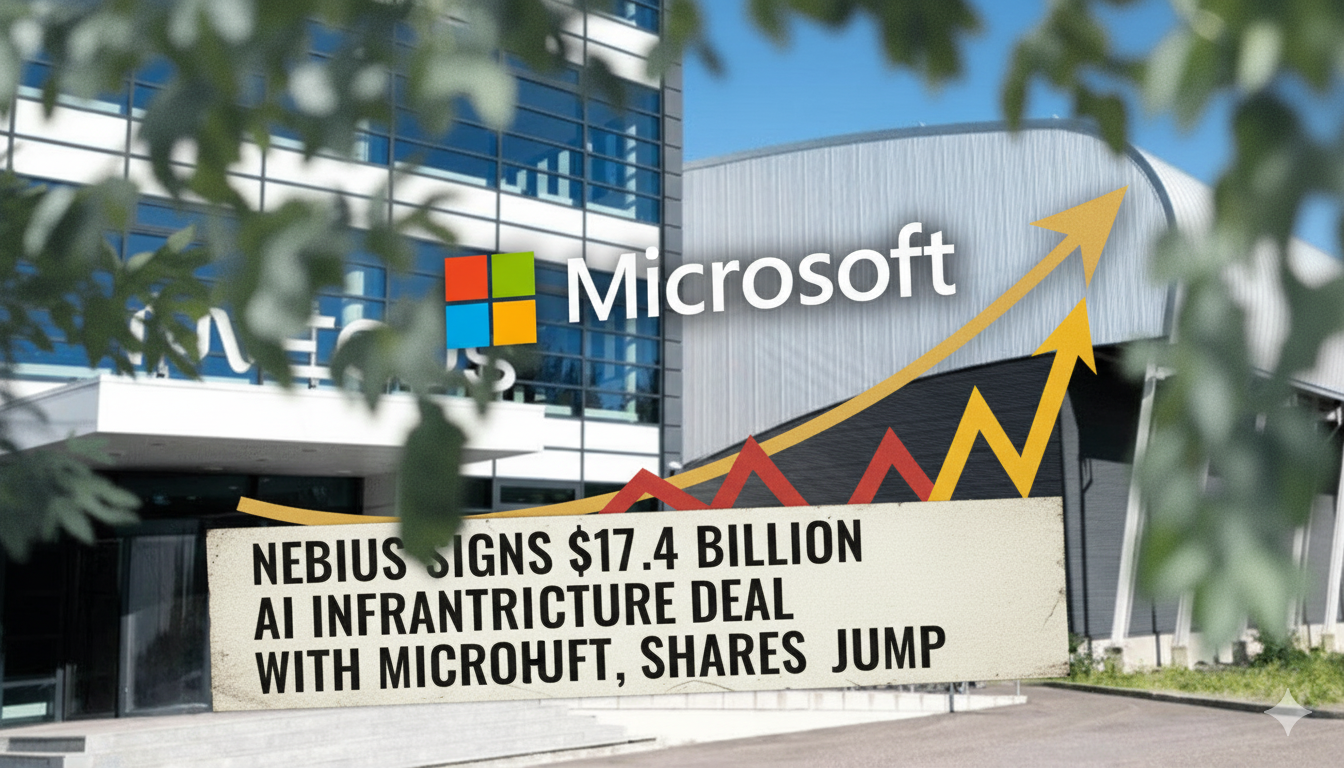
Microsoft Nebius AI Deal: $17.4 Billion GPU Infrastructure Pact Sends Nebius Stock Surge
Microsoft signed a five-year agreement worth $17.4 billion (expandable to $19.4 billion) with AI infrastructure provider Nebius, securing dedicated high-speed GPUs at Nebius’s Vineland, New Jersey data center and triggering a major market reaction on Tuesday.
Key takeaways
- Deal value: $17.4 billion over five years, expandable to $19.4 billion.
- Capacity: Dedicated high-speed GPU infrastructure hosted at Nebius’s Vineland, New Jersey data center.
- Market reaction: Nebius stock jumped about 45% after the announcement.
- Financing plan: Nebius will use contract cash flow and debt secured against the deal to fund expansion.
Deal details and strategic purpose
Microsoft’s agreement with Nebius guarantees a steady pipeline of GPU-accelerated AI computing power at a time when demand for specialized chips and server capacity is soaring. The five-year contract secures access to Nebius’s high-performance GPU infrastructure in Vineland, NJ, with flexibility to expand if Microsoft’s compute needs rise (Mitrade).
The move reflects an industry shift: even cloud giants are turning to third-party suppliers for heavy AI workloads because internal capacity is strained. Analysts note the arrangement is intended to plug capacity gaps quickly while preserving Microsoft’s broader strategy in AI research and services — an observation highlighted in industry coverage such as Thurrott.
“Attractive in its own right,” said Nebius leader Arkady Volozh, noting the deal will accelerate Nebius’s AI cloud business through 2026 and beyond.
Market reaction: Nebius stock surge and investor response
Investors rewarded the deal immediately: Nebius shares jumped about 45% on the news, one of the largest single-day moves for an AI infrastructure startup after landing a major tech contract (TipRanks).
Microsoft’s own stock reaction was muted but constructive. Market observers tied the deal to Microsoft’s strong quarterly results — earnings per share of $3.65 on revenue of $76.44 billion, with the Intelligent Cloud unit delivering $29.88 billion — which helped reassure investors that Microsoft can secure external compute without destabilizing its balance sheet (Mitrade).
Financing and risk profile
Nebius plans to finance capital expenditures tied to the agreement using a mix of contract-backed cash flow and debt secured by that revenue. This structure is common in infrastructure deals: a stable, long-term contract with a high-credit partner usually unlocks lower borrowing costs.
However, the arrangement increases leverage as Nebius scales GPU capacity rapidly. If AI demand softens or if Microsoft does not exercise expansion options, Nebius could face tighter margins or refinancing challenges. Investors and regulators will want to see conservative underwriting and contingency planning.
Industry significance and competitive landscape
This ranks among the largest deals announced between a major cloud provider and an AI infrastructure startup, underscoring how the AI race is reshaping supply chains. Large, long-term contracts such as this can lock in significant portions of next-generation accelerator supply, affecting startups, research institutions, and universities that rely on GPU cycles.
The deal follows other big cloud contracts with third-party suppliers and signals rising competition for GPU capacity among major cloud players, including Microsoft’s prior relationships with other providers such as CoreWeave (Thurrott) and market reporting that ranked this among the largest third-party supplier engagements (TipRanks).
Questions for oversight and transparency
- How binding are the expansion options that increase the deal to $19.4 billion, and what triggers them?
- What specific types of GPU accelerators will be deployed, and will Nebius’s facility run on energy sources meeting local regulatory or community standards?
- How will Nebius manage rapid hiring, supply chain, and permitting needs that come with constructing and operating GPU-heavy data centers?
- What contingency plans exist if GPU supply shortages or geopolitical events disrupt chipset shipments?
Sources and reporting
This report draws on company releases, market coverage, and financial reporting. Key sources include:
- Nebius press release
- Business Wire release
- Market coverage and Microsoft earnings context (Mitrade)
- Market reaction coverage (TipRanks)
- Industry context on cloud supplier deals (Thurrott)
Implications for Redding, California
Economic impact
- Job creation: The deal could open opportunities for Northern California firms to supply parts, services, or skilled workers for data-center builds and GPU maintenance. Local contractors and electrical firms in the Redding area may bid on regional projects tied to AI infrastructure.
- Investment flow: Peripheral spending on logistics and services could benefit local businesses if Nebius or competitors expand in the U.S.
Political consequences
- Local incentives: Cities and counties often compete for data centers with tax breaks and expedited permitting; conservative voters in Shasta County may demand evidence that incentives return clear jobs and tax revenue.
- Regulatory scrutiny: Energy and water use from large data centers typically draw oversight; local officials will balance business attraction with resource stewardship.
Social effects
- Workforce training: Community colleges and trade schools can align programs to server maintenance, power systems, and network operations to prepare residents for higher-paying technical jobs.
- Housing and services: Temporary influxes of contractors or staff could pressure housing and public services in smaller communities near Redding.
Cultural relevance
Community values: Transparency about incentives, environmental safeguards, and long-term benefits will matter to conservative residents who favor fiscal responsibility and local control.
Practical applications for residents
- Business opportunities: Local firms supplying electrical work, HVAC, construction, and logistics should monitor procurement notices and vendor registrations.
- Energy planning: County officials should prepare for possible increases in electricity demand and negotiate community benefits such as local energy investments or improved grid resilience.
Reporting notes for local stakeholders
- Watch for permit applications and tax incentive proposals at county planning meetings.
- Ask for clear job-count projections and timelines from any data-center project proponents.
- Seek community benefits agreements that prioritize local hiring, workforce training, and infrastructure investments.



