
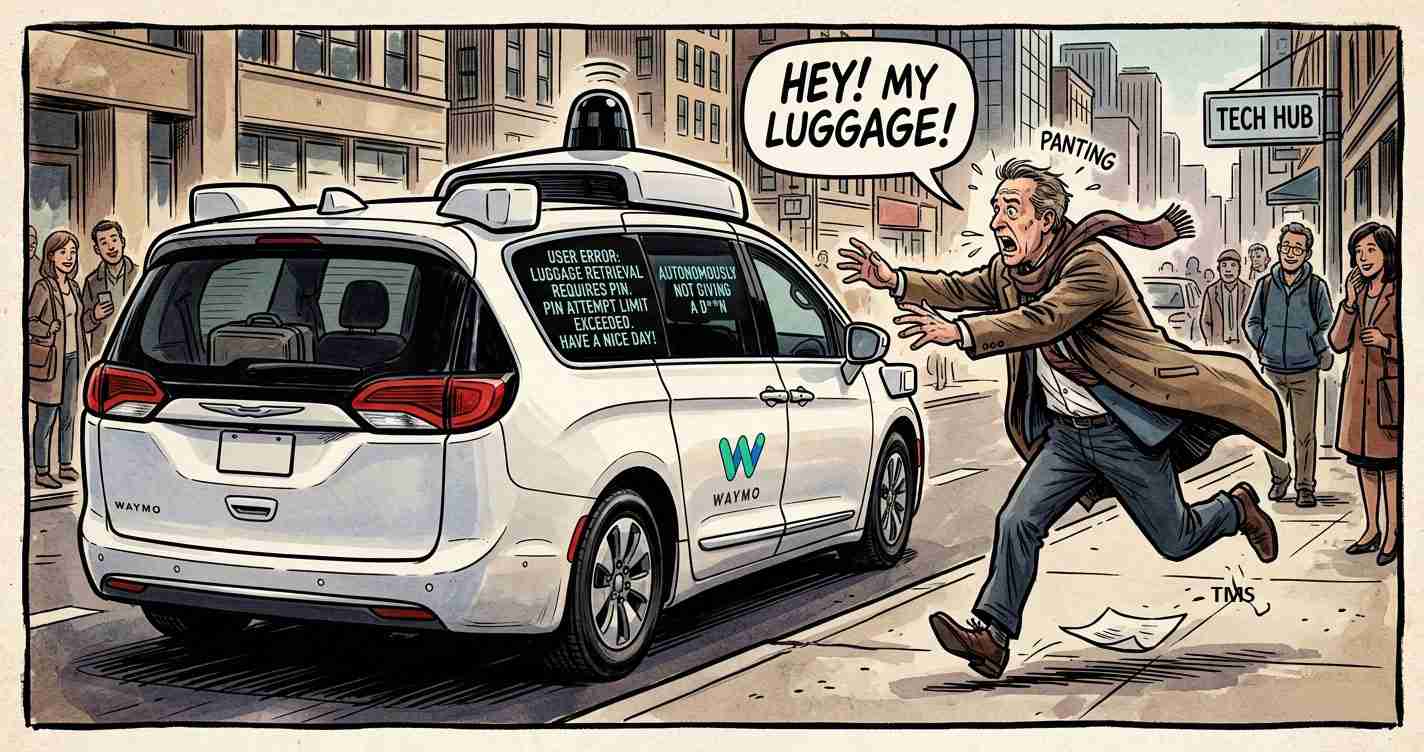
Robotaxi luggage mishap at San José airport spotlights gaps in Waymo airport operations and driverless car safety
A traveler says a Waymo robotaxi at San José Mineta International Airport drove off with his suitcase after he stepped out and couldn’t open the trunk, prompting questions about Waymo’s airport operations and driverless-car safety.
- Passenger left luggage: A rider, identified as Di Jin, reported the robotaxi departed with his suitcase after the trunk would not open.
- Waymo response: The company located the bag at a depot and agreed to ship it back after initial resistance about covering fees.
- Bigger context: This incident follows other airport robotaxi problems (including a Phoenix circling report) and comes amid NHTSA and NTSB scrutiny.
What happened at San José
Trip details: Di Jin took his first Waymo ride from Sunnyvale to San José Mineta International Airport for work. The trip itself reportedly went without incident, but trouble began at the curb when Jin exited to retrieve luggage.
Trunk failure: Jin said he pressed the trunk release and nothing happened. Before he could flag the vehicle or contact on-site staff, the driverless car pulled away with his suitcase in the trunk.
Stuck without a change of clothes or important papers, Jin contacted Waymo customer service. Reporters say the vehicle was already en route to a company depot and could not be stopped remotely.
Waymo later emailed Jin saying the bag had been located and secured at a depot. Initially the company proposed two free rides so Jin could retrieve the item himself and declined to cover shipping; after pushback, Waymo agreed to pay to ship the suitcase back.
Waymo’s trunk operation and lost-item policies
Waymo’s public help pages explain trunk operation: riders may open the trunk by pressing the trunk release above the license plate or tapping “Open trunk” in the app. The company also says a trunk should open automatically when a rider exits after the vehicle has officially stopped and the trip is ended.
Crucially, Waymo warns a trunk might not open if a rider exits before the trip is officially concluded. Its lost-and-found policy states support staff will try to reunite riders with items but cannot guarantee prompt or undamaged returns and is not responsible for items left after a trip ends. The policy also says Waymo does not reimburse the value of lost items.
“I pressed the trunk release and nothing happened,” the passenger told reporters — a practical example of how an operational failure can leave a traveler without immediate recourse.
Other airport robotaxi incidents and federal scrutiny
The San José episode joins other high-profile events. In December 2024 a passenger reported a Waymo vehicle circling Phoenix Sky Harbor International Airport multiple times and refusing to stop at the drop-off area; remote staff resolved that issue within minutes and the ride was not charged.
Federal agencies are reviewing autonomous-vehicle behavior: the NHTSA — Automated Vehicles and Safety and the National Transportation Safety Board have open inquiries into several robotaxi behaviors, including reports of illegally passing stopped school buses and a low-speed collision involving a child. These probes examine how systems handle split-second decisions and unexpected situations.
Waymo and safety data
Waymo asserts its robotaxis are safer than human drivers, citing insurance and industry analyses. A Swiss Re Institute research referenced in industry reports compared claims over tens of millions of miles and found fewer property-damage and bodily-injury claims for Waymo than for human drivers on equivalent miles.
However, even rare failures at airports can have outsized consequences: missed flights, lost luggage and disrupted schedules carry significant personal and economic costs.
Passengers’ expectations vs. company rules
For many riders, stepping into a driverless car feels like a leap of faith. Passengers often expect a vehicle to behave like a human-driven taxi — to stop, wait for luggage and respond to a curb-side flag. Waymo’s design shifts control to remote systems and the app, which can leave no immediate human on site to intervene when curb-side issues arise.
That mismatch between expectation and policy explains why incidents such as Jin’s attracted attention: an operational failure that prevents access to belongings can collide with company rules that limit liability, leaving travelers to shoulder cost and inconvenience.
Implications for Redding, California
Economic impact
- Redding travelers who connect through San José, Sacramento or San Francisco rely on predictable ground transport; robotaxi glitches could add hidden costs for business travelers and local companies.
- Local hotels, shuttles and taxis could face competition if robotaxi services expand — but reliability problems at airports could slow adoption and protect incumbents.
Political and regulatory consequences
- Incidents where private operators limit liability may prompt calls in Redding and Shasta County for clearer rules and stronger oversight before expanded deployment.
- Local leaders may press regulators to require stricter service guarantees for airport operations, clearer lost-property procedures, and better on-the-ground support.
Social and community effects
- Older residents and families who value hands-on assistance could be disadvantaged if human drivers are replaced by robotaxis without adequate support.
- High-profile problems may erode trust in rapid, unregulated deployment, particularly in conservative-leaning communities that emphasize consumer protection.
Cultural relevance and practical takeaways
In a region that values self-reliance, stories about being stranded without a driver to help resonate. Travelers should plan extra time, avoid placing critical items in trunks they cannot immediately access, and confirm app-based services offer clear lost-item recovery options.
Practical tips for travelers
- Keep essentials on you: medications, chargers and important documents should be in carry-on or on-person.
- Wait for trip confirmation: do not exit until the app confirms the trip has ended.
- Document incidents: if a vehicle departs with your belongings, note the vehicle ID and time, contact support immediately and save all correspondence.
- Escalate if needed: consumer-rights or travel advocates can help if a company resists covering fees or liability.
Sources and further reading
- Waymo Help Center
- Waymo press and news
- NHTSA — Automated Vehicles and Safety
- National Transportation Safety Board
- Swiss Re Institute research
Reporting by Times Media Service



