
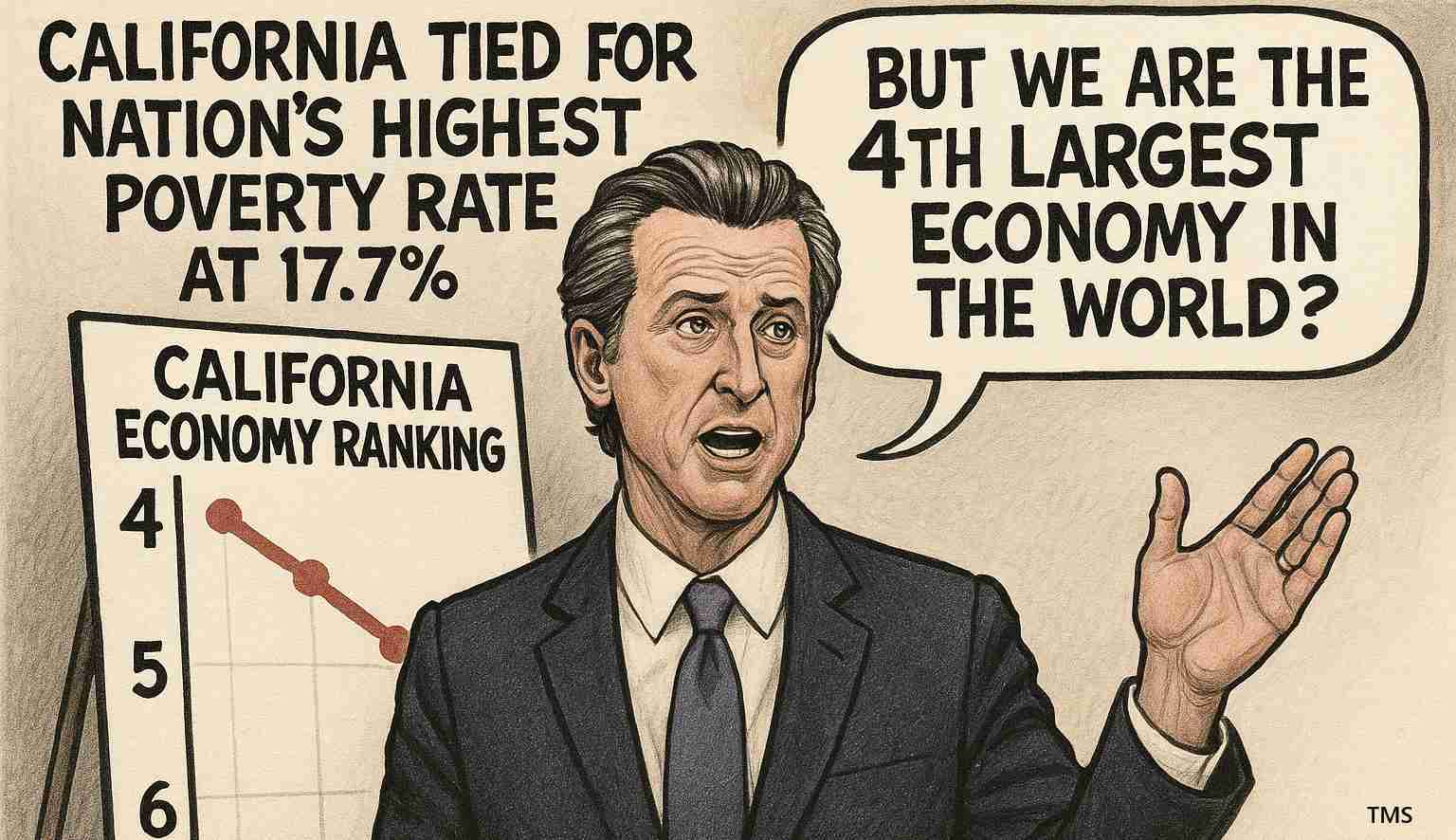
California Tied for Nation’s Highest Poverty Rate at 17.7% as Child and Senior Hardship Soars
California’s poverty rate hit 17.7% in 2024, tied with Louisiana, leaving nearly seven million residents—including a sharp rise in child and senior poverty—struggling amid high costs and the rollback of pandemic-era supports and renewed calls for policy intervention.
- Statewide rate: California’s poverty rate reached 17.7% in 2024, tied with Louisiana, per U.S. Census Bureau, reported in multiple news releases and related coverage (U.S. Census Bureau, reported in multiple news releases).
- Nearly 7 million affected: The rate represents nearly seven million Californians living under the poverty threshold—more than the combined populations of Los Angeles, San Diego, San Jose and San Francisco (U.S. Census Bureau reporting; California Budget & Policy Center analysis).
- Child and senior hardship: Child poverty rose to 18.6% and seniors 65+ faced a 21.1% poverty rate, highlighting acute age-based impacts (child poverty report; senior poverty report).
Main coverage and analysis
Overview: New U.S. Census Bureau-based figures show California tied for the highest poverty rate in the nation at 17.7% in 2024, a multifaceted crisis driven by housing costs, the expiration of pandemic-era supports, and policy shifts that magnified inequities.
Why the poverty rate climbed: big-picture drivers
Analysts point to several overlapping causes. The Supplemental Poverty Measure (SPM), which adjusts for local living costs and medical outlays, shows California’s high housing costs push more families below the adjusted poverty line. Reporting and analysis highlight housing as a dominant factor (KFI AM 640 reporting).
Pandemic-era federal programs—expanded Child Tax Credits and stronger food supports—drove poverty down during COVID-19, with some measures falling below 12%. When those supports ended, poverty rebounded sharply, producing one of the largest single-year increases in decades, indicating the strong effect of public policy on household well-being (KFI AM 640 reporting; California Budget & Policy Center).
“The timing suggests public policy can rapidly change poverty outcomes—both up and down.”
Demographic disparities: who is hardest hit
Children: Child poverty climbed sharply to 18.6% in 2024 after the rollback of the Child Tax Credit and other supports—an increase from 7.5% in 2021, concentrating hardship among families with young kids (report; analysis).
Seniors: People aged 65+ face the highest age-group rate—21.1%—often driven by out-of-pocket medical costs and housing expenses (report).
Race and housing status: Racial gaps persist, with Black and Latinx Californians experiencing poverty roughly ten points higher than white Californians, reflecting long-run inequities. Renters are far more likely to be poor (about 27.1% versus 11.1% for homeowners) (CBPC; KFI reporting).
Recent trends: small shifts, persistent problems
The statewide rate eased slightly from 18.9% in 2023 to 17.7% in 2024, but analysts describe the change as modest and insufficient to indicate sustained recovery. Gains during the pandemic were largely reversed when federal aid ended, and state and federal budget adjustments have further constrained supports for low-income families (KFI AM 640).
Policy debate: what could be done
Experts agree that poverty responds to policy. Proposals span a wide spectrum:
- Progressive revenue approaches: Higher corporate and wealth taxes to fund anti-poverty programs and housing investments (analysis).
- Market-focused reforms: Increase housing supply, cut regulatory barriers, and incentivize job creation in higher-wage sectors (reporting).
- Practical, locally resonant steps: Vocational training, streamlined permitting, targeted child care supports, and improved coordination of safety-net programs to reduce dependency while expanding opportunity.
Implications for Redding, California
Economic impact: Higher statewide poverty places extra demand on Redding and Shasta County services—food banks, health clinics, and county social services—while local budgets face strain if state and federal aid declines (CBPC analysis).
Housing and workforce: Although Redding housing costs are lower than coastal metros, regional shortages and SPM adjustments can classify more local renters as struggling, affecting workforce stability in health care, public safety, and small business sectors (KFI reporting).
Political and social effects: For conservative readers and local leaders, the data sharpen choices: pursue state-level funding for anti-poverty programs or prioritize market-based reforms and targeted supports that encourage work, training, and housing supply expansion (CBPC).
Practical applications for residents
- Zoning and permits: Prioritize zoning reforms and fast-track permits for affordable and workforce housing (KFI reporting).
- Workforce training: Expand vocational training tied to employer needs—health aides, skilled trades, public safety support roles (CBPC).
- Coordination: Combine county, nonprofit and faith-based resources for food, medical care, and short-term rental assistance to prevent homelessness and school disruption (report).
Sources and reporting
This article draws on U.S. Census Bureau summaries and reporting compiled by multiple outlets and research organizations. Full source material:
- Xinhua/English News (northamerica report)
- Xinhua/English News (child poverty report)
- California Budget & Policy Center analysis
- KFI AM 640 reporting
- KFI AM 640 (redirect link)
Reporting note
Figures and analysis are based on U.S. Census Bureau summaries and reporting from the California Budget & Policy Center and local outlets. Readers who wish to review underlying data and original reporting can follow the links above for source documents and deeper analysis.



