
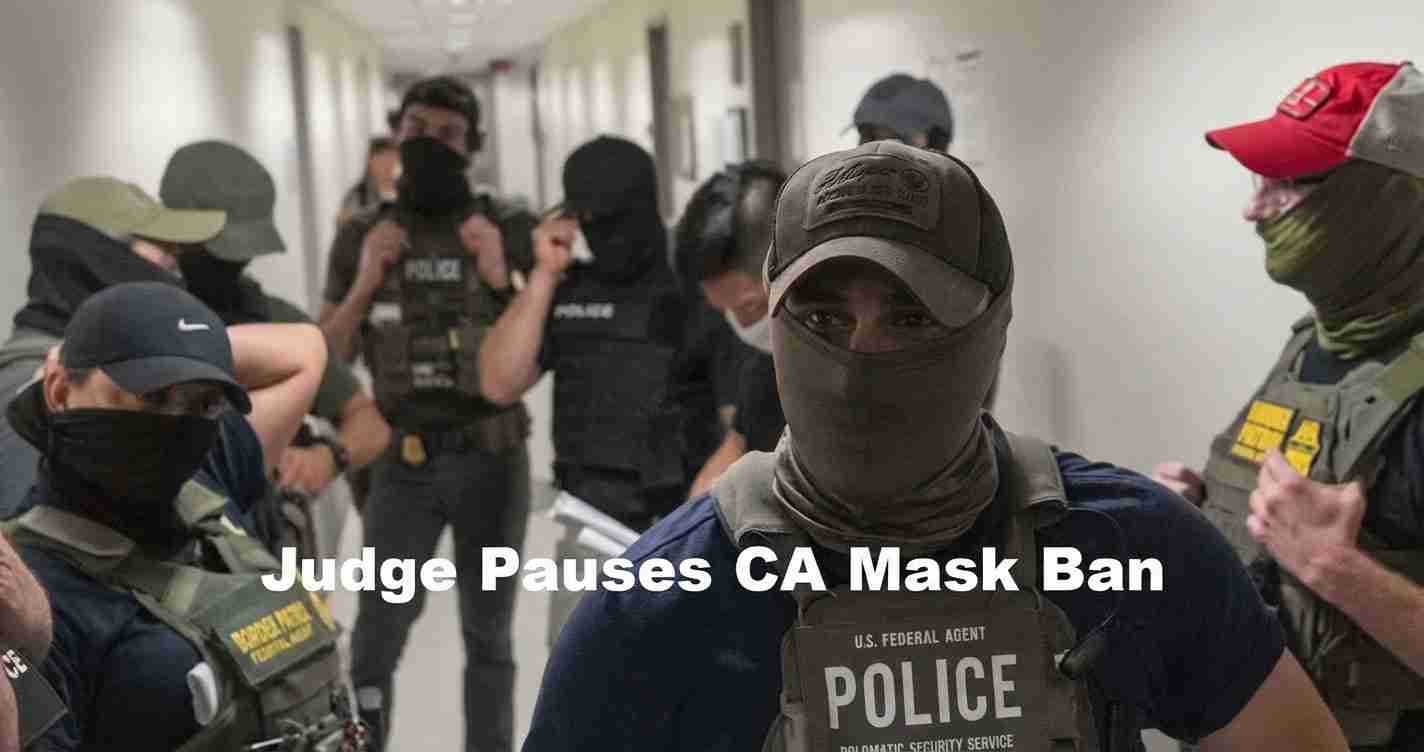
Federal judge blocks California mask ban for feds, upholds ID rule in mixed ruling on No Secret Police Act
A federal judge in Los Angeles on Monday blocked California’s mask ban for federal officers under the No Secret Police Act but left intact the No Vigilantes Act, requiring visible identification for officers across the state.
- Judge Christina A. Snyder granted a preliminary injunction against the mask ban, finding it discriminated against federal officers under the Supremacy Clause.
- The No Vigilantes Act (SB 805), requiring visible names or badge numbers, was upheld and applies to local, state and federal officers.
- The injunction is preliminary; lawmakers may revise the mask law to remove the exemptions that triggered the ruling.
- Both sides framed the ruling as a partial victory—federal safety safeguarded, while accountability measures remain in place.
Key facts
Judge Christina A. Snyder, a Clinton appointee in Los Angeles, issued a preliminary injunction against the No Secret Police Act (SB 627), stopping California from enforcing the state’s mask ban for federal officers, including ICE agents. (California News Online)
Snyder found the law unlawfully discriminated against federal officers because it exempted California state officers while penalizing federal agents, running afoul of the Supremacy Clause. (Daily Journal)
The judge left intact the No Vigilantes Act (SB 805), which requires visible name, badge or agency identification for officers on duty and applies equally to local, state and federal officers. (FOX 11 Los Angeles, California News Online)
Why the judge blocked the mask ban
Judge Snyder’s order centers on the Supremacy Clause: state laws may not single out or unduly burden federal functions. The court determined SB 627’s exemptions for state officers but not federal officers created unequal treatment that is legally fatal at the preliminary stage.
“The law singles out federal officers for different treatment from state officers,” the ruling stated, emphasizing that unequal statutory schemes can conflict with federal prerogatives.
The injunction is preliminary, so the mask ban is paused while the litigation continues; it was not permanently struck down in this order.
Background: how the laws were enacted
Governor Gavin Newsom signed both bills in September 2025; they took effect Jan. 1, 2026. Lawmakers advanced the bills in response to high-profile Department of Homeland Security and ICE operations in Southern California that used masked, unmarked officers during deportation actions. The measures were framed to increase transparency and accountability during enforcement operations.
California became the first state to attempt specific limits on federal enforcement practices, prompting immediate federal litigation.
The federal challenge and the court fight
The U.S. Department of Justice sued California in November 2025, arguing the laws interfere with federal operations, risk officer safety through doxing/retaliation, and unlawfully regulate federal functions. The DOJ asked the court to enjoin both the mask ban and the identification rule; the judge granted a partial win by blocking the mask ban but upholding the ID requirement. (California News Online, FOX 11 Los Angeles)
What the laws actually said
No Secret Police Act (SB 627): Sought to ban masks and face coverings for officers during enforcement operations so people could see who was entering homes or public spaces. The statute included exemptions for California state officers — the feature the court found problematic. (California News Online)
No Vigilantes Act (SB 805): Requires visible name, badge or agency identification on uniforms or vehicles for officers on duty; the judge left this law intact. (FOX 11 Los Angeles)
Reactions from both sides
Supporters — including bill sponsors and Gov. Newsom — framed the upheld ID law as a win for accountability and public safety. Newsom called the ID decision a “clear win for the rule of law.” Sen. Scott Wiener said he will seek legislative fixes to eliminate exemptions. Sen. Lena Gonzalez said the ID rule aids communities harmed by federal actions. (California News Online)
Critics — including the DOJ and law enforcement advocates — warned the mask ban would risk officer safety and interfere with federal missions. Attorney General Pamela Bondi praised the ruling as protective of federal agents facing rising targeting and harassment. (California News Online)
Implications for Redding, California
Economic: Redding and Shasta County work with federal partners; protecting federal officer discretion may ease coordination and avoid operational delays that could affect investigations, wildfire support and border-related cooperation.
Political: The decision may energize conservative voters emphasizing law enforcement authority and national sovereignty, while rewriting the state law could become an issue in local races.
Social & practical: Agencies in Redding should review training and mutual-aid protocols; some departments may voluntarily mirror the No Vigilantes Act to bolster trust while federal agents retain discretion on facial coverings.
Legal watch and next steps
Snyder’s injunction is preliminary and likely to prompt appeals or legislative amendments. California lawmakers signaled plans to revisit SB 627 to remove exemptions; the DOJ has said it will continue litigation. The matter could eventually reach higher courts on constitutional grounds.



