
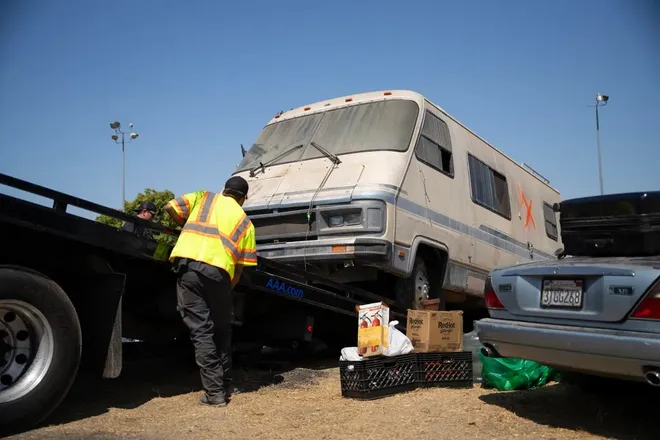
California cities tighten rules on lived‑in vehicles as officials roll out permits and safe parking pilots
Cities across California are tightening parking limits for RVs and lived‑in vehicles while pairing enforcement with permits, safe‑parking pilots and outreach—aiming to clear public spaces, connect residents in vehicles to services and create pathways to housing.
Key takeaways
- Stricter parking rules: Several cities have adopted time limits and bans targeting large and lived‑in vehicles.
- Enforcement plus services: Permits, outreach, buybacks and safe‑parking programs aim to avoid simple displacement.
- State support: SB748 (amended 2025) funds safe parking and outlines removal/storage standards.
New enforcement measures sweeping California
Local officials in San Francisco, San Diego and San José have moved to curb vehicular homelessness by tightening where and when large vehicles can park and by increasing enforcement. These measures target RVs, vans, trucks and other lived‑in vehicles.
San Francisco has established a two‑hour citywide parking limit for large vehicles, with narrow exceptions for commercial operators and permit holders. Vehicles parked beyond those limits may be cited or towed; the city outlines its approach in the San Francisco strategy and in a background outreach video.
San Diego forbids living in a vehicle on city streets between 9 p.m. and 6 a.m. in many areas and bans habitation within 500 feet of residences or schools (in many cases). Local legal settlements and guidance shape how officers implement the ordinance; see San Diego reporting for details.
San José uses outreach teams to map vehicle hotspots, deploy temporary parking restrictions and pilot targeted areas to reduce neighborhood impacts. The city’s transportation and parking office outlines abatement and enforcement steps on the San José enforcement page.
Permits, refuge programs and buybacks: enforcement paired with services
Cities enforcing stricter parking rules are also deploying transitional programs to reduce displacement and give people options.
San Francisco’s large vehicle refuge permit offers temporary legal street parking to qualifying vehicle residents while they work with outreach teams and case managers. Initial permits often allow six months of parking and can be renewed as individuals pursue housing placements. The city has also offered buyback incentives—cash in exchange for relinquishing lived‑in vehicles—to encourage exits from vehicle dwelling. See the San Francisco strategy and the outreach video for details.
At the state level, SB748 (amended 2025) expands support for safe parking programs, creates reporting requirements for program effectiveness and permits protocols for removal and storage of abandoned vehicles.
Social services tied to enforcement
Municipal plans emphasize outreach teams trained in trauma‑informed care and equipped with language services. Teams connect vehicle residents to mental health support, food resources and rapid rehousing subsidies. San Francisco cites expanded outreach and housing placement as central to its plan to restore public spaces and reduce hazards from encampments (San Francisco strategy; outreach video).
Officials say combining enforcement with services both protects public health and offers vehicle dwellers pathways to permanent housing. Cities emphasize documenting hotspots, offering temporary exemptions through permits, and steering residents to safe parking options rather than leaving them on city streets.
Why officials say action is needed
City statements frame measures as responses to resident complaints about safety, blocked sidewalks, trash, illegal dumping and environmental hazards tied to long‑term vehicle dwelling. San Francisco explicitly links enforcement and services to improving pedestrian and street safety (San Francisco strategy; city outreach video).
Officials reported hundreds of RV dwellers in San Francisco—one mid‑2025 figure cited 427 large vehicles—illustrating the scale leaders say requires enforcement and programmatic response (outreach video).
Controversies, legal limits and civil‑liberties concerns
“Advocates say enforcement risks criminalizing homelessness and pushing people into more dangerous situations.”
Critics argue fines, towing and time‑of‑day bans disproportionately affect the most vulnerable when housing is scarce. Reporting on San Diego highlights controversy and the legal constraints shaping enforcement decisions (San Diego reporting).
Court settlements and state law already influence enforcement: San Diego cases narrowly define “vehicle habitation,” limit enforcement near certain sites and restrict actions during specified hours. State law also treats RVs as designed for temporary recreational or emergency use rather than long‑term residence—a backdrop cited in discussions of SB748.
What SB748 changes
SB748, amended in 2025, directs additional state funding to safe parking programs and creates guidance for cities balancing enforcement with services. The measure supports opening managed safe parking sites where people can park and receive basic services while establishing standards for removing abandoned vehicles and reporting on program outcomes.
Implications for Redding, California
Redding leaders weighing similar policies should consider economic, political and social tradeoffs if adopting enforcement-plus-services models used elsewhere in California.
Economic impact
- Local government costs: Enforcement staffing, towing and impound storage plus safe‑parking site setup and outreach team operations would increase expenses. State funding from SB748 may offset some costs, but local budgets are likely to cover ongoing operations.
- Business and tourism: Clearing encampments and enforcing RV rules can improve street cleanliness and perceived safety—factors important to downtown businesses and visitors. The San Francisco strategy connects these goals to public‑space restoration.
Political consequences
- Local control and law enforcement balance: Adopting time‑of‑day bans or strict two‑hour limits signals a tougher stance and may satisfy voters focused on public order.
- Budget scrutiny: Conservative taxpayers will likely demand clear cost‑benefit analysis before approving spending for safe parking or outreach, especially if state funds are insufficient for long‑term operations.
Social effects
- Public safety and health: Clear parking rules could reduce blocked sidewalks, trash and fire hazards; outreach can connect vulnerable residents to services. But without adequate housing exits, enforcement risks displacing people to other neighborhoods or rural areas.
- Community expectations: Conservative communities that prioritize order and predictable enforcement may support paired measures if policies are transparent and offer options like safe parking sites.
Cultural relevance
Values and local norms matter: residents favoring local control and enforcement will likely support measures that restore public spaces, while conservative readers will expect accountable stewardship of taxpayer funds and measurable program results.
Practical applications for Redding residents
- New RV parking rules to consider: Targeted time or size limits, commercial exceptions and a refuge permit system similar to San Francisco’s could avoid penalizing transitional residents engaged with services (San Francisco plan).
- Safe parking options: Design strict eligibility and site rules, cost‑sharing plans, and leverage SB748 funds where possible.
- Enforcement with transparency: Document hotspots, publish cost estimates and performance reports, and coordinate with county and state agencies. San José’s mapping and targeted pilot sites provide a model (San José enforcement page).



