
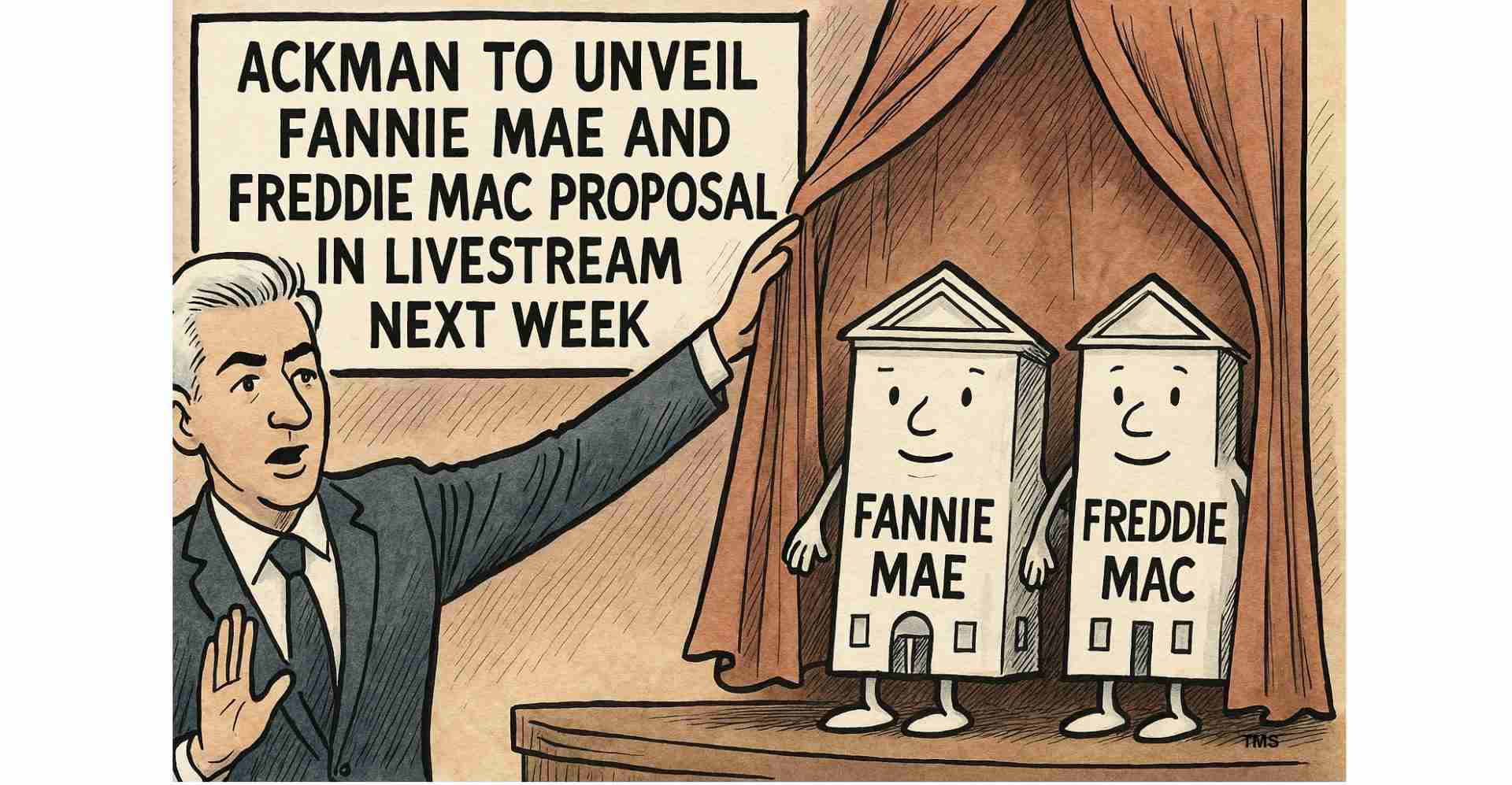
Bill Ackman to unveil Fannie Mae and Freddie Mac merger plan this week, promising lower costs and sparking debate over privatization
Lede: Billionaire hedge fund manager Bill Ackman will unveil a plan to merge Fannie Mae and Freddie Mac into a single entity, arguing it will cut operating costs, streamline oversight, and could lower mortgage rates while prompting privatization debate.
Key takeaways
- Merger proposal: Ackman plans to fold Fannie Mae and Freddie Mac into one company and outline possible privatization steps in a livestream next week (Fox Business: Bill Ackman to unveil new plan for Fannie Mae and Freddie Mac, Benzinga: Billionaire Bill Ackman set to unveil new proposal).
- Systemic stakes: Fannie and Freddie back about 70% of U.S. mortgages; merger or privatization could reshape federal exposure and consumer costs (Friedman Vartolo analysis).
- Trade-offs: Proponents cite efficiency and lower taxpayer risk; critics warn privatization could raise mortgage costs and limit access for low-income borrowers.
What Ackman is proposing and why
Proposal overview: Ackman plans to present a detailed blueprint to merge Fannie Mae and Freddie Mac into a single, privately held company. The proposal emphasizes reducing duplicated functions, cutting operating expenses, and creating clearer regulatory lines for agencies such as the Federal Housing Finance Agency (FHFA).
Supporters say a unified firm would eliminate inefficiencies accumulated since the 2008 crisis and make supervision more straightforward. The plan also dovetails with ideas to return the enterprises to private markets through a major IPO—reports suggest an offering could raise up to $30 billion by selling as much as 15% of a combined company (Friedman Vartolo analysis).
Regulatory and market impact
Supervision: Proponents argue one consolidated balance sheet would simplify stress testing, capital rules, and reduce overlapping oversight, allowing regulators to focus on a single institution rather than two GSEs (Friedman Vartolo).
Risks: Because Fannie and Freddie guarantee a vast share of the mortgage market, removing or narrowing government support could change pricing and loan availability. Economists warn privatization without strong consumer safeguards could raise mortgage bills; one analysis estimates potential annual increases of $1,800–$2,800 for a typical borrower under certain designs (Friedman Vartolo).
Political timing and coordination
Ackman’s timing aligns with pressure from conservative and moderate policymakers to reduce federal risk and return the firms to private markets. Any structural change would require coordination among the White House, Treasury, the FHFA, and Congress—previous attempts stalled over balancing borrower protections with taxpayer risk reduction (Benzinga; Friedman Vartolo).
Market reactions and investor interest
Ackman has reportedly discussed the concept with major Wall Street firms. Supporters see potential long-term gains if a privatized, efficient entity attracts private capital and reduces taxpayer exposure. Critics caution that removing government backing could raise borrowing costs during stress periods when private capital retracts. Investors will seek clarity on capital reserves, loss backstops, and crisis response plans (Friedman Vartolo).
Economic trade-offs and consumer costs
The proposal frames the merger as a path to reduced duplication and operating costs that could, in theory, lower mortgage rates. However, privatization changes the incentives: private investors seeking returns could capture savings as shareholder payouts rather than passing them to borrowers. Policy choices—reserve requirements, pricing rules, and government guarantees—will determine who benefits and who bears higher costs (Friedman Vartolo).
Voices for and against
Supporters call the plan common-sense reform to reduce waste and taxpayer exposure while letting private capital discipline the system. Critics warn that rushed privatization could raise costs, reduce access for low-income borrowers, and increase systemic instability. Lawmakers across the aisle are debating how to protect borrowers while shrinking the federal footprint (Benzinga; GuruFocus: Bill Ackman proposes new strategy; Friedman Vartolo).
“Any shift will require careful design to preserve mortgage access and protect taxpayers; details on reserves, guarantees, and pricing will determine the outcome.”
What to watch when Ackman speaks
- Timeline: Will he provide a merger and IPO schedule?
- Government backing: How would guarantees or federal support change?
- Capital rules: What reserves and buffers would be required?
- Consumer protections: Mechanisms to keep mortgage rates affordable in downturns?
Implications for Redding, California
Economic impact
Redding homeowners and buyers could feel indirect effects. If operational savings lead to lower mortgage rates, local borrowers may benefit from smaller monthly payments and broader qualification. Conversely, if privatization pushes rates higher, buying power and affordability could worsen. The net local outcome depends on federal policy design and market reaction (Friedman Vartolo).
Local banking and lending
Regional banks and mortgage lenders in Redding rely on secondary-market guarantees to sell loans. Changes to Fannie and Freddie’s structure could alter guarantee pricing and availability. Higher private-return demands might squeeze small-lender margins and reduce competition; alternatively, streamlined guarantees could lower compliance costs and improve service for community lenders (Friedman Vartolo).
Housing affordability and local politics
Redding’s market features supply constraints, wildfire risk, and modest local incomes. Any national shift that raises rates would reduce affordable housing options. While conservative local officials may favor reduced federal exposure, they could face constituent pressure if costs rise—prompting local leaders to press for safeguards for first-time buyers, veterans, and low-income residents (Friedman Vartolo).
Practical effects for Redding residents
- Mortgage shoppers: Monitor rate and fee changes closely — small shifts matter for monthly payments.
- ARMs holders: Watch how private guarantees allocate risk in down cycles.
- Local lenders and realtors: Expect an adjustment period as pricing and rules evolve.
- Policymakers: Local representatives will face constituent questions on affordability and federal exposure.
Sources and further reading
Reporting based on Times Media Service synthesis and cited public reporting:
- Fox Business: Bill Ackman to unveil new plan for Fannie Mae and Freddie Mac
- Benzinga: Billionaire Bill Ackman set to unveil new proposal for Fannie Mae and Freddie Mac
- Friedman Vartolo analysis: Fannie Mae and Freddie Mac IPO plans, privatization, and Ackman’s merger proposal
- GuruFocus: Bill Ackman proposes new strategy for Fannie Mae and Freddie Mac



