
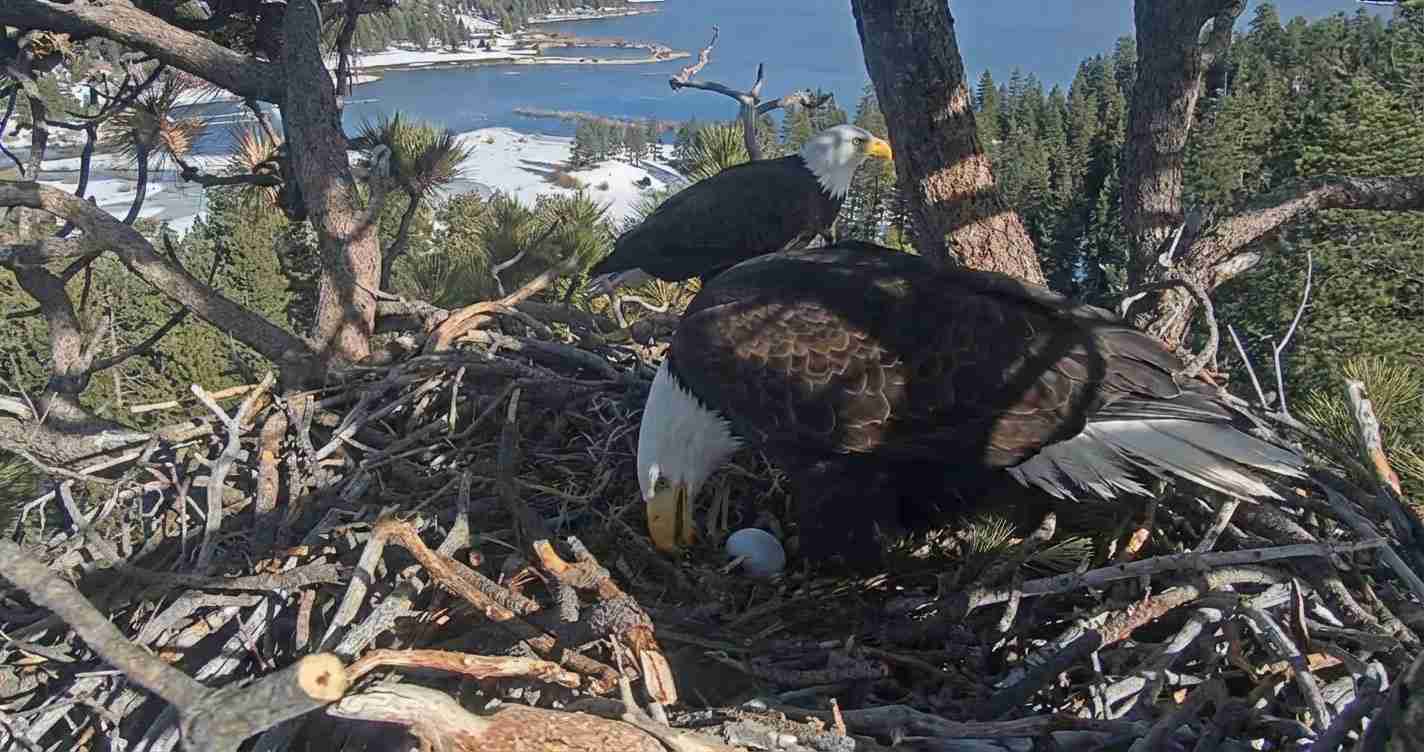
Big Bear bald eagles’ third egg arrives on Jackie and Shadow cam after raven attack
Big Bear, California — Big Bear Lake’s beloved pair, Jackie and Shadow, laid a third egg on Feb. 24, 2026, after ravens destroyed their January clutch. The moment was captured live on the Friends of Big Bear Valley Nest Cam, renewing hope worldwide.
Key takeaways
- Third egg observed Feb. 24 (~2:30 p.m. PT) on the CBS Los Angeles reporting and live cam footage.
- Earlier eggs (Jan. 23 & Jan. 26) were destroyed by ravens during an unattended period on Jan. 30, according to footage cited by CBS.
- Incubation ~35 days: a viable egg would suggest a hatch window in late March or early April.
- FOBBV cam provides continuous documentation — courtship, feeding, mating and snow impacts — via archived clips and YouTube highlights.
Main story
What happened at the nest: timeline and evidence
Sequence of events: Jackie and Shadow laid two eggs on Jan. 23 and Jan. 26. On Jan. 30, ravens attacked the open nest and destroyed both eggs while the adult eagles were away. The pair responded by rebuilding the nest, resuming courtship and mating, and continued provisioning. Their persistence culminated in a new egg appearing on camera on Feb. 24 at about 2:30 p.m. Pacific time.
Video and reporting draw from continuous footage maintained by the Friends of Big Bear Valley and coverage by CBS Los Angeles, which cites the live nest cam recordings.
Timing and hatch expectations
Bald eagle eggs typically incubate for about 35 days. If Jackie laid additional eggs on a roughly three-day schedule, more eggs could appear soon. Given the Feb. 24 lay date, watchers now expect any hatch to fall in late March or early April if the egg remains viable.
Behavior on the cam: what the footage shows
FOBBV’s continuous footage documents feeding, courtship and nest preparation in the days before Feb. 24. Notable observations include:
- Provisioning: Shadow delivered fish and a coot to the nest in the days leading up to the lay.
- Mating activity: multiple matings recorded on the nest “porch” and a nearby snag.
- “Pancaking”: Jackie flattened herself to prepare the nest surface prior to egg-laying.
- Specific feeding and courtship instances on Feb. 20–21 are preserved in cam clips and Friends of Big Bear Valley cam footage and other highlights like cam highlights.
Community and cam management
The Friends of Big Bear Valley (FOBBV) operates the 24/7 Nest Cam and a wider-view camera. The cam has become a global touchpoint for wildlife fans and a local resource for education and volunteerism. After the January loss, supporters rallied with donations, social posts and viewership that sustain the cam’s staffing and operations.
“The cam’s stewardship and archived footage are central to ongoing monitoring and public engagement,” as documented in reporting and cam updates.
Threats and past success rates
Raven predation illustrates a known risk to open nests. The Jan. 30 raid shows how gaps in adult attendance can leave eggs vulnerable to opportunistic birds. Across the species, roughly half of eaglets reach adulthood, so each successful hatch is meaningful.
Jackie and Shadow have recorded successful years in 2019, 2022 and 2025. The first recorded Big Bear Valley eaglet hatched in 2012; since then, about a dozen eggs have been laid with only a fraction surviving to maturity — underscoring the value of monitoring and stewardship.
Local figures and recent loss within the community
The cam and program were championed by volunteers including Sandy Steers, whose recent passing was noted by supporters as a loss for local conservation. The cam continues as a volunteer-driven effort funded by donations and worldwide viewership.
Questions for investigators and wildlife managers
- How to deter raven attacks without harming native species?
- Can habitat management reduce adults’ time away from the nest?
- Does cam visibility create unintended disturbance, or does it primarily aid conservation through awareness?
- What funding or policy support do local groups need to protect nests during vulnerable periods?
These questions matter for agencies, nonprofits and residents balancing nest protection with broader wildlife management.
Jackie and Shadow eagle cam: public engagement and data value
FOBBV’s cameras generate continuous records valuable to researchers, students and managers. Footage of courtship, feeding, intruder interactions and snow-cover impacts informs nesting success analyses. For example, the nest was recently snow-covered and cleared by Feb. 24, information that helps explain adult behavior around incubation and provisioning. Archives and clips are publicly available for study via the Friends of Big Bear Valley cam footage.
Implications for Redding, California
Economic impact
Wildlife viewing and nature cams can bring measurable economic benefits. Communities that host wildlife attractions see spillover tourism. Redding could support local projects — river otter viewing, raptor cams, salmon monitoring — to attract visitors and support small businesses. The Big Bear example demonstrates how a volunteer-backed project can draw global attention and local dollars.
Political and policy consequences
The Friends of Big Bear Valley model — volunteers, donations and local oversight — aligns with community-led conservation preferred by many civic-minded residents. Redding officials might consider modest support for volunteer camera programs and habitat protections through partnerships instead of large regulatory shifts.
Social effects and community engagement
The cam’s global following shows how wildlife stories can unite communities. Redding schools, scout troops and civic groups could use local cams for conservation education. The sustained volunteer effort behind the Big Bear cam illustrates how persistent local action builds national attention and civic pride.
Cultural relevance
Protection of iconic species resonates with values of land stewardship and intergenerational conservation ethics. The Big Bear story models how to balance recreation, wildlife appreciation and private land interests — messaging that may appeal to conservative-leaning audiences in Redding.
Practical applications for daily life
- Donate time or funds to local groups that monitor wildlife.
- Promote responsible recreation and report nest disturbances.
- Support small grants for volunteer monitoring equipment and habitat-friendly zoning.
- Keep respectful distances from nesting sites to reduce disturbance.
Sources and further viewing
- CBS Los Angeles reporting on the egg and background.
- Friends of Big Bear Valley cam footage (YouTube).
- Additional cam highlights (YouTube).
Bottom line: The Feb. 24 egg gives Jackie and Shadow another chance this season. The live cam will continue to track incubation, feeding and any additional eggs while volunteers and a global audience keep the nest in the public eye.



