
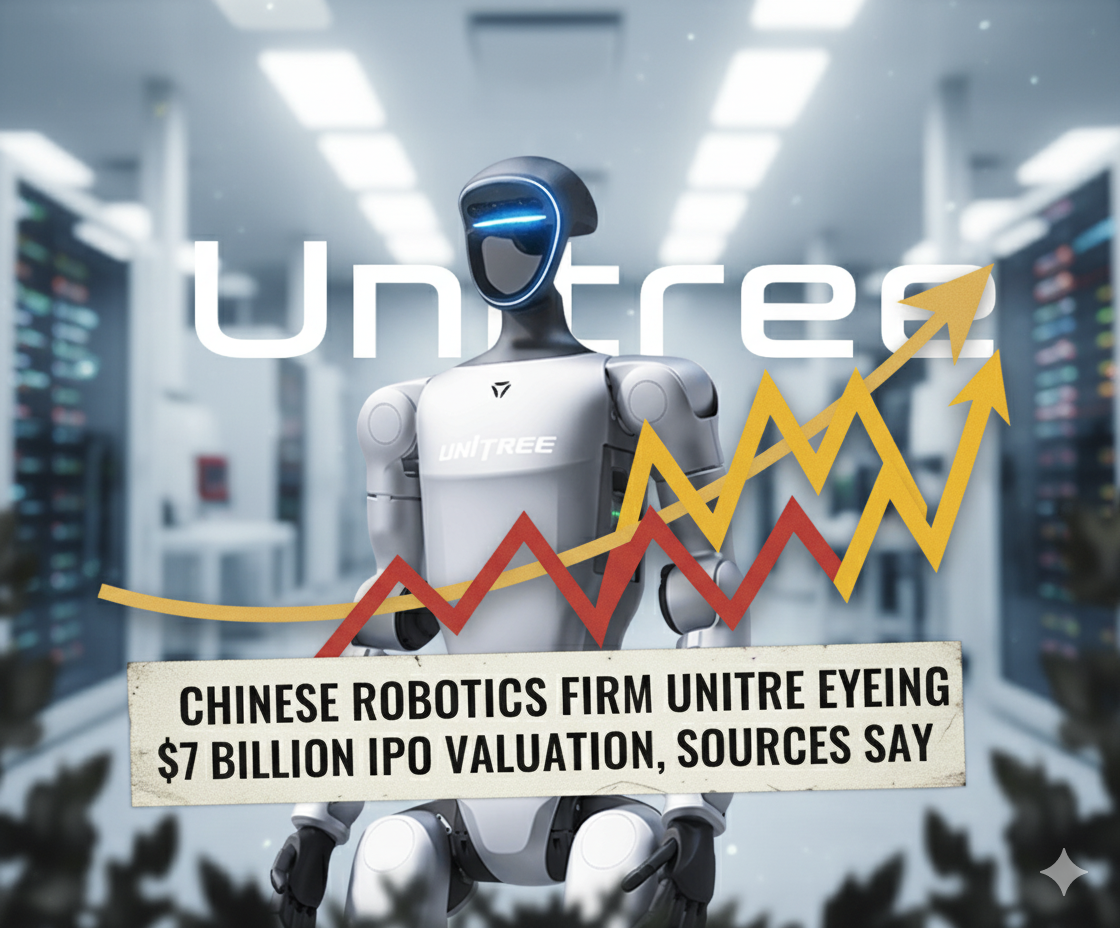
Unitree Robotics Eyes $7 Billion IPO on Shanghai STAR Market, Deepening China’s Push in Humanoid Robots
Unitree Robotics plans a Shanghai STAR Market IPO targeting about $7 billion (50 billion yuan) by late 2025, backed by Alibaba and Tencent, as China accelerates its strategic push into affordable humanoid and quadruped robots.
Key takeaways
- Ambitious valuation: Unitree is aiming for roughly 50 billion yuan (~$7 billion), up sharply from prior estimates.
- Major backers: Strategic investors reported include Alibaba, Tencent and Geely supporting expansion.
- High unit sales: Company reports ~23,700 units sold in 2024 at about $2,700 apiece and >1 billion yuan revenue.
- Broader implications: The IPO highlights Beijing’s drive to keep high‑growth tech listings onshore and accelerate robotics adoption.
What Unitree is planning and why it matters
Unitree is preparing what would be one of China’s largest onshore tech listings in recent years, targeting a valuation of about 50 billion yuan (~$7 billion) and plans to list on the STAR Market. The company told local media it expects to submit listing documents in the fourth quarter of 2025 (Benzinga).
That target would mark a sharp jump from prior valuations — for example, a July 2024 valuation of about 12 billion yuan — prompting analysts to question whether the increase reflects fundamentals or policy support.
Backers, sales and market position
Unitree has attracted heavyweight strategic investors. Reports cite Benzinga naming Alibaba, Tencent and Geely among backers. Founder Wang Xingxing has been visible at high‑level events, which some analysts interpret as close alignment with Beijing’s industrial priorities (Benzinga).
The company says it sold about 23,700 units in 2024 at roughly $2,700 each — a price point that undercuts Western rivals — and reports annual revenue exceeding 1 billion yuan (Benzinga; The Bamboo Works).
Technology and business model
Unitree produces both quadruped “robot dogs” and experimental humanoid models, marketed for industrial inspection, emergency response and entertainment. The company says roughly 20% of robot dogs are used in industrial settings, a point highlighted in coverage by The Bamboo Works.
Affordable pricing has driven higher unit sales versus some competitors, but the low price per unit raises questions about margins, long‑term profitability and the costs of advancing robotics hardware and autonomy.
Valuation questions and the broader China robotics boom
The planned IPO has reignited debate about valuations in China’s robotics sector. Some analysts warn that government support, subsidies and a protected domestic market can lift valuations beyond fundamentals; others point to rapid sales growth and investor backing as signs of real demand (video reference; Heartspace).
Comparisons with Western rivals — including Boston Dynamics, Tesla’s Optimus program and startups such as Figure AI — underscore tensions around pricing, data strategy, service offerings and durability.
Role of government and strategic aims
Observers view the Unitree listing as part of Beijing’s effort to keep high‑growth tech firms listed onshore and to channel capital into strategic industries. The STAR Market was created to support innovative firms and reduce reliance on foreign exchanges, aligning with a larger push for self‑reliance in robotics and AI.
Reporting caveats and next steps
Many details remain unconfirmed — including the final share offering size, exact valuation and listing date. Reports cite sources familiar with the plans but note Unitree did not publicly respond to media requests (Heartspace; The Bamboo Works; MarketScreener (Reuters‑sourced)).
Implications for Redding, California
A Unitree IPO at a high valuation signals Beijing’s prioritization of robotics and automation. For Redding-area businesses, the most immediate effects may include:
- Economic pressure: Faster adoption of low-cost robotic inspection and monitoring could heighten competition for local manufacturers, loggers and utilities.
- Workforce shifts: Automation can displace routine tasks but also create demand for technicians, integrators and service providers; vocational programs can adapt to capture these roles.
- Security concerns: State-connected investment and foreign supply chains raise questions about procurement, data policies and critical‑infrastructure risk.
- Opportunity for development: Redding could attract investment by positioning as a lower‑cost hub for robotics services, apprenticeships and specialized manufacturing.
Practical steps: businesses should assess where automation cuts costs without sacrificing quality; workforce developers should expand robotics training; local governments should review procurement and security rules.
Sources and media coverage
Reporting note: Unitree has not released full IPO documentation and the company did not publicly respond to inquiries; the plan is based on reporting citing sources familiar with the company’s intentions (Heartspace; Benzinga; MarketScreener).



