
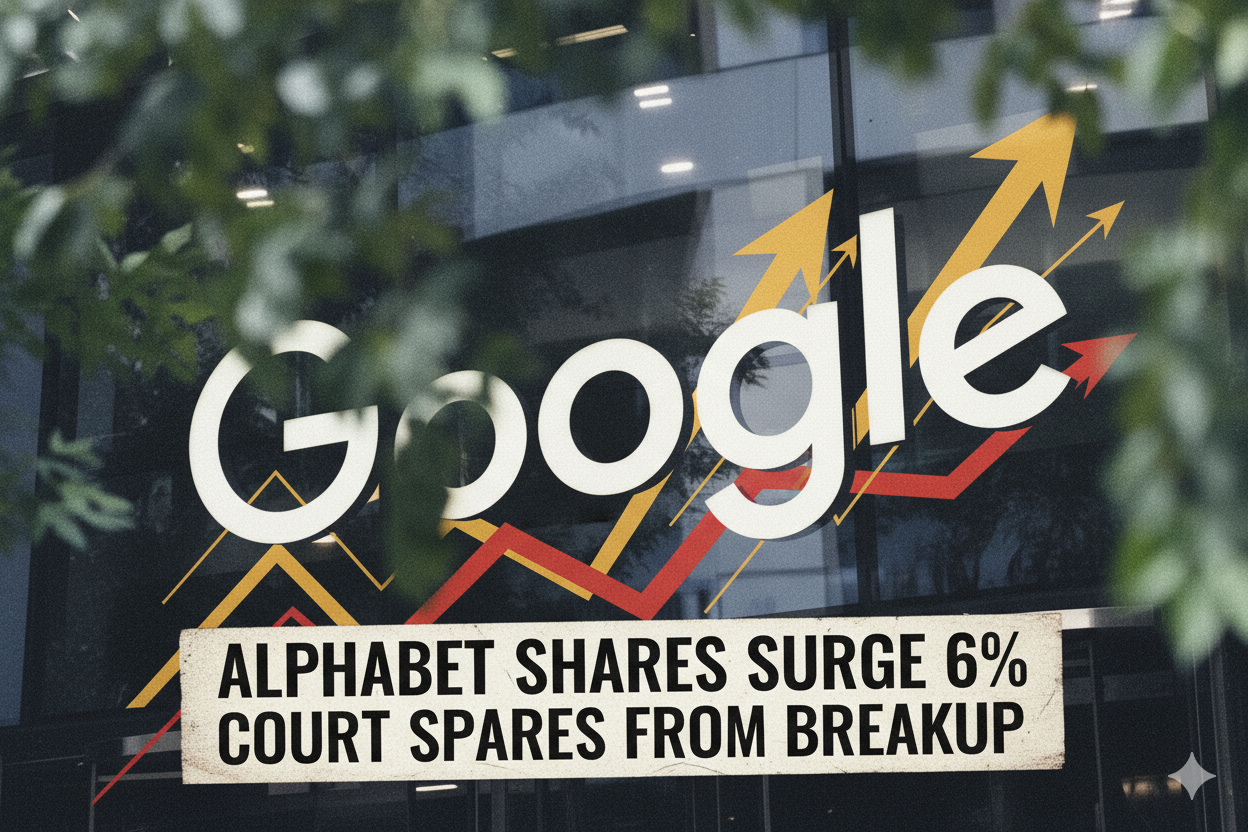
Google Antitrust Ruling Spurs Relief on Wall Street — Alphabet Shares Surge After Judge Rejects Forced Breakup
Alphabet shares jumped more than 6% after a federal judge denied the DOJ’s request to break up Google, allowing Chrome, Android and YouTube to remain intact nationwide while imposing limits on exclusive default search deals.
- Judge denies structural breakup: Judge Amit Mehta refused forced divestment of Chrome, Android or YouTube.
- Non‑exclusive defaults: Google may pay to be default but cannot enforce exclusivity, opening slots for rivals and new AI-driven search tools.
- Market reaction: Alphabet surged ~6% premarket, adding roughly $120 billion in value; Apple also moved higher on preserved partnership revenue (market data).
- Broader effect: The decision favors behavioral remedies and recognizes generative AI as changing competitive dynamics (analysis).
Background: What the DOJ alleged
The Department of Justice sued Google in 2020, alleging the company maintained an illegal monopoly in search by securing default search status on devices and browsers through paid agreements that steered users and shut out rivals. The complaint emphasized deals that put Google as the default on devices like Apple’s iPhone and on major browsers, which prosecutors said harmed competition and consumers. See DOJ vs Google lawsuit for background.
Why the judge denied a breakup
In his ruling, Judge Amit Mehta declined to order structural remedies that would force Alphabet to divest key assets such as Chrome, Android and YouTube. Mehta highlighted the rise of competition from generative AI and other entrants as a reason that sweeping breakups were unnecessary, concluding that narrower remedies would better fit the market and facts. Read the court analysis and reasoning in AInvest’s coverage and reporting in Economic Times.
What the ruling requires and allows
- No forced divestment: Alphabet retains Chrome, Android and YouTube, preserving its integrated advertising, search and video platform — see TechBuzz.
- Non‑exclusive default deals: Google can continue to pay partners to be the default search engine but not exclusively, which opens opportunities for competitors to bid for default slots (analysis: AInvest).
- Ongoing oversight: The order implements guardrails aimed at stopping exclusionary conduct while avoiding structural breakup (TechBuzz).
Market reaction: Why investors cheered
Investors reacted swiftly. Alphabet’s stock jumped about 6% in premarket trading, a move that recovered a substantial share of value that a breakup would have threatened; market coverage documented the surge and the roughly $120 billion uplift in market capitalization (Benzinga). Analysts framed the decision as a major win for the status quo and adjusted price targets upward (AInvest analysis).
Apple and other partners
Apple’s shares rose after the ruling because its lucrative agreements with Google remain largely intact, though non‑exclusive rules could require Apple to present alternative search choices and remove exclusive terms. That preserves major revenue arrangements while nudging the ecosystem toward more consumer choice (AInvest).
AI’s role in the judge’s reasoning
Generative AI figured prominently. The judge cited growing competition from tools like ChatGPT and Microsoft’s Copilot as evidence that search competition is evolving rapidly, reducing the need for the most extreme structural remedies. See commentary on AI’s competitive impact in AInvest.
Analyst and industry perspectives
Industry analysts called the decision a “home run for the status quo,” noting that Google’s business model remains intact while being subject to behavioral guardrails. Firms such as Oppenheimer raised price targets and highlighted reduced legal and structural risk, though analysts caution that limits on exclusivity may reshape competitive dynamics over time (AInvest; Economic Times).
Broader implications for competition and tech policy
The ruling represents a middle ground: it keeps major platforms intact while signaling that courts may prefer behavioral fixes over breakups, especially as rapid innovation — notably generative AI — reshapes markets. This precedent may influence how future antitrust suits are framed and how governments weigh structural versus behavioral remedies (TechBuzz).
Implications for Redding, California
Economic impact: Local investors and retirement accounts holding mutual funds or ETFs with Alphabet likely saw portfolio gains after the stock rise. Advertisers and small businesses that rely on Google’s ad tools and listings face less immediate disruption, while potential rivals may gain limited entry points as exclusivity rules loosen (market report).
Political and social effects: For conservative readers, the outcome may be seen as a win for restrained remedies and limited government intervention. Residents who use Google services should not expect major service disruption, though non‑exclusive defaults could gradually expand consumer choice on devices sold in the U.S., affecting students, journalists and civic groups over time (analysis).
Practical advice: Local advertisers and city communications teams should monitor implementation of the non‑exclusive rule. If device makers and browsers begin offering alternative default engines, local SEO and ad strategies may shift; workforce programs should track AI‑driven search advances for training and job opportunities (TechBuzz).
Where to read the ruling and coverage
- TechBuzz coverage of the ruling and market reaction
- AInvest analysis on competition and generative AI cited by the judge
- Economic Times report on market moves and investor response
- Benzinga on premarket movers and the stock jump
- Additional market analysis from AInvest
“Reporting on this ruling will continue as appeals and regulatory follow‑up move forward. For Redding readers, the immediate effect is clear: the Google antitrust ruling spared a breakup, Alphabet shares surged, and the DOJ vs Google lawsuit has prompted changes that could slowly shape how search competition unfolds in the U.S.”



