
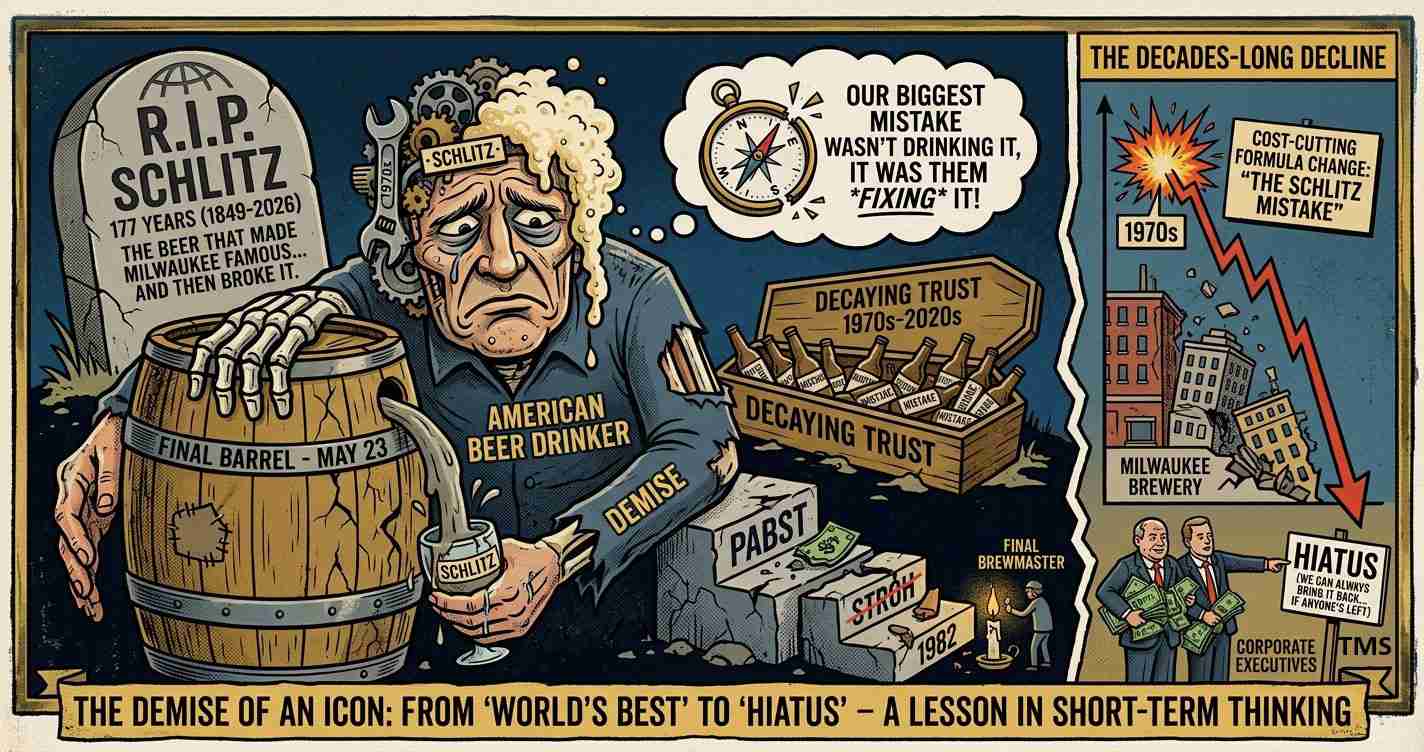
Final Schlitz beer batch brewed May 23 marks end of 177‑year American brewing era
Milwaukee’s iconic Schlitz beer brewed its final batch on May 23, 2024, ending 177 years of continuous production as Pabst retires the label; the last run used the recreated 1948 recipe by Wisconsin Brewing Company.
- Final batch: Brewed and rolled out May 23, 2024, under license by Wisconsin Brewing Company.
- Historic roots: Brand traces to Joseph Schlitz Brewing Co., formally established in 1849.
- Final recipe: A recreation of the 1948 Schlitz formula by WBC for the last authorized run.
- Owner’s reason: Pabst Brewing Company cited rising storage and shipping costs for retiring the label.
The rise of Schlitz: Milwaukee brewing history
Schlitz began with immigrant brewers who helped make Milwaukee a brewing powerhouse. August Krug opened a small brewery in 1848; after Krug’s death Joseph Schlitz took the company name in 1849 and began aggressive national marketing.
A pivotal moment came after the Great Chicago Fire of 1871, when Schlitz shipped beer to fill a shattered market and widened its reach. By the post‑World War II era into the 1950s, Schlitz was among the most popular beers worldwide, using the slogan “The beer that made Milwaukee famous.” For historical context see the Encyclopedia of Milwaukee.
The Schlitz Mistake 1970s: cost cutting and reputation damage
Industry historians and beer writers point to a 1970s reformulation as the turning point. Facing competition from national rivals, Schlitz changed production methods to cut costs and speed brewing. That reformulation — widely called the Schlitz Mistake 1970s — substituted cheaper adjuncts, shortened processes and used additives to stabilize output.
Result: haze, flavor shifts and a loss of the distinct taste many drinkers remembered. Trade retrospectives document the decline; see analysis at AmericanCraftBeer.com.
“Not the real stuff for years,” one longtime drinker wrote online — a common refrain among nostalgic consumers.
Decline, consolidation and ownership changes
As sales fell after the 1970s, Schlitz underwent ownership changes and restructuring. Pabst Brewing Company acquired the brand in 1999 and maintained Schlitz as a heritage label. Attempts at revival leaned on nostalgia but did not restore mass‑market prominence.
Why Pabst pulled the plug now
Pabst’s head of brand strategy, Zac Nadile, told Milwaukee Magazine that rising storage and shipping costs made continued production of lower‑volume legacy brands unsustainable. The decision reflects an industry pattern of trimming underperforming labels amid changing consumer tastes and logistics pressures.
The final batch: who brewed it and how to get it
The last official batch was brewed under license by Wisconsin Brewing Company. WBC brewmaster Kirby Nelson recreated the 1948 Schlitz recipe for the final run that Pabst authorized. WBC accepted online pre‑orders and collectors secured bottles; coverage documented strong fan interest (see reporting from Fox News).
Cultural reaction: nostalgia, derision and family stories
Social posts quoted in reporting show Schlitz’s mixed emotional place in American life. Some remember it as a family staple — “My wife’s grandma’s favorite” — while others recall college and fraternity memories. Responses mix nostalgia, anger over past reformulation and commentary about corporate cost‑cutting undermining brand value.
Physical legacy and collectibles
The original Joseph Schlitz Brewing Co. site in Milwaukee is preserved as Schlitz Park, retaining the brewery’s architectural memory. With production ending, vintage bottles, cans and marketing materials are poised to become more collectible. Pabst retains trademarks and could reintroduce Schlitz in the future, but the label is shelved for now.
Where Schlitz fits in American beer history
Schlitz’s history mirrors broader U.S. beer trends: immigrant founders building regional brands, post‑war advertising creating national reach, cost‑driven reformulations eroding trust, and consolidation leaving heritage names sidelined. Schlitz is a case study on the costs of sacrificing perceived quality for short‑term savings.
Implications for Redding, California
Economic impact
Local retailers and bars in Redding may see modest shifts as nostalgic customers hunt remaining stock. Immediate disruption is likely small because Schlitz has been a low‑volume national label. Meanwhile, antique shops and online sellers in Redding could see increased interest in Schlitz collectibles.
Political consequences
The Schlitz story may resonate with readers who value stewardship and long‑term planning, and local leaders may cite it when discussing corporate decisions that prioritize short‑term margins. Pabst’s logistics explanation could prompt local review of shipping and storage costs affecting small businesses.
Social effects
For many in Redding, Schlitz evokes working‑class and college memories. The label’s retirement will prompt conversations in families, churches and alumni groups, and may shift drinking habits toward other value lagers, imports or private‑label options.
Practical impact on daily life
Availability of the final Schlitz batch will be limited; residents may need to order online or check specialty stores. Retailers should prepare substitute recommendations for budget‑minded customers.
Sources and further reading
- Encyclopedia of Milwaukee — Joseph Schlitz Brewing Co.
- Milwaukee Magazine — reporting and interview with Zac Nadile
- Fox News — coverage of the final batch and pre‑orders
- The Independent — reporting on Schlitz retirement
- AmericanCraftBeer.com — history and analysis of the 1970s reformulation
- Pabst Brewing Company corporate site
- Wisconsin Brewing Company
- Schlitz Park



