
Palantir CTO Says AI Is Driving a Blue‑Collar Productivity Boom — Not Mass Job Losses
Palantir CTO Shyam Sankar argues AI is driving a blue‑collar productivity boom in manufacturing and frontline jobs, accelerating hiring and training rather than causing mass layoffs, and urging demand‑side investments to translate technology into real jobs.
- AI boosts frontline productivity: Sankar describes an “AI blue‑collar productivity boom” that helps factory workers, foremen and nurses spend more time on high‑value tasks (Fox Business).
- Shorter training, more hiring: Examples cited include Panasonic Energy cutting apprenticeship from three years to three months for battery technicians, enabling hiring from nontraditional labor pools (Fox Business).
- Policy debate: supply vs. demand: Sankar warns U.S. policy overemphasizes data centers and models and underinvests in practical applications and workforce programs (Sankar commentary).
AI blue‑collar productivity boom: Sankar’s case
On Dec. 17, 2025, Palantir CTO Shyam Sankar told Fox Business that AI is already improving productivity on shop floors and in frontline jobs. He described practical shifts: AI helps with production planning, labor scheduling and material requirements planning, freeing workers to build parts and keep lines running.
Sankar said one manufacturing customer was able to add a third shift because AI improved labor utilization enough to make the extra shift profitable — leading to more hiring, not layoffs. He framed this as software and data tools unlocking capacity and demand that create jobs in manufacturing and logistics (Palantir tools).
Concrete workplace examples
- Factory foremen and line workers: AI systems that balance production and forecast parts let teams spend more time assembling and less time troubleshooting paperwork and scheduling (Fox Business).
- Healthcare: In intensive care units, clinical software handling routine documentation lets nurses devote more time to direct patient care (Fox Business).
- Training: Sankar highlighted Panasonic Energy’s shift in battery technician training from three years to three months, creating faster pathways into EV production jobs in Reno, Nevada (Fox Business).
“AI blue‑collar productivity boom” — Sankar used this phrase to describe how tools help employers increase output while offering workers higher‑value tasks; he dismissed mass‑unemployment warnings as a “propaganda schtick” tied to some Silicon Valley commentary (Fox Business).
Sanders’ warning and the moratorium proposal
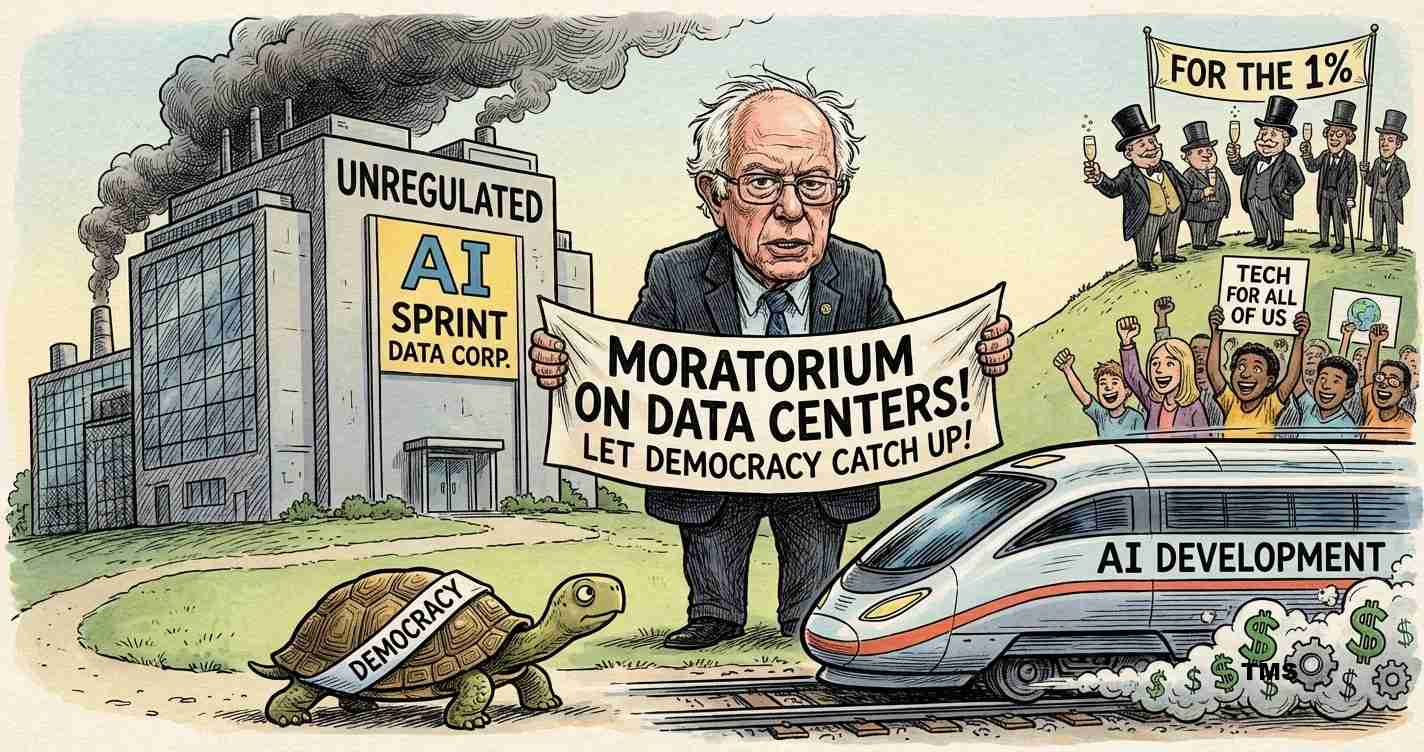
Senator Bernie Sanders warned rapid AI and robotics adoption could eliminate “millions of jobs” and in a video posted Dec. 16, 2025, urged a moratorium on new data center construction to slow AI’s scaling so “democracy can catch up” (Fox Business coverage).
Sanders argues a pause would give lawmakers time to craft rules to ensure AI’s benefits spread broadly rather than concentrating wealth with a few large companies.
Where the debate centers: supply side vs. demand side
Sankar criticized the policy focus on the “supply side” — big models and massive data centers — while underinvesting in the “demand side”: applications, training and business changes that create jobs. He urged more investment in tools that let ordinary businesses use AI to boost productivity and hiring (Sankar commentary).
This tension underlies the disagreement: Sanders emphasizes systemic risk and concentration of power, while Sankar emphasizes practical deployments that, in his view, help frontline workers and spur business formation.
Palantir’s role and product claims
Palantir builds software tying data to operations. Independent coverage notes Palantir’s tools can dramatically speed production‑line balancing and material requirements planning — tasks that traditionally take planners hours or days (MLQ coverage).
Sankar also promotes programs such as the Palantir meritocracy fellowship to train young people in technical skills tied directly to jobs, and he predicts AI will enable entrepreneurs to test ideas quickly while urging colleges to adapt curricula for hands‑on technical roles (Sankar writing).
Questions that remain
Investigators and local leaders should note that Sankar and Palantir present company examples of added shifts and compressed training times, but broad labor‑market effects are complex. Most cited research is company case studies and industry reporting; independent, peer‑reviewed studies measuring net job creation versus displacement are still limited.
Sankar himself has warned software can cause productivity stagnation when implemented poorly, calling out “cargo cult” approaches that add little value (Sankar commentary).
Implications for Redding, California
- Local manufacturing and trades: Small‑ and mid‑size manufacturers, construction firms and transport services in Redding and Shasta County could benefit from AI tools for planning and scheduling, enabling profitable night shifts and hiring local welders, assemblers and machine operators (Palantir/MRP coverage).
- Workforce training: Community colleges and vocational programs could shorten pathways into battery assembly and EV supply‑chain work through partnerships and fellowships, echoing the Panasonic example (Fox Business).
- Public policy and permitting: A Sanders‑style moratorium on data centers could slow investment in parts of California, offering time for community input on power, water and land use impacts (Sanders proposal coverage).
- Economic resilience: Local leaders may favor demand‑side investments that support worker training and plant upgrades rather than blanket halts that risk slowing job‑creating projects (Sankar demand‑side argument).
- Social services: Even if AI creates net jobs, transitions can be disruptive; officials should plan for career counseling, targeted retraining and portable benefits to protect families during job shifts.
Reporting and sources
This article draws on Sankar’s comments to Fox Business (Dec. 17, 2025), related industry coverage including a Moomoo summary, analysis of Palantir tools (MLQ), and Sankar’s own essays on technology and productivity (Sankar writing).
Senator Sanders’ video and moratorium proposal were reported in the same coverage (Fox Business). Additional public remarks by Sankar are available on his channels (example: example short).



