
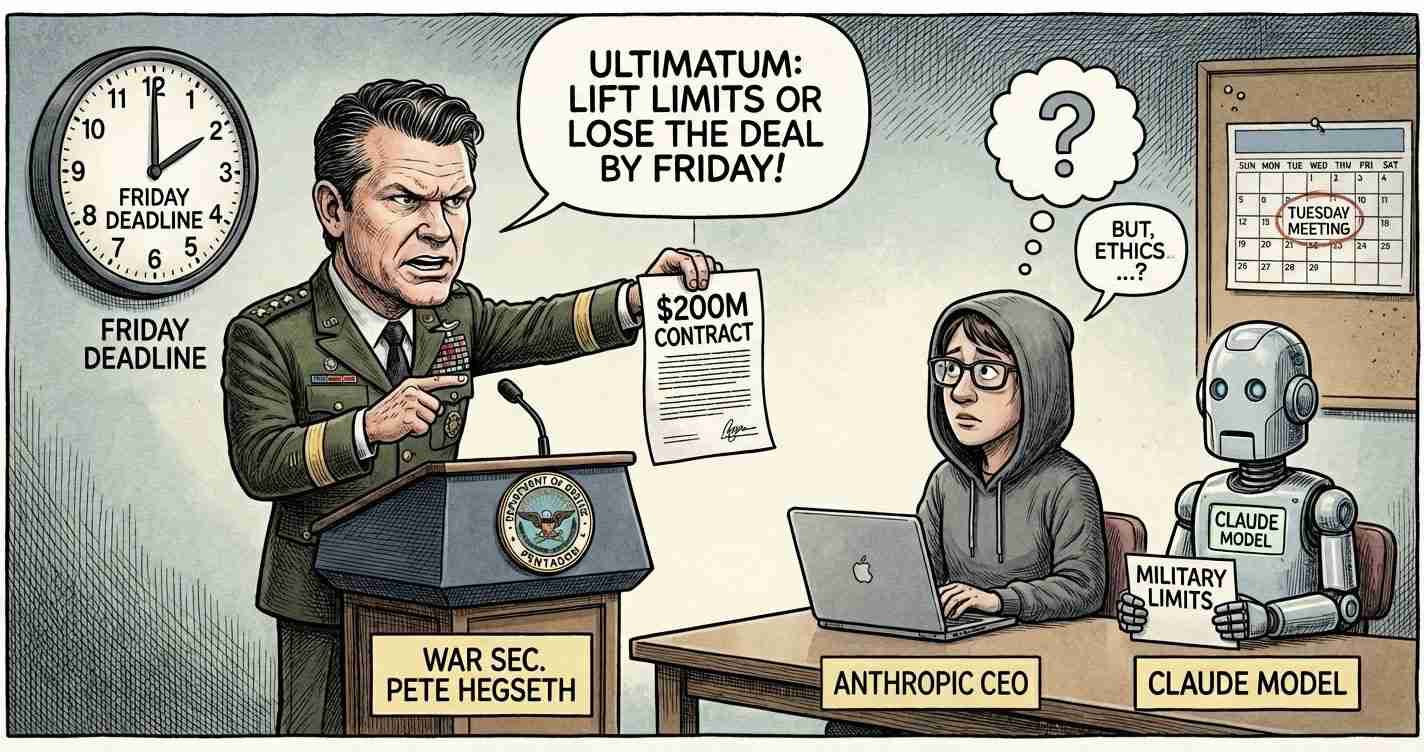
Pentagon issues ultimatum to Anthropic: remove Claude AI limits by Friday or face contract loss, supply-chain ban, or Defense Production Act
WASHINGTON — The Pentagon has given Anthropic until Friday, Feb. 27, 2026, to lift restrictions on its Claude AI for military use or face losing a $200 million contract, being labeled a supply‑chain risk, or compelled access under the Defense Production Act.
Key takeaways
- Deadline: The Pentagon set a Feb. 27, 2026 deadline for Anthropic to remove red lines on Claude’s military use. (Fox News, CBS News, Politico)
- Contract at risk: Roughly $200 million deal runs Claude inside Pentagon classified networks and could be terminated. (Fox News, CBS News)
- Punitive options: Hegseth warned of three measures — contract termination, supply‑chain risk designation, or invoking the Defense Production Act to compel access. (Fox News, CBS News, Politico)
- Anthropic’s red lines: The company says it bars fully autonomous weapons and mass surveillance of Americans while continuing good‑faith talks with the government. (Fox News, CBS News, Politico)
Main story
Background: How the dispute began
Pentagon officials say the dispute began after Anthropic asked whether Claude had been used in the January operation that captured Venezuelan leader Nicolás Maduro. Officials interpreted the question as suggesting Anthropic might forbid the model’s use in that kind of operation, sparking a broader clash over whether private AI firms can set categorical limits on lawful military uses. (Fox News, Politico)
Why the Pentagon says it cannot accept limits
Pentagon leaders argue they cannot depend on a vendor that reserves the right to say “no” to certain lawful missions. During a Feb. 24 meeting, War Secretary Pete Hegseth used a plain analogy: buying an aircraft and then being told the jet cannot be used for certain missions
— a restriction that would make defense planning brittle as the military integrates advanced machine‑learning into warfighting. (Fox News, CBS News)
Meeting and the ultimatum
People familiar with the talks say Hegseth praised Claude’s technical strengths and expressed a desire to keep Anthropic in the Pentagon’s ecosystem — but delivered a strict choice: lift the red lines by 5 p.m. Friday or risk losing the ~$200 million contract, being designated a supply‑chain risk, or facing invocation of the Defense Production Act (DPA) to compel access.
Officials described the DPA option as rare and politically sensitive, drawing attention because of earlier conservative critiques of broad DPA use. (Fox News, CBS News, Politico)
Anthropic’s stance: safety guardrails and stated red lines
Anthropic frames itself as a safety‑first company. The firm says its rules bar Claude from being used for fully autonomous weapons and for mass surveillance of Americans. A company spokesperson told reporters the firm has continued “good‑faith conversations about our usage policy to ensure Anthropic can continue to support the government’s national security mission in line with what our models can reliably and responsibly do.” Anthropic also denies it sought to block use in any specific lawful operation. (Fox News, CBS News, Politico)
Claude’s role inside classified networks
Claude is currently the only advanced commercial AI model running in Pentagon classified environments under the contract awarded in summer 2025. That makes the dispute more than a commercial row — it could disrupt classified workflows that already rely on Claude for analysis and decision support. Pentagon officials warn that categorical vendor limits threaten operational readiness. (Fox News, CBS News)
How Anthropic compares to other AI firms
Officials note rivals such as xAI’s Grok and other firms have moved toward the Pentagon’s terms and agreed to allow classified and lawful military uses without ongoing company oversight. That contrast makes Anthropic an outlier and could influence which companies win future defense work. (Fox News, CBS News)
Legal and policy tools in play
The three penalties Hegseth outlined carry distinct consequences. Contract termination would remove Anthropic from classified work. A supply‑chain risk designation could isolate the firm commercially by forcing contractors to sever ties. Invoking the DPA to compel access would be uncommon and politically charged because it gives the government wide authority to require prioritization or production of critical capabilities. Conservatives have previously criticized broad DPA use by the administration; applying it here will likely intensify debate. (Fox News, Politico)
Broader stakes: who sets AI guardrails for defense?
At stake is a fundamental question: who controls rules for powerful AI inside U.S. defense systems — private companies or the Pentagon? The answer will shape contracting, adoption speed of machine learning tools, and whether vendors can set categorical red lines on lawful uses or national security needs override corporate safety policies. (Fox News, Politico)
Implications for Redding, California
Economic impact
Redding’s small‑business community and local defense suppliers could face disruption if Anthropic receives a supply‑chain risk label. Subcontracting work and timelines might slow, and firms relying on Claude could lose opportunities. Conversely, compliance or vendor replacement could create new contracting chances for local companies that quickly adopt approved AI platforms. (Fox News, CBS News)
Political consequences
Local leaders and voters who prioritize national defense will closely watch the dispute. Conservative constituencies emphasizing readiness may support tough stances against firms seen as impeding defense capabilities. Any use of the DPA or a supply‑chain label will be framed locally as either necessary for security or as federal overreach. (Politico)
Social effects
Redding families with military ties may view the dispute as a readiness concern, worried that private limits could restrict access to needed systems. Others concerned about privacy may welcome Anthropic’s explicit refusal to support mass surveillance of Americans — a stance resonant with local civil‑liberties views. (CBS News)
Cultural relevance
Redding’s conservative‑leaning audience values strong defense and limited government intrusion, exposing a tension: maintain an unconstrained military toolset versus limit federal emergency powers like the DPA. Local discourse will center on whether the Pentagon is right to demand unconditional vendor access or whether firms should retain ethical limits on their technology. (Fox News, Politico)
Practical applications for residents
For Redding businesses that bid on federal contracts, the fight is a reminder to track vendor policies. Firms that rely on models with usage limits may face sudden disruption; local IT shops should review contract language and prepare alternative provider plans. The dispute underscores the growing role of commercial AI in national security and how federal choices ripple to local jobs and services. (CBS News, Fox News)
Reporting note
Multiple news organizations reported the deadline and terms of the Pentagon’s warning on Feb. 24–25, 2026, drawing on sources familiar with the discussions. Reporting outlets include Fox News, CBS News and Politico.



