
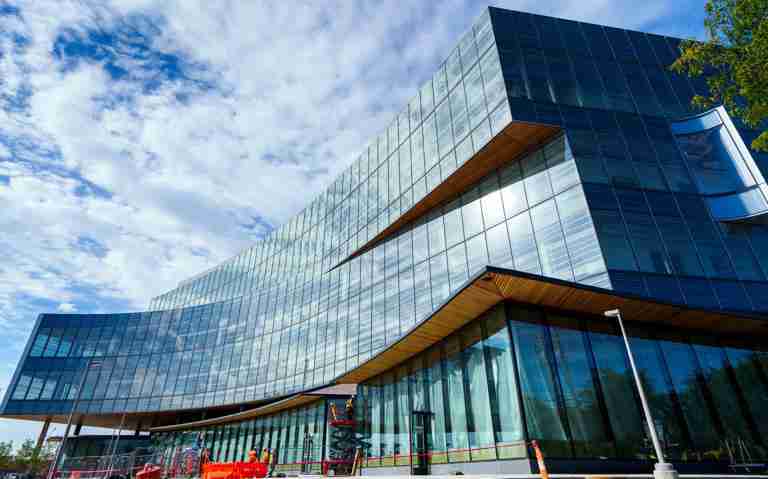
Ford to Move World Headquarters After Nearly 70 Years; Iconic Glass House to Be Demolished for New Henry Ford II World Center
Ford is relocating its global headquarters from the historic Glass House in Dearborn to the Henry Ford II World Center, opening November 2025, in a modernization move designed to boost collaboration, house 4,000 staff and densify the Dearborn campus.
- New headquarters: Henry Ford II World Center opens November 2025 and will house up to 4,000 employees; roughly 14,000 employees will work within walking distance of the broader campus.
- Legacy site: The Glass House, Ford’s HQ since 1956, will be vacated by mid‑2026 and demolished between late 2027 and mid‑2028 under a planned “sustainable decommissioning.”
- Strategy: Company leaders call the move a modernization to speed decision‑making, improve collaboration and meet 21st‑century sustainability and workspace needs.
- Open questions: Reporters and stakeholders want a full environmental review, a detailed cost accounting, and specifics about preserving Glass House artifacts and records.
Key information
Ford will relocate its global headquarters from the Glass House, which has served as the company’s headquarters since 1956, to the new Henry Ford II World Center at 20901 Oakwood Blvd. on the Dearborn campus. See the Ford press release for company materials and renderings.
Opening and scale: The new facility opens in November 2025 and will house up to 4,000 employees. Ford says the broader campus will have about 14,000 employees within walking distance; details are summarized in the Ford key facts and reported by Automotive Dive.
Glass House timeline: The Glass House will be vacated by mid‑2026 and is slated for demolition between late 2027 and mid‑2028; Ford describes the work as a “sustainable decommissioning” intended to reclaim materials and reduce environmental harm, per reporting by Automotive Dive and USA Today.
Why the move — and why now?
Ford leadership frames the relocation as a strategic update to meet 21st‑century needs. The Glass House is an emblem of mid‑20th century corporate design that, according to company statements and outside experts, no longer meets modern workspace demands or current sustainability standards.
Ford presents the Henry Ford II World Center as a purpose‑built facility for flexible work, faster decision‑making and closer ties between product development, engineering and corporate teams. See analysis in the Ford press materials and reporting by the Detroit Free Press.
On sustainability: Ford describes the demolition as a staged, sustainable decommissioning meant to limit waste and emissions and reclaim materials when possible, but a full environmental impact report has not yet been released publicly (Automotive Dive).
A short history of the Glass House
Built in 1956, the Glass House has been woven into Ford’s public story: it hosted major negotiations, public relations campaigns (including early Mustang promotions) and key boardroom decisions during crises such as 2008. For many, the building symbolizes Ford’s industrial strength and corporate identity (USA Today history).
Ford says those memories will be honored even as the company moves forward. As Chairman Bill Ford put it:
“Structures are merely structures. The true importance lies in the individuals within those buildings and the choices that were made there.”
See Bill Ford’s comments in USA Today.
Timeline and logistics
- New headquarters opens: November 2025 (Automotive Dive).
- Employee moves: Most employees expected to be moved by the end of Q2 2026 (reported by USA Today and Detroit News).
- Demolition window: Scheduled between late 2027 and mid‑2028; decommissioning and demolition estimated to take ~18 months (USA Today; Automotive Dive).
Scale and features of the new campus
The Henry Ford II World Center is roughly double the size of the Glass House and sits about one mile west of the original site, adjacent to Greenfield Village. The new location enables deeper integration with Ford’s development teams and campus facilities, with open collaboration spaces, modern amenities and infrastructure aimed at faster product cycles (Ford key facts; USA Today).
Leadership and strategy
CEO Jim Farley and Chairman Bill Ford have framed the move as central to Ford’s transformation into a more agile company. Farley says the design will speed decision‑making and make cross‑discipline collaboration easier across vehicle, software and services teams; the company markets the headquarters as an investment in competitiveness amid industry electrification (Ford press materials).
Investigative questions and what remains unclear
Ford has released many high‑level facts but left some specifics open. Reporters and local stakeholders should press for:
- Full environmental review: Detailed demolition waste estimates, reuse plans and an environmental impact report — Ford has outlined goals but not published full documentation (Automotive Dive).
- Costs and accounting: A clear financial breakdown tied to the move and demolition; public statements focus on long‑term gains but lack granular cost disclosures (Detroit News).
- Preservation plans: Specifics about preserving artifacts, records or design elements from the Glass House; statements promise legacy preservation but lack detail (USA Today).
Implications for Redding, California
Economic impact: Ford’s move signals continued investment in U.S. manufacturing and product development. Suppliers and smaller firms making components, tools and services may see new contracts or expanded demand as Ford centralizes product teams. Redding‑area firms that supply specialty parts or engineering services could pursue subcontracting opportunities with national suppliers linked to Ford’s product pipeline.
Jobs and remote work: The new headquarters concentrates jobs in Dearborn, but Ford’s investments in electrification and software could create remote or distributed roles. Redding’s labor market may benefit if Ford or its suppliers hire remote engineers, software developers, technicians or project managers; local workforce programs should align training with automotive tech needs.
Political consequences: The visible U.S.‑based headquarters move bolsters arguments for domestic manufacturing policies — tax incentives, infrastructure support and pro‑business incentives. Redding leaders and northern California representatives can use this moment to lobby for state incentives to attract supplier investments and outreach to auto clusters and trade groups.
Social and cultural effects: The shift toward electrification and software‑heavy vehicles raises retraining and STEM education needs. Redding community colleges and vocational centers can prepare residents for roles in vehicle electrification, battery tech and software testing. The move may also resonate culturally with conservative values favoring American manufacturing and local jobs.
Practical applications for residents and local leaders
- Business outreach: Chambers of commerce should contact Tier 1 and Tier 2 suppliers and logistics firms in Ford’s network to pitch Redding as a cost‑effective base for warehousing, light manufacturing or engineering support.
- Training and education: Expand programs in mechatronics, electrical systems, battery maintenance and software testing; pursue state workforce grants for accelerated, industry‑aligned training.
- Real estate and logistics: Market commercial and industrial parks to supplier distribution networks, emphasizing lower costs and access to major highways and ports.
Reporting next steps
Local policymakers and business leaders should request Ford’s environmental and demolition plans once filed, track federal and state incentives related to manufacturing and EV supply chains, and align workforce readiness with supplier needs. For Redding, the opportunity is to convert a national corporate shift into local economic momentum.



