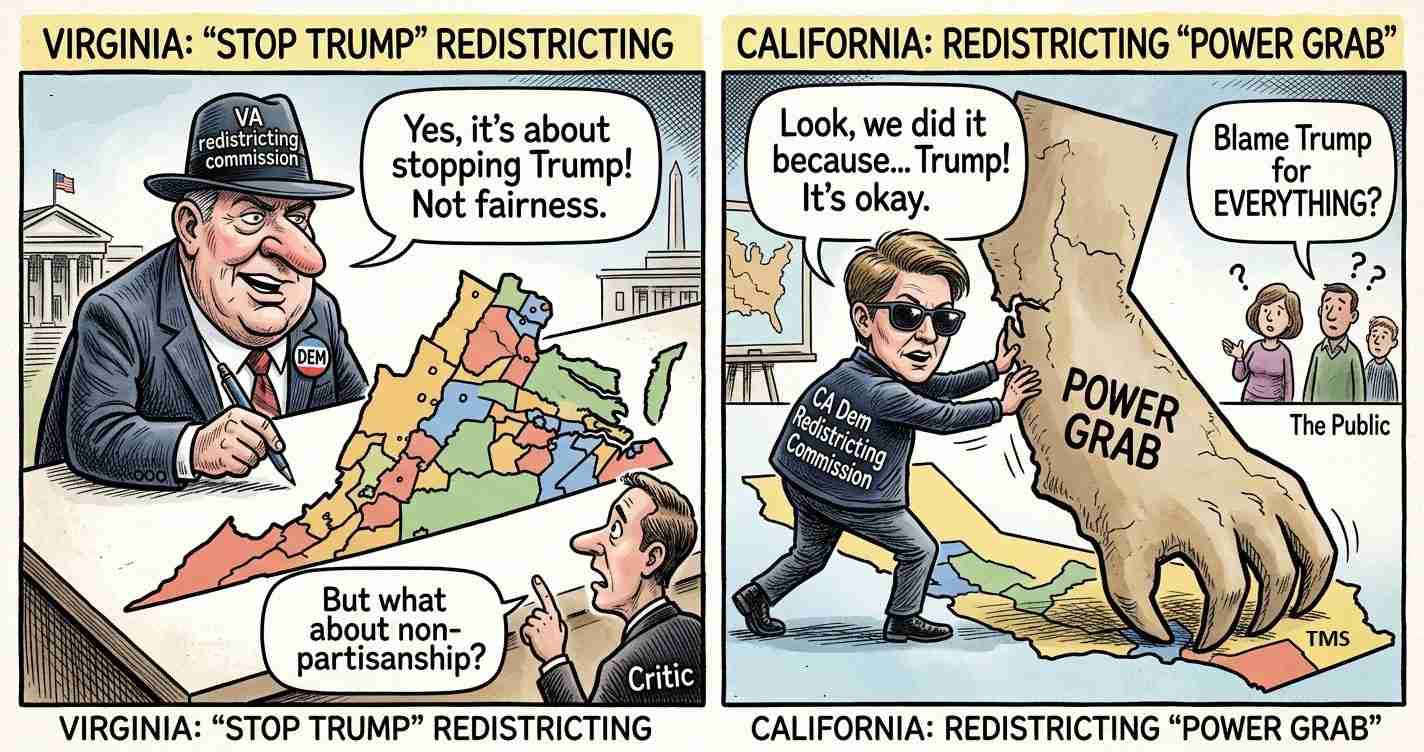
Virginia redistricting amendment sparks claims of a partisan power grab as Democrats push to redraw congressional map
Richmond, Virginia (Times Media Service) – Virginia Democrats are advancing a constitutional amendment to let the General Assembly redraw congressional districts before the 2026 midterms, a move critics call a partisan power grab ahead of the April 21, 2026 referendum.
- What’s at stake: The amendment would temporarily override the 2020 bipartisan commission so lawmakers can adopt interim congressional districts before 2026.
- Political math: Draft maps could flip up to four Republican seats and produce a map that critics say would look like a 10-1 Democratic advantage.
- Public split: A Roanoke College poll found 62% support the independent system and 52% of respondents oppose the amendment (44% support, 4% undecided).
What the amendment would do
The proposed constitutional amendment, sponsored by House Speaker Don Scott and Senate Majority Leader Scott Surovell, asks voters to allow the General Assembly to adopt temporary congressional districts “to restore fairness” prior to the 2030 census cycle. Backers say the change is temporary and intended to counter recent mid‑decade GOP redistricting elsewhere. (Sources: video 1, video 2.)
Opponents and map designs
Opponents argue the amendment would suspend the bipartisan commission that voters approved in 2020 and return mapmaking power to a Democratic legislative majority. Critics point to draft maps that stretch oddly shaped districts from Northern Virginia into Republican areas — described pejoratively as “spaghetti” or “scorpion” districts — which they say dilute conservative votes by moving population out of Fairfax and Alexandria suburbs. (Sources: video 1, video 3, video 7.)
“Manifestly unfair for the Commonwealth of Virginia,” said House Minority Leader Terry Kilgore, calling the effort a move that would silence nearly half the state’s voters.
Claims of a national motive
The debate sharpened after coverage quoting Rep. Donald Beyer as saying Democrats must make the case the plan is “totally fair for America” because retaking the U.S. House would stop former President Donald Trump. Republicans seized on that framing as evidence the effort is national in motive, not local. Multiple outlets reported GOP leaders calling Beyer’s remarks the “quiet part out loud.” (Sources: video 1, video 3b.)
Note: A direct, full transcript of Beyer’s NBC remarks was not available in the search streams used for this report, though multiple outlets repeated the coverage framing his comments in the context of national House control.
Republican reactions and rhetoric
Virginia Republicans have framed the amendment as an assault on fair representation. Senate Minority Leader Ryan McDougle and Rep. Ben Cline called the proposal a “partisan power grab,” warning that it would chop and reassign districts in a way that weakens conservative voters. GOP messaging centers on urging Virginia voters to reject the amendment as a threat to representative fairness. (Source: video 3.)
Democrats’ rationale and defense
Democratic leaders defend the amendment as a defensive measure against recent mid‑decade redistricting in GOP‑controlled states such as Texas and North Carolina. Supporters, including Gov. Abigail Spanberger, urge a yes vote, calling the patch temporary and narrowly tailored to preserve competitive and fair districts and to protect Virginia’s influence in national fights over House control. (Sources: video 1, video 5.)
Legal fights and the commission
Lawsuits are already filed by Republicans, including the RNC and NRCC, contesting the proposed maps and the process. Virginia’s bipartisan redistricting commission — created by voters in 2020 — remains contentious. If commission maps fail to secure bipartisan support, the Virginia Supreme Court could be asked to weigh in or block actions deemed outside constitutional limits. (Sources: video 5, video 9.)
Public opinion and voting status
Early voting for the April 21 referendum began March 6, 2026. A Roanoke College poll from February 2026 found 62% of Virginians back the independent system created in 2020 and 52% oppose the amendment (44% support, 4% undecided). Local grassroots signage and promotions, such as a Page County Democratic billboard urging “yes,” have drawn attention as evidence of aggressive campaigning. (Sources: video 3, video 1.)
Maps and the political math
Currently Virginia’s 11 congressional districts are split 6-5 in favor of Democrats. Draft maps under the amendment could reconfigure many districts and potentially turn up to four Republican-held seats into Democratic-leaning seats, producing a map that some analyses say would resemble a 10-1 Democratic advantage — an outcome critics call textbook partisan gerrymandering. Supporters argue the maps are corrective tools against unfair GOP maps elsewhere. (Sources: video 8, CBS News report.)
Implications for Redding, California
Though geographically distant, Virginia’s redistricting fight carries national consequences that can affect local budgets, federal funding priorities and political messaging in Redding and Shasta County.
Economic impact
Control of the U.S. House affects federal spending priorities. If the amendment alters national control, it could influence funding for wildfire response, flood control, infrastructure grants and other programs that reach Redding. Local officials and residents focused on FEMA funding, forest management grants and infrastructure dollars should monitor the outcome closely.
Political consequences
Conservative voters in Redding follow national power shifts. The Virginia referendum can be used by local GOP leaders and activists to argue against similar maneuvers in California and to rally turnout in local, state and federal contests, emphasizing the risks of partisan mapmaking.
Social effects
Rhetoric such as “partisan power grab” resonates with conservative readers in Redding, potentially heightening skepticism about political institutions and energizing local efforts to defend independent mapmaking and transparency in map‑drawing processes.
Cultural relevance
Redding communities value local representation and accountability. The idea that lawmakers could redraw maps to favor one party runs counter to local expectations of fair play, likely increasing civic engagement among residents who prioritize impartial representation.
Practical applications
For Redding residents: monitor how other states handle redistricting, support local measures that protect independent maps, and remember the April 21 referendum date as a reminder of how out‑of‑state map fights can ripple into local budgets and policy priorities.
Sources used in this report
- https://www.youtube.com/watch?v=RXC6Q4VJ6z4
- https://www.youtube.com/watch?v=zsyDVr2oW_Q
- https://www.youtube.com/watch?v=tb2WGxnNc98
- https://www.cbsnews.com/video/what-virginia-democrats-redistricting-effort-could-mean-control-house/
- https://www.youtube.com/watch?v=dAZCPHhXk5Y
- https://www.youtube.com/watch?v=ttGDc5b6J9E
- https://www.youtube.com/watch?v=EbBKFw2Gdxg
- https://www.youtube.com/watch?v=SdsyJ-FMWwM
- https://www.youtube.com/watch?v=EMv1mbjBmiw
For full coverage and video reports, see the sources above.