
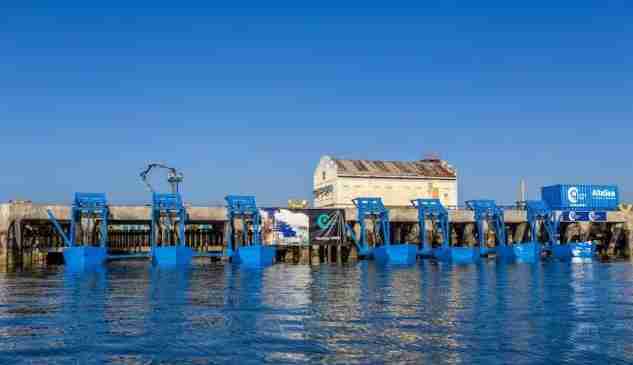
First onshore wave energy project in U.S. launches at Port of Los Angeles using Eco Wave Power technology
The United States launched its first onshore wave energy pilot at the Port of Los Angeles, using Eco Wave Power’s float-based system to convert waves to electricity. The demonstration aims to power homes and inform future scaling.
Key takeaways
- Pilot live: A shore-mounted installation at AltaSea in the Port of Los Angeles is operating and producing power (Los Angeles Times; CBS Los Angeles).
- Technology: Blue steel floats on the wharf drive hydraulics and a generator without seabed anchors — biodegradable hydraulic fluid and onshore gear lower maintenance complexity.
- Scale potential: Pilot capacity ~100 kW (~100 homes); planners estimate up to ~60 MW along the breakwater if scaled (roughly 60,000 homes).
- Environmental & policy fit: Project claims minimal seabed impact and supports Los Angeles’ goal of 100% clean energy by 2035 and California’s 2045 carbon-neutral target.
How the technology works
System design: A string of bolted floating devices is attached to an onshore wharf. Wave motion moves the floats, converting mechanical motion into hydraulic pressure that drives a motor and generator to produce electricity.
Key technical features:
- Blue steel floats ride the waves and move up-and-down.
- Hydraulic cylinders compress biodegradable fluid to power the generator.
- Heavy equipment is housed onshore, avoiding large offshore platforms and minimizing seabed disturbance (CBS Los Angeles; Los Angeles Times).
Pilot scale, performance and expansion plans
The pilot uses seven or eight blue steel floats (reports vary) and currently delivers up to 100 kW — roughly the electricity for about 100 homes. Officials and Eco Wave Power emphasize the installation is a demonstration to test reliability, durability and cost-effectiveness.
If successful, planners envision extending systems along the Port of Los Angeles breakwater — nearly 8 miles — with a long-term target of about 60 MW, roughly enough for 60,000 homes (Los Angeles Times; KFI AM 640).
Cost, maintenance and grid value — issues to watch
Potential advantages: Keeping heavy gear onshore and using floats instead of seabed anchors can lower installation and maintenance costs compared with deepwater platforms. Easier access may reduce lifecycle expenses and downtime (KFI AM 640).
Outstanding questions: Pilot data must show how the system performs in big storms, typical replacement cycles, uptime, and real-world maintenance costs. These data will be vital for conservative stakeholders assessing fiscal prudence before large investments.
Environmental claims and local health benefits
Project backers state the system attaches to existing port infrastructure and avoids seabed disruption, which they say reduces harm to marine habitats. Port officials add the project supports efforts to cut diesel pollution — a local health concern for communities such as Wilmington and Carson — by replacing some fossil generation and aiding the port’s transition.
Independent monitoring during the pilot will be important to verify environmental claims and public-health benefits (Los Angeles Times; KFI AM 640).
Wider potential and grid role
The U.S. Department of Energy and studies highlight wave energy’s large technical potential. Wave generation’s temporal patterns differ from solar and wind, so it can complement other renewables and help stabilize coastal grids during variable conditions. Eco Wave Power brings overseas operational experience from projects in Taiwan, India and Portugal to this U.S. pilot (CBS Los Angeles; Los Angeles Times).
Statements from leaders
Inna Braverman, Eco Wave Power CEO: “This installation is a milestone.” She said the technology is replicable on other coasts, does not harm the ocean, and supports local jobs.
Michael Galvin, Port of Los Angeles: “The project will help the port move toward zero emissions and reduce pollution for adjacent communities.”
These remarks were reported by Los Angeles Times, CBS Los Angeles and KFI AM 640.
Regulatory and local permitting questions
Scaling from a pilot to tens of megawatts will require extensive permitting, environmental review and coordination with agencies including the U.S. Army Corps of Engineers and state regulators. Ports are complex operational spaces with commercial, security and environmental priorities; public input and clear accounting of costs and timelines will be essential before broader rollouts (Los Angeles Times).
Implications for Redding, California
Economic impact
- Jobs: If wave energy scales, manufacturers and service firms in California — including Redding-area suppliers of steel, hydraulics and electronics — could see new contracts.
- Investment: Reliable pilots may attract private capital; onshore designs and lower maintenance claims can strengthen a conservative business case.
Political consequences
- Wave deployment could influence state and federal energy debates and coastal job strategies.
- Local officials in Northern California may watch Los Angeles’ permitting and public-private partnership models as potential templates.
Social effects & practical applications
- Grid resilience: Coastal wave power could reduce reliance on inland fossil plants, helping during peak demand and wildfire-related grid stress.
- Supply chain & workforce: Redding firms could pursue component or service contracts; community colleges could develop technical training in hydraulics, marine mechanics and renewable systems.
Conservative readers: clarity on long-term costs, subsidies and who bears scaling risks will be central to evaluating consumer impacts and fiscal prudence.
Sources
Reporting note: This article preserves original facts and sources. Reporting continues as pilot performance data and permitting processes evolve.



