
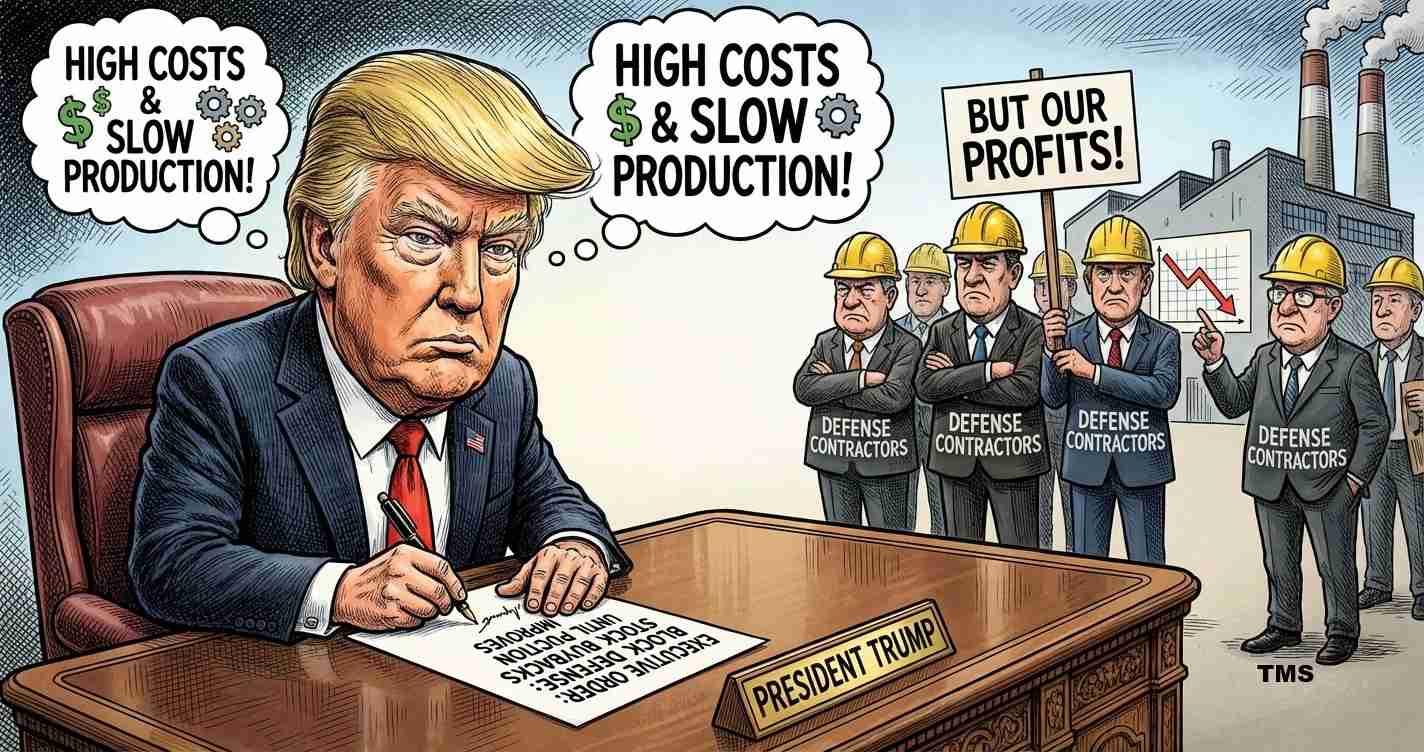
Trump Signs Defense Executive Order to Block Buybacks, Forcing Firms to Prioritize Production Over Payouts
President Donald Trump signed a Defense executive order barring underperforming U.S. defense contractors from paying dividends or buying back stock until they improve production, delivery and invest in manufacturing—tying remediation, executive pay and contracts to performance measures.
- Immediate restrictions: The order bars dividends and stock buybacks for Pentagon-designated “underperforming” defense contractors — until remediation is achieved (White House fact sheet).
- Pentagon deadlines: The Defense Secretary must ID underperformers in 30 days and add contract language blocking buybacks within 60 days (Breaking Defense; Fox Business).
- Pay and incentives retooled: Executive compensation and future contract awards will be tied to metrics such as on-time delivery, increased production and capital investment in U.S. capacity (Defense One; Politico).
- Market and local impact: Shares of major primes fell on the news; localities such as Redding, California could see both job opportunities and investor effects depending on implementation (Politico).
What the order says and how it will work
The executive order targets contractors the Pentagon judges are not dedicating sufficient time, money or attention to producing weapons, spare parts and maintenance. The text emphasizes using contracting leverage rather than sweeping changes to corporate law to change incentives (Breaking Defense; White House fact sheet).
“are not permitted in any way, shape, or form to pay dividends or buy back stock, until such time as they are able to produce a superior product, on time and on budget.”
The order directs the Pentagon to identify firms that:
- Are underperforming on production or delivery;
- Are not investing enough capital in capacity; or
- Are conducting stock buybacks or large shareholder distributions while failing to meet contract goals.
Those companies will be notified and asked to submit remediation plans on short timelines. Within 60 days, the Pentagon must add contract provisions barring buybacks and distributions during periods of underperformance (Fox Business; Breaking Defense).
Executive pay and incentives
The administration makes clear it wants to curb compensation that rewards short-term financial engineering over production. Public comments by the president included suggested ceilings — for example, a social-media post calling for “no Executive should be allowed to make in excess of $5 Million Dollars” — though the executive order gives the government flexible authority to cap or condition pay and incentives (Politico; Defense One).
The order redirects bonuses away from metrics like EPS and toward on-time delivery, production increases and plant modernization.
Why the White House says this is needed
Administration officials argue that years of prioritizing shareholder payouts have weakened the defense industrial base. They contend contractors spent billions on dividends and buybacks instead of upgrading plants, buying equipment and maintaining spares that keep weapons ready. The White House frames the policy as “prioritizing the warfighter in defense contracting” and reorienting incentives toward supply and readiness; the administration is also pushing for a larger Pentagon budget to pair with these contractor changes (White House fact sheet; Defense One).
How industry and markets reacted
Markets moved quickly: shares of major defense firms fell during afternoon trading in New York — Lockheed Martin down ~4.8%, Northrop Grumman ~5.5%, General Dynamics ~3.6% — as investors weighed tighter restrictions on buybacks and dividends. Several large primes returned heavy sums to shareholders in recent years; Politico noted that Lockheed, RTX (Raytheon), General Dynamics and Northrop together returned roughly $89 billion to shareholders from 2021–2024 (Politico).
The order appears to single out RTX/Raytheon in particular; the president said the Department of War had identified Raytheon as “the least responsive,” warning that RTX should stop buybacks if it seeks future U.S. government business (Breaking Defense).
Experts raise legal and practical questions
Legal and defense analysts note the government’s real lever is contract conditioning rather than direct control of corporate boardroom decisions. Law professors and attorneys say the government can set contract terms but can’t easily micromanage all corporate choices. Critics also note that forbidding buybacks alone may not spur factory construction or hiring without longer-term contract assurances that justify capital investment. Observers expect legal challenges, lobbying and negotiation as firms respond (Politico; Defense One).
What the order could mean for foreign sales and U.S. advocacy
The fact sheet warns the U.S. may “cease ongoing advocacy” for underperforming firms in foreign military sales, a diplomatic and commercial lever that could pressure primes that rely on U.S. backing to sell large platforms abroad (Breaking Defense; Defense One).
Implementation timetable and open questions
The order is in force and triggers Pentagon deadlines. Key open questions include how the Pentagon will define “underperformance,” how broadly it will use these new contract terms, whether contractors will sue or seek negotiation, and how the policy will interact with existing multi-year production efforts for interceptors and munitions (Breaking Defense; Politico).
Implications for Redding, California
Jobs and local suppliers: Northern California suppliers and small manufacturers serving defense primes could see opportunities if primes are pushed to rebuild U.S. capacity. Local shops that make parts or provide maintenance may compete for more subcontracts, potentially creating more jobs in Redding and Shasta County (White House fact sheet).
Local investors and retirement accounts: Many Redding residents hold retirement accounts with defense-stock exposure. Short-term volatility is possible as markets digest limits on buybacks and dividends (Politico).
Veterans, military families and readiness: The administration presents the order as improving readiness and delivery for U.S. forces; Redding’s veterans and military families may view faster deliveries and stronger stockpiles as support for troops (White House fact sheet).
Local government and training: If primes expand domestic production, community colleges, trade schools and workforce programs in the Redding region could see opportunities to train residents for manufacturing and maintenance roles tied to Pentagon contracts.
Political and economic lens for conservatives: For local conservative readers, the order links strong defense priorities with fiscal accountability — the question is whether it spurs production and readiness without harmful market disruption or unintended costs to local savers (Defense One).
Key sources
Reporting for this story was compiled from the executive order and public coverage, including the White House fact sheet and reporting from Breaking Defense, Fox Business, Defense One and Politico.



