
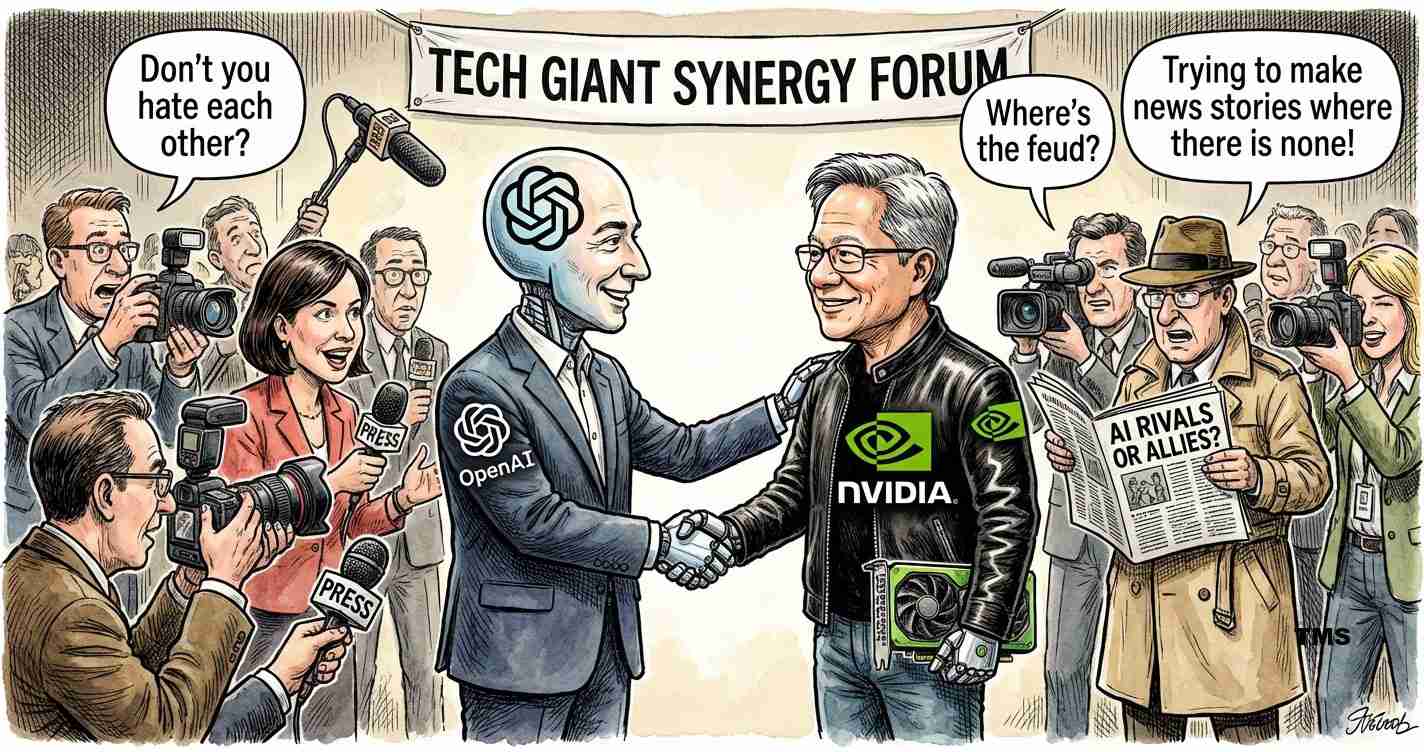
Nvidia CEO Denies $100B OpenAI Deal Has Stalled, Says Company Will Make a “Huge” Investment
Nvidia CEO Jensen Huang rejected reports the company’s $100 billion OpenAI investment had stalled, calling them “nonsense” and saying Nvidia will “definitely participate” and make a “huge” investment, Huang told reporters in Taipei on Jan. 31, 2026.
Key takeaways
- Nvidia will “definitely participate” in OpenAI’s current funding round and plans a “huge” investment, Jensen Huang said in Taipei. (Source: TechCrunch)
- The $100 billion figure stemmed from a non-binding September 2025 letter of intent tying investment to deploying 10 gigawatts of Nvidia systems. (See the Nvidia press release.)
- Reports suggested internal doubts at Nvidia had slowed the plan; Huang called such reporting “nonsense” while declining to confirm a dollar figure. (Summaries: TechCrunch; MLQ.)
- OpenAI and Nvidia say they are still working through terms and have not publicly confirmed final deal numbers. (See TechCrunch.)
Jensen Huang statement, Taipei — what he said and why it matters
In Taipei, Huang pushed back hard against reporting that his company had grown unhappy with OpenAI or had stalled on investment plans. He called claims that Nvidia was unhappy “nonsense” and said Nvidia would “definitely participate” in the OpenAI funding round. Huang described OpenAI as “one of the most consequential companies” and praised its work as “incredible,” while declining to pin down a dollar figure. (Reporting compiled by TechCrunch and industry feeds such as BloomingBit.)
Why it matters
Huang’s remarks are significant because Nvidia is a top maker of AI chips and systems. If Nvidia invests heavily, it would ensure a steady pipeline of high-end chips for OpenAI’s massive models and data centers — access that matters in an arms race for compute power between major AI players. (See the original Nvidia press release.)
Background: the September 2025 letter of intent
Last September, Nvidia and OpenAI announced a strategic partnership and a non-binding letter of intent. The plan described progressive investment tied to deploying at least 10 gigawatts of Nvidia systems into OpenAI’s infrastructure, beginning phases of deployment in late 2026 on Nvidia’s Vera Rubin platform. That announcement did not finalize a single lump-sum payment and included standard forward-looking disclaimers about market and competitive risks. (See the Nvidia press release.)
Why the $100 billion figure drew attention
Industry reports suggested OpenAI aims to raise roughly $100 billion overall, drawing interest from cloud giants and big investors, including Nvidia, Microsoft, Amazon and SoftBank. A $100 billion fund would pay for computing hardware, power, specialized data centers, and engineering to scale next-generation AI models. At the same time, the scale raised questions about how much would be equity versus equipment/services and how investors would manage risk. (Reporting and summaries: TechCrunch.)
Conflicting reports and internal concerns
On Jan. 30, a Wall Street Journal report said some people inside Nvidia had expressed doubts about the $100 billion plan and suggested the deal had stalled. The report quoted people saying Huang had privately called the $100B figure non-binding and criticized OpenAI’s “lack of discipline.” Those accounts said talks were shifting toward a smaller equity investment in the tens of billions. Tech outlets summarized that reporting and noted Nvidia executives had raised competitive worries about Google and Anthropic. (Summaries: TechCrunch; MLQ.)
Nvidia and OpenAI responses
Both companies emphasized they are still working out details. OpenAI noted that Nvidia has “underpinned our breakthroughs” and will remain an important partner as deal terms are clarified. Huang stressed Nvidia’s interest without committing to the $100 billion number. That mix of public support and private caution is typical in big tech deals, where letters of intent give way to detailed contracts and financial modeling. (Reporting: TechCrunch.)
Investment context: competition and compute
The dispute over numbers reflects a larger rivalry over compute and market share. OpenAI’s models need massive amounts of GPUs, high-speed networking, and racks of systems that demand steady power and data center capacity. Nvidia’s offer to pair investment with hardware deployments — the 10-gigawatt target — ties financing to purchases of Nvidia technology. That approach reduces supply risk for OpenAI but also creates commercial ties and concentration of supplier power. Competitors like Google and Anthropic are building alternative stacks, and cloud providers such as Microsoft and Amazon remain key backers and customers. (See the Nvidia press release.)
Why this matters to conservative readers
For conservative audiences, the story raises questions about corporate discipline, market concentration, and strategic risk. Large, non-binding funding figures can fuel hype and uncertainty. Huang’s private remarks about discipline and public denial of unhappiness show a balance: companies hedging risk while preserving partnerships that give them market advantage. The interplay of private deal-making and public messaging is central to how major tech strategy is formed. (Analysis based on reporting in TechCrunch.)
Implications for Redding, California
Economic impact
If Nvidia and OpenAI proceed with large investments tied to new servers and data centers, regions that host data centers and cloud nodes could see construction jobs, equipment sales, and energy demand increases. While Redding is not a major data center hub today, Northern California benefits when tech spending flows into state infrastructure, suppliers, and the local supply chain. Local companies that provide power services, maintenance, or equipment logistics could find new business. (See the Nvidia press release.)
Political consequences
Large private investments in AI prompt questions for local and state leaders about permitting, grid readiness, and tax incentives. Conservative officials in Shasta County and Redding often stress fiscal prudence and careful review of tax deals. Officials may press for clear commitments on jobs and local benefits before approving zoning or tax breaks for related projects. Discussions about energy use and grid impact could become part of local political debates. (Reporting: TechCrunch.)
Social effects
Rapid expansion in AI infrastructure can change job demands. Some local tech and trades workers could see new opportunities in construction, electrical work, and data center operations. At the same time, worry about automation and job displacement remains. Conservative readers often favor job training, apprenticeships, and local hiring rules to make sure community members benefit from outside investment. (See Nvidia press release.)
Cultural relevance and practical applications
Redding values independence, careful stewardship of local resources, and public safety. Large AI projects bring debates about data security, surveillance, and state control. Local leaders may ask how major investments will affect privacy, emergency services, and civic control of critical infrastructure. For homeowners and businesses, immediate effects would likely be indirect: energy costs, local job listings, and contractor demand could shift. Community colleges and vocational programs may see interest in training for data center skills. County planners would need to monitor power grid capacity and environmental permitting if major facilities were proposed nearby. (Source: Nvidia press release.)
Reporting note and sources
This article is based on reporting and public statements from Nvidia and industry outlets. Key sources include TechCrunch’s coverage of Huang’s Taipei remarks and the earlier Wall Street Journal reporting summarized by TechCrunch, an MLQ summary of internal Nvidia concerns, the original Nvidia press release on the September 2025 partnership, and reporting compiled by industry feeds such as BloomingBit. OpenAI and Nvidia statements referenced in reporting say both companies are “actively working through details.” (See TechCrunch.)
What could come next
Further developments could clarify whether Nvidia’s eventual investment is close to the previously cited $100 billion figure or a smaller but still substantial commitment. For now, Huang’s public denials and promise to “definitely participate” keep Nvidia at the center of the OpenAI funding story as the tech industry watches how compute, capital, and competition reshape the next phase of AI.



