
NATO Shoots Down Russian Drones After Poland Airspace Violation; Article 4 Invoked in Historic Response
On September 9, 2025, NATO fighter jets — including Dutch F-35s and Polish F-16s — shot down multiple Russian drones after they crossed into eastern Poland, killing one civilian, wounding five, and prompting Poland to invoke NATO Article 4.
- First direct engagement: NATO jets engaged and destroyed multiple drones over allied territory — a historic first for the alliance.
- Human cost: The incident left one civilian dead, at least five wounded and caused property damage in eastern Poland.
- Political escalation: Poland invoked NATO Article 4, triggering emergency consultations in Brussels.
- Disputed intent: Moscow and Minsk deny deliberate intent, citing navigation or electronic-warfare issues; Western officials call it a provocation.
What happened
In the early hours of September 9, 2025, more than a dozen unmanned aerial vehicles crossed from Belarusian airspace into eastern Poland near the Ukrainian border. Polish air controllers detected multiple small drones on coordinated routes toward villages and towns. NATO air-policing assets were scrambled and, according to military and diplomatic reports, Dutch F-35s and Polish F-16s engaged and destroyed a number of the drones after they violated Polish airspace.
(Sources: Stars and Stripes; Los Angeles Times)
NATO response and rules of engagement
Allied jets and air defenses acted under national and NATO rules of engagement to protect sovereign airspace. Dutch F-35 units assigned to NATO air policing and Polish F-16 squadrons were credited with the shoot-downs. German Patriot surface-to-air missile teams and Italian surveillance aircraft assisted with tracking and interceptor coordination, underscoring NATO’s layered air-defense approach.
Officials described the action as defensive and proportionate, a measured response to an airspace breach affecting civilians and sovereign territory.
(Analysis: Council on Foreign Relations; Stars and Stripes)
Casualties, local damage and eyewitness accounts
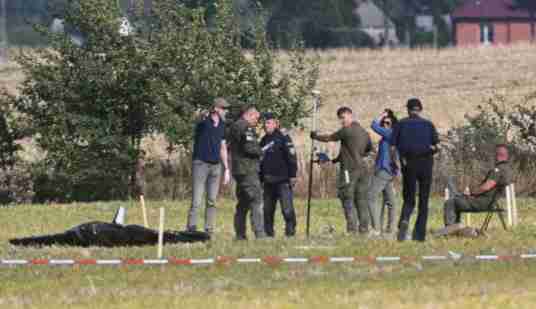
Local authorities reported one civilian killed and at least five others wounded due to drone strikes and falling debris. Homes and small businesses in affected areas suffered damage. Video from regional sources and on-the-ground reporters shows emergency crews and residents assessing damage and assisting the injured. Polish emergency services mobilized quickly to treat the wounded and secure crash sites for forensic and safety work.
(Reporting: Los Angeles Times; video footage: video 2)
Political fallout: NATO Article 4 invoked
Poland formally invoked NATO Article 4, requesting consultations among alliance members when a member’s security is threatened. The move prompted emergency talks in Brussels and public statements from Western leaders calling the incident a “game changer.” NATO and Polish officials described the breach as the largest violation of alliance airspace since the intensification of the Russia‑Ukraine war in 2022.
Allied capitals discussed options ranging from tighter air defenses and increased patrols to new diplomatic and economic measures against Moscow.
(Sources: Stars and Stripes; Council on Foreign Relations)
What Russia and Belarus say
The Russian Defense Ministry denied the drones were intended to strike Polish targets, claiming some unmanned systems “lost their course” after encountering electronic jamming. Belarusian officials echoed that claim and said there was no intent to provoke NATO territory. Western officials rejected those technical explanations as implausible, citing the drones’ number, timing and flight patterns.
(Sources: Los Angeles Times; Council on Foreign Relations)
Escalation risks and alliance deterrence
Defense analysts warn the breach raises the risk of the Ukraine war spilling over into NATO territory. The shoot-downs mark the first time NATO aircraft have fired on aerial targets in defense of a member’s airspace against assets tied to Russia — a step that both signals deterrence and increases responsibility for allied commanders.
Proposals under discussion include more forward-deployed air policing, additional Patriot and other air-defense batteries in vulnerable sectors, and stepped-up intelligence sharing to better deter future incidents.
(Analysis: Council on Foreign Relations; Stars and Stripes)
Legal and diplomatic considerations
The use of force inside a NATO ally’s territory activates legal and diplomatic processes. By invoking Article 4, Poland opened formal consultations without immediately requesting collective military action under Article 5. NATO leaders emphasized that Article 4 consultations aim to build a unified political and military response; Article 5 would be a separate determination about collective defense.
Allies framed the September 9 response as necessary to defend civilians and sovereignty while preserving options for diplomatic pressure and sanctions.
Historic first and NATO credibility
Military and diplomatic sources called the operation a historic first: NATO jets shot down potential Russian assets over an alliance member. Officials said the action demonstrates NATO will use direct military means to protect its territory, but analysts cautioned it carries escalation risks if Moscow interprets the engagement as part of a larger attack.
Questions that remain
Investigators continue to work to identify the drones’ origin, control links and flight plans. Forensics at crash sites and radar data will be crucial to establish whether systems were launched from Russian territory or operated from Belarus. Full attribution and a public report are expected to take weeks.
(Sources: Council on Foreign Relations; Los Angeles Times)
Implications for Redding, California
Local security and defense outlook: Residents of Redding and Shasta County should view the incident as a sign of elevated global risk that could shape U.S. defense policy and funding priorities, including programs for air and missile defense.
Political and civic effects: Conservative voters prioritizing national security may back firm responses; local town halls and civic discussions could focus on U.S. commitments to allies and deterrence.
Economic and personnel impact: Increased U.S. support or deployments to Europe could affect military families and units from California, creating potential needs for veteran and family support services locally.
Energy and supply-chain concerns: Escalation risks could push energy prices higher, affecting living costs and operations in the region.
Civic preparedness: The incident is a reminder for local officials to review emergency response, medical readiness and communication systems.
Cultural and values frame: For many in Redding, the event reinforces support for strong defense, ally commitments, and accountability for adversaries.
(Sources for global incident: Stars and Stripes; Los Angeles Times; Council on Foreign Relations)
Reporting notes and sources
This article draws on reporting and analysis from multiple outlets and regional video footage. Key sources and reporting: Stars and Stripes; Los Angeles Times; Council on Foreign Relations; video footage: video 1 and video 2.
Reporting by Times Media Service


