
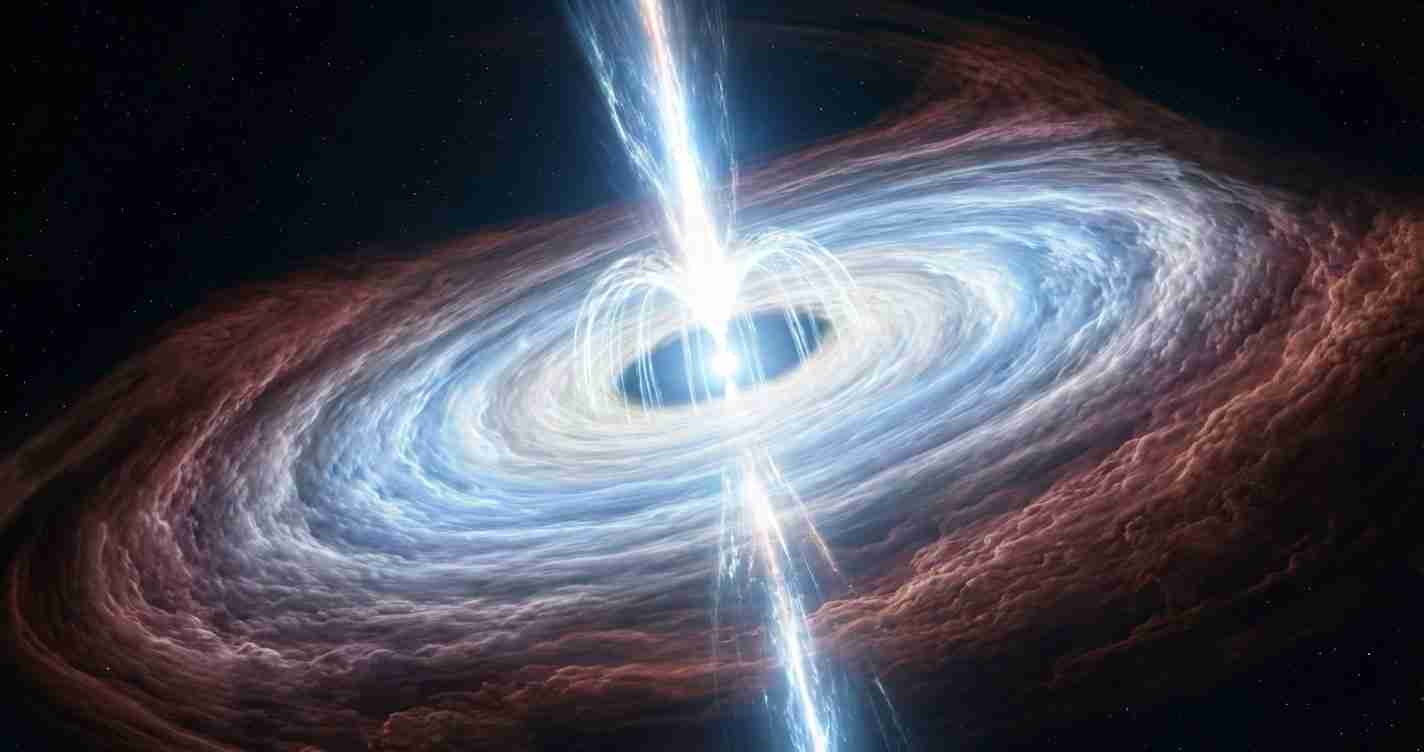
Astronomers confirm magnetar birth in distant blast, solving mystery of superluminous supernovae and revealing a new “general relativity chirp”
Astronomers observed the birth of a magnetar inside supernova SN 2024afav, confirming decade-old magnetar models for superluminous supernovae and detecting a relativistic ‘chirp’ in the light curve that directly ties general relativity to the explosion.
- First direct confirmation: A newborn magnetar is observed powering the superluminous supernova SN 2024afav.
- Extreme properties: The compact object spins every 4.2 milliseconds with a magnetic field ~300 trillion times Earth’s.
- Relativistic signature: A distinctive light-curve “chirp” provides observable evidence of general relativity shaping the energy release.
- Broader impact: Confirms the Dan Kasen magnetar model (2010) for SLSNe-I and helps connect magnetars to fast radio bursts and stellar-evolution outcomes.
How researchers caught a rare birth
SN 2024afav exploded in December 2024 and was flagged by survey telescopes for its extraordinary brightness and prolonged glow. Teams followed the event with dense photometric monitoring and spectroscopy, noticing irregular bumps as the supernova faded that standard models could not explain.
Those bumps—interpreted as a subtle rising-and-falling “chirp” in the light curve—match predictions for an infant magnetar depositing energy into expanding debris. Researchers combined ground-based light measurements with detailed theoretical modeling to reproduce the pattern and timing of the observed features.
Magnetar properties
Modeling indicates a central compact object with an initial spin period of roughly 4.2 milliseconds and a magnetic field strength on the order of 3×10^14 gauss—about 300 trillion times Earth’s field. Those parameters allow sustained energy injection into the ejecta for months, prolonging and enhancing the supernova’s brightness.
Why this settles a long-standing debate
Since the early 2000s astronomers have debated the engine behind superluminous supernovae (SLSNe-I). A leading idea—proposed in 2010 by Dan Kasen (and colleagues such as Lars Bildsten and Stan Woosley)—posited a rapidly spinning, highly magnetized neutron star, or magnetar, as the power source.
The SN 2024afav observations provide the first direct evidence that a newborn magnetar can indeed power an SLSN, lending strong empirical support to that theoretical framework (Kasen 2010 model discussed in UC Berkeley writeup).
The magnetar mechanism and the “general relativity chirp”
When a massive star collapses, its core can compress into a city-sized neutron star with the Sun’s mass. If the core retains rapid spin and strong magnetism, a magnetar forms. The spinning magnetic field accelerates particles and channels energy into the expanding debris, heating it and sustaining luminosity far beyond normal supernova timescales.
Researchers identified a subtle, rising-and-falling ripple in the light curve—labeled a “chirp”—that arises from relativistic effects on how magnetar energy is released and transmitted. In short, general relativity alters the timing and distribution of energy arriving at the ejecta, producing the telltale ripple predicted by theory; UC Berkeley co-author Alex Filippenko called seeing this result “especially rewarding.”
Who led the work
The lead analyst was Joseph Farah (UC Santa Barbara/Las Cumbres Observatory; soon a UC Berkeley Miller Fellow), who described the finding as “the most exciting thing I have ever had the privilege to be a part of… the universe telling us… we don’t fully understand it yet.” Other contributors include Dan Kasen (UC Berkeley), Lars Bildsten, D. Andrew Howell (LCO/UCSB), Logan Prust (Flatiron Institute), and Yuan Qi Ni (UCSB).
The full study appears in Nature (March 11, 2026) and is summarized in University of California materials (UC Berkeley Laboratory for Space Sciences news release; Berkeley Today coverage).
Why the finding matters beyond astronomy
This result refines models of stellar death and compact-object formation, which feed into many areas of astrophysics and cosmochemistry—from element production to rates of neutron-star and black-hole formation. Magnetars are also candidate sources for fast radio bursts, so pinpointing their births helps link multiple cosmic mysteries.
Implications for Redding, California
Although the explosion occurred roughly a billion light-years away, the discovery offers concrete local opportunities:
- Economic impact: Grants, public talks, and STEM programming tied to the discovery can draw visitors, fund events, and support small businesses in downtown and Riverfront areas.
- Political consequences: Local leaders can frame investments in science education and workforce development as nonpartisan, pro-jobs initiatives that require modest, targeted funding.
- Social and cultural effects: Schools, libraries, and museums can use the magnetar story for curricula, star parties, and outreach that align with regional values of practical skills and workforce readiness.
- Practical actions: Redding residents can tap free or low-cost online talks and lesson plans from institutions such as UC Berkeley, host viewing parties, and recruit interns for local tech and engineering firms.
- Regional connections: At roughly 200 miles from UC Berkeley, Redding institutions could coordinate visiting scholars, virtual lectures, or classroom partnerships to bring cutting-edge science to the North State (UC Berkeley coverage and researcher contacts).
Plans ahead
Researchers will use the chirp signature as a template to search archival and future supernova light curves for other magnetar births. Building a larger sample will reveal how common magnetar-powered SLSNe are, clarify formation channels, and test links to fast radio bursts. The signature will also inform telescope scheduling and survey design to optimize follow-up observations.



