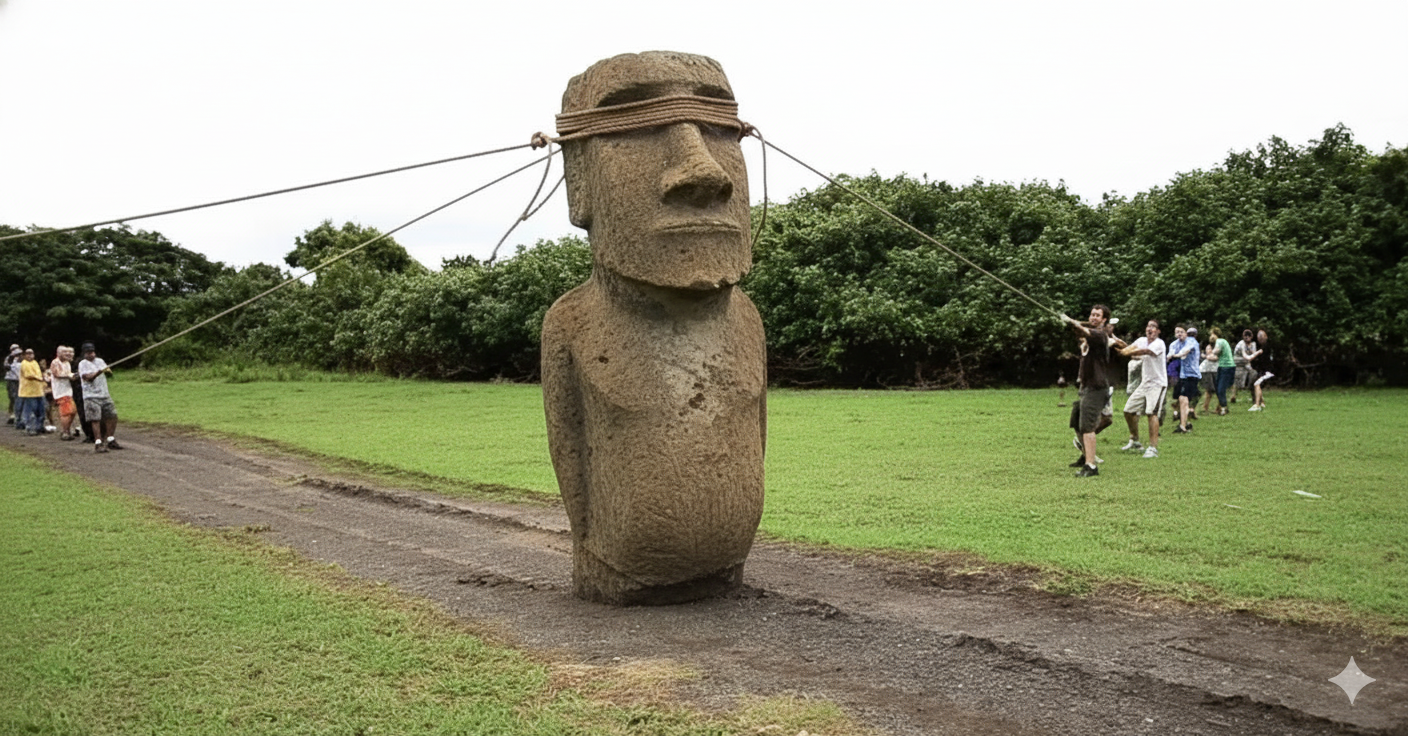
Scientists say Easter Island Moai walked — study backs Rapa Nui oral history and solves ancient engineering mystery
Scientists report that Easter Island’s colossal Moai were deliberately engineered to “walk” upright from quarries, confirming Rapa Nui oral histories and revealing sophisticated pendulum-based transport techniques that resolve a long-standing archaeological engineering mystery and practical ingenuity.
- Design and physics: Nearly 1,000 moai show a repeated D-shaped base and forward-shifted center of mass consistent with controlled upright “walking.”
- Field demonstration: A 4.35-ton 3D replica was moved ~328 feet in 40 minutes by 18 people, validating efficiency of the method.
- Oral history confirmed: Rapa Nui traditions that the statues “walked” are supported by physics, modeling and experiments.
- Historical implications: The technique reduces the need for massive deforestation or huge labor forces, reframing narratives of collapse.
Key research and methods
Researchers Carl P. Lipo and Terry L. Hunt led a study published in the Journal of Archaeological Science, using 3D modeling and statistical mapping to test whether moai were built to be moved upright.
What the study found
The team examined the shape, balance and distribution of nearly 962 statues. They identified a repeated design pattern — a D-shaped base and a center of mass shifted slightly forward — that makes an upright statue both stable and amenable to a controlled rocking or pendulum step.
Physics models show that once a rocking motion is established, momentum carries each step. Teams alternated tugs on ropes attached to opposite sides so the statue could be “stepped” forward in measured increments, rather than dragged horizontally.
Reports and analysis of this model appear in explanatory coverage by Popular Mechanics and Live Science, which outline the pendulum dynamics and labor estimates (as few as 15–18 people for average statues).
How they tested it
To validate the physics, the team built a faithful 3D replica weighing roughly 4.35 metric tons. In a controlled trial, 18 people used ropes and coordinated pulls to “walk” the replica about 328 feet in 40 minutes. The field experiment demonstrated a transport rate far faster and less resource-intensive than dragging or roller models (field experiments).
Physicists described the motion as pendulum dynamics. Depending on statue size, researchers estimate between 5 and 60 people could move a moai; typical practical tests suggest 15–18 are sufficient for average examples. Under ideal conditions, larger moai could approach speeds estimated at up to 1,000 feet per hour (Live Science; ScienceDaily).
Archaeological backing and Rapa Nui oral history
Field observations on Rapa Nui show many moai left along transport routes still standing upright rather than toppled or laid on their sides — physical evidence consistent with upright transport. Statistical mapping across the island supports a widespread design logic rather than isolated anomalies (Fox News; Lipo & Hunt paper).
Crucially, long-standing Rapa Nui oral traditions that the statues “walked” are corroborated by the mechanical explanation: elders’ accounts describe the statues moving upright, step by step, which matches the pendulum-step method demonstrated experimentally (Local12; Popular Mechanics).
“The physics and field trials show the oral histories were describing an actual transport technique — the statues were walked in the real, mechanical sense.”
Reassessing the story of decline
For decades, dominant narratives suggested moai construction required large-scale deforestation and contributed to ecological collapse. The walking model reduces the need for rollers, sleds or hundreds of workers, suggesting statue transport could have been accomplished with minimal wood and relatively small, well-coordinated teams. This invites a more nuanced history of the island—one of engineering skill and planning rather than simple resource overuse (Popular Mechanics; Live Science).
Responses from the scientific community
Outside experts have described the work as an “ingenious and worthwhile contribution” that explains moai distribution across the island and provides a robust alternative to previous hauling models. The combination of mapping, physical modeling and field demonstration has given the walking model substantial credibility (Live Science).
Why this matters to readers in Redding
- Human ingenuity: The study highlights how small, well-organized teams using clever design can solve large problems — a theme that resonates with local values of resourcefulness and practical problem-solving.
- Respect for local knowledge: The validation of Rapa Nui oral history reinforces the idea that traditional stories often contain testable, practical knowledge rather than mere folklore.
- Rethinking environmental narratives: The findings encourage nuanced local discussions about sustainability and human agency rather than deterministic collapse narratives.
Implications for Redding, California
Economic: The moai story can inspire museum exhibits, lectures and tourism programming. Local cultural institutions could partner with universities for traveling displays and talks.
Political & social: For audiences valuing local initiative, the research supports themes of community self-reliance and efficient use of labor. It also underscores the importance of respecting indigenous voices—an idea local educators and leaders can emphasize.
Practical applications: The teamwork, planning and simple physics behind the walking method provide a model for local projects—emergency response drills, volunteer builds and rural infrastructure work can benefit from similar coordination and design thinking.