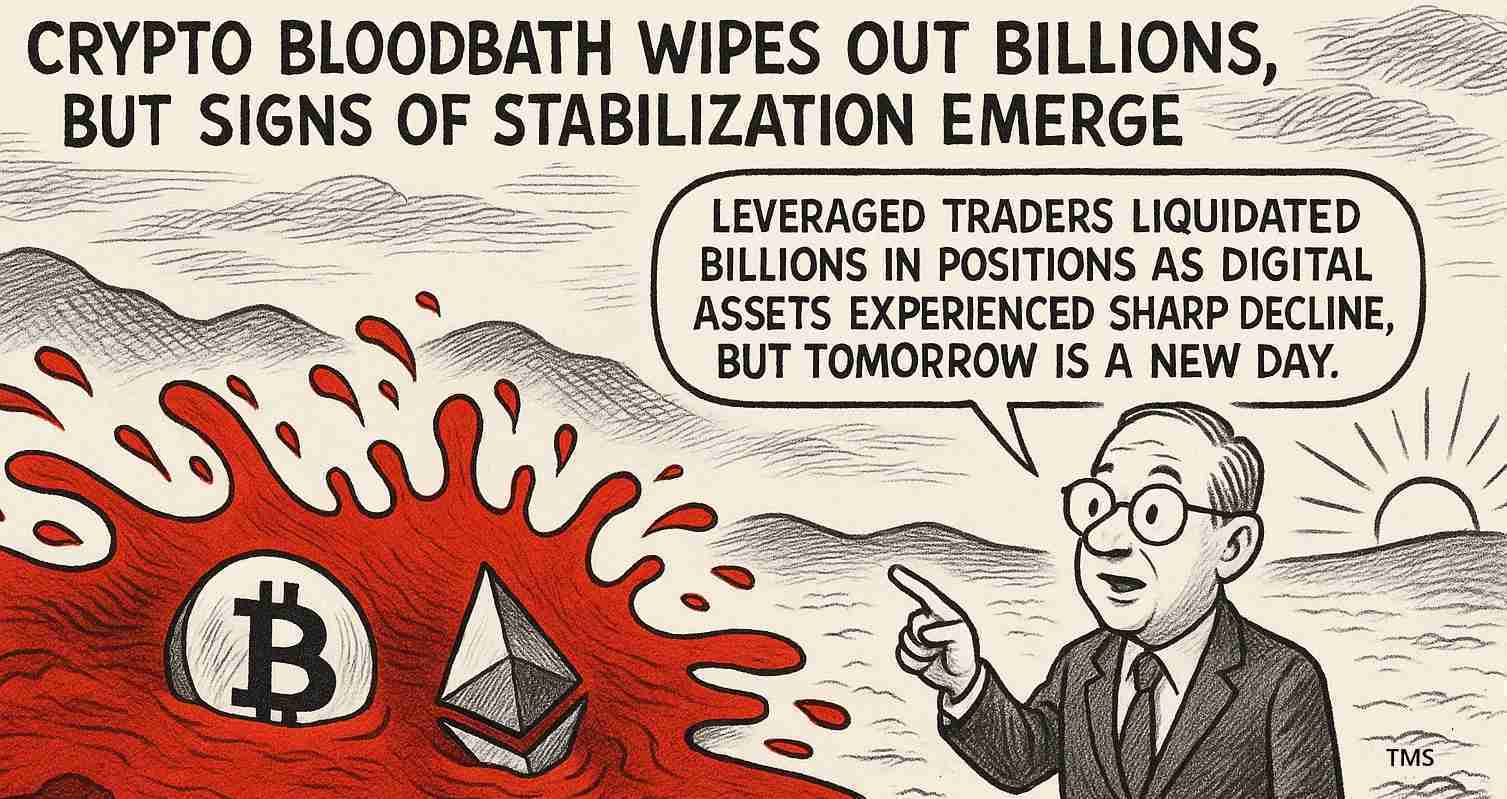
Crypto Bloodbath Wipes Out Billions as Leverage Cascade and Tariff Fears Trigger Sharp Drop — Signs of Bitcoin, Ethereum Recovery and a Possible Altcoin Season 2025
The cryptocurrency market suffered a severe bloodbath beginning Oct. 10, 2025, erasing about $560 billion amid a leverage cascade and tariff fears; despite massive liquidations, early signs point to stabilization and potential recovery into Q4 and altcoin season 2025.
- Roughly $560 billion of market value was erased since Oct. 6, 2025, with about $18.7–$19 billion in leveraged positions liquidated.
- Altcoins plunged ~33% (ex-Bitcoin, Ether, stablecoins) before partial recoveries began.
- Tariff talk from the U.S. administration amplified macro risk and likely accelerated the cascade.
- Analysts forecast optimistic rebounds for Bitcoin ($150k–$180k) and Ethereum ($8k–$12k) by end of Q4 if buying returns and leverage subsides.
What happened: a leverage cascade and policy news met a fragile market
Oct. 10, 2025 saw sharp declines across cryptocurrencies as a classic leverage cascade unfolded: highly borrowed positions were forcibly liquidated, producing rapid sell pressure that pushed prices down further. Market observers described the move as a “bloodbath.” Sources documenting the event include Coindesk.
Tariff news as an amplifier
Simultaneously, President Donald Trump’s announcement of potential new tariffs on Chinese imports increased fears of broader economic disruption. That policy shock hit a market already vulnerable after rapid gains, and many traders say tariff headlines helped tip a correction into a larger crash. See coverage from DL News and Coindesk.
Why leverage matters
Leverage magnifies both gains and losses. When many traders hold large borrowed positions, even modest adverse moves can trigger automatic liquidations. Those forced sales create a feedback loop across exchanges and tokens, turning thin liquidity into a market-wide slide. Analysts warn this remains a structural risk for the crypto ecosystem (Coindesk).
How bad were the losses?
Scope of impact: Market-cap data show about $560 billion evaporated across the crypto universe in days from Oct. 6 onward. Exchange liquidation trackers recorded roughly $18.7–$19 billion in leveraged positions closed out during the sharp moves. Altcoins (excluding Bitcoin, Ether and stablecoins) fell about 33% at the low point before partial recoveries kicked in. (Sources: Coindesk; DL News.)
Bitcoin and Ethereum: damage, resilience and recovery paths
Bitcoin generally held up better than smaller tokens, regaining some relative dominance as altcoins sold off. Analysts note Bitcoin’s longer-term uptrend remains intact for now, serving as a relative safe harbor during corrections. Some market models and commentators see a rebound potential into Q4, with optimistic forecasts projecting Bitcoin at $150,000–$180,000 and Ethereum at $8,000–$12,000 by the end of the quarter, contingent on renewed buying, reduced leverage, and calmer macro headlines (TradingView).
Signs the market may stabilize
Several indicators suggest stabilization is possible rather than an extended collapse:
- Technical resilience: Some analysts say Bitcoin’s long-term averages, including the 365-day EMA, have not been decisively broken — a sign buyers may return (Coindesk).
- Liquidation exhaustion: As forced sellers complete exits, liquidity stress can ease and a base may form.
- Reset for healthier rally: Some analysts view the correction as a necessary reset that could precede a more sustainable rally later in the year (TradingView).
Expert views and what to watch next
Charlie Erith of Wiston Capital emphasizes watching market structure and sentiment readings: key moving averages and daily/yearly volume signals will indicate whether buyers are stepping back in. If those trend lines break, deeper correction risk rises (Coindesk).
Other analysts underscore macro policy — the tariff announcement amplified fears that trade tensions could slow growth and reduce risk appetite. Calmer policy headlines and clearer trade signals would help restore sentiment (Coindesk; DL News).
What this means for traders and conservative investors
For risk-averse investors, the crash reinforces standard risk-management lessons:
- Avoid excessive leverage. Large borrowed positions can be wiped out quickly.
- Limit position sizes relative to total net worth.
- Treat crypto as speculative. Don’t make it the core of retirement savings.
- Use discipline: stop-losses and strict risk limits helped many survive the event.
Implications for Redding, California
Though Redding is not a global crypto hub, local investors, small businesses, and tech entrepreneurs with crypto exposure will feel immediate and follow-on effects. Below are likely economic, political, social, and cultural consequences, plus practical steps for residents.
Economic impact
Local investors who made speculative bets may face losses. Financial advisers and tax preparers in Redding will likely see increased demand for guidance on taxable events and liquidations. Businesses accepting crypto payments could experience payment volatility and reduced customer demand in the short term.
Political consequences
In a conservative-leaning community, the crash may strengthen calls for fiscal responsibility and consumer protections. Local officials and business groups may press for clearer guidance around risky financial products. Tariff-driven market anxiety also ties national trade policy to local political sentiment.
Social effects
Households that relied on short-term crypto gains for purchases may face setbacks. Leverage-related losses can strain family budgets and increase demand for nonprofit financial counseling. Conversely, the event may push more residents toward conservative planning and emergency savings.
Cultural relevance
Redding’s values of self-reliance and stewardship may amplify skepticism of speculative schemes. Community groups, churches, and local media may host workshops on risk management, tax implications, and sound financial planning.
Practical applications for residents
- Check local tax guidance: liquidations can trigger taxable events — contact a tax preparer familiar with crypto.
- Review retirement plans: avoid using retirement savings to chase speculative crypto returns.
- Seek education: banks, credit unions and community colleges can offer seminars on investing and leverage.
- Business owners: if you accept crypto, consider stablecoins or fiat to reduce volatility exposure.
Sources and further reading
- Coindesk: “Altcoins cratered in Oct. 10 crypto flash crash as Bitcoin held up, Wiston Capital says”
- DL News: “Leverage and China tariffs drive $19bn crypto crash”
- TradingView: “Crypto crash prediction comes true — here’s what’s next for Bitcoin and Ethereum”
Tomorrow is a new day for markets. For Redding residents and conservative investors, the Oct. 10 bloodbath is a reminder: manage risk, avoid excessive leverage, and prepare for both volatility and opportunity as Bitcoin and Ethereum recovery efforts and the potential Altcoin season 2025 play out.