
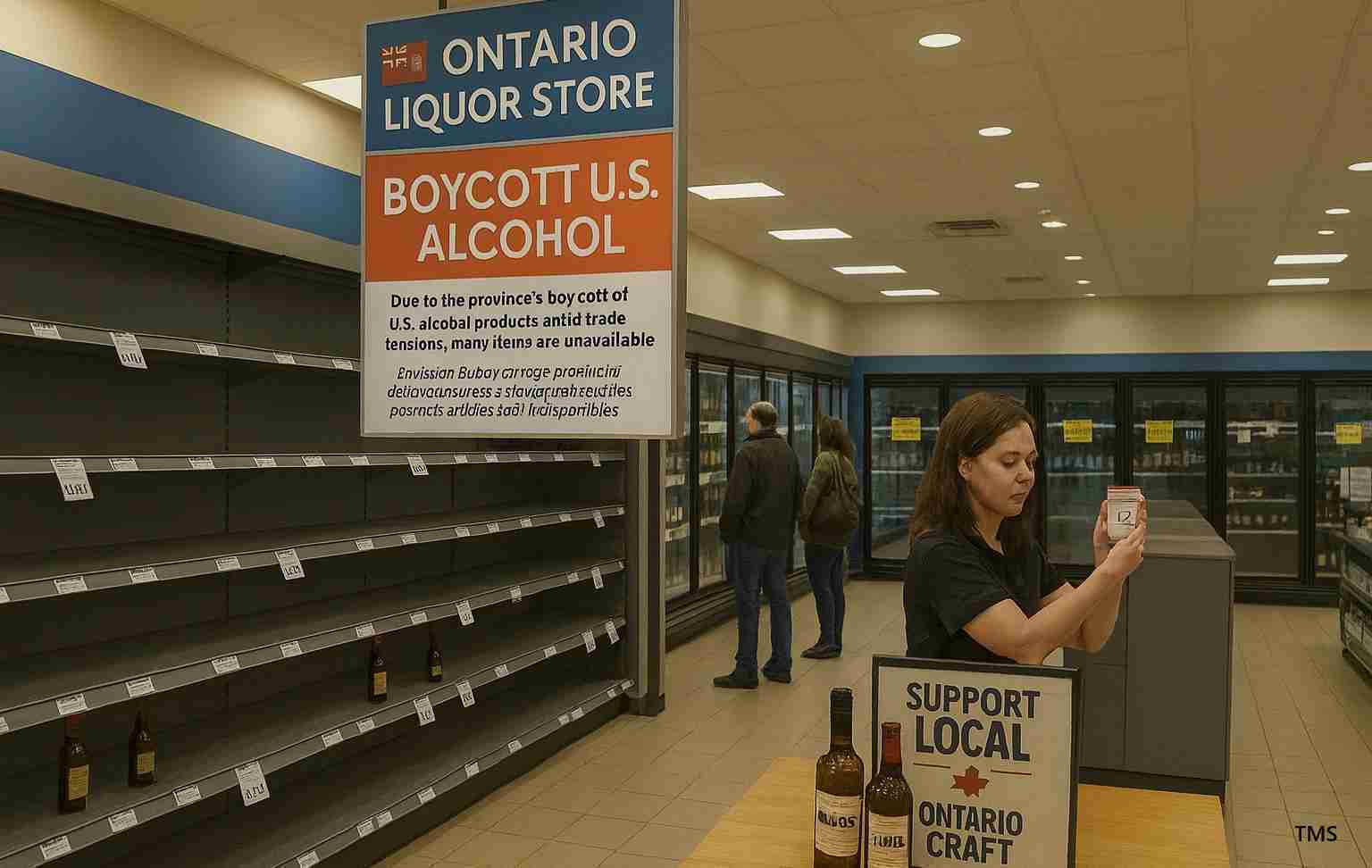
Canada’s alcohol boycott slashes U.S. exports, strains long-standing trade ties
Canada’s widespread boycott of American alcohol, triggered by U.S. tariffs in 2025, led provinces such as Ontario to delist U.S. products, collapsing U.S. wine and spirits exports to Canada by more than 60% and sharply escalating economic and diplomatic tensions.
Key takeaways
- U.S. exports plunged: Distilled spirits exports to Canada fell about 62% in H1 2025 (to ~$43.4m from $114m); U.S. wine exports plunged ~67% (Drinks Retailing News and video coverage).
- Ontario delisted U.S. brands: The LCBO removed all American products, effectively cutting U.S. alcohol sales in Ontario to zero and hitting what had been a >$700m annual market share (Drinks Retailing News; The Independent).
- Domestic effects in Canada: Overall spirits spending contracted (reports show drops from ~3.3% to ~13% in different measures), and even some Canadian producers saw sales declines despite short-term gains for select local brands (Supply Chain Brain).
- Local U.S. risks: California wineries reportedly lost about $173m in H1 2025, with ripple effects for growers, suppliers and regional communities such as Redding ( The Independent ).
What triggered the boycott
Background: In 2025 the United States imposed new ad valorem tariffs on a range of Canadian goods, explicitly including wine, beer and spirits — 25% in March and rising to 35% in August. In response, Canadian provincial authorities and government-run stores moved to restrict or delist U.S. alcoholic products.
Officials in Ottawa and many Canadians framed the tariffs as aggressive trade policy, prompting retail delistings and consumer-led boycotts that cut market access rather than merely raising prices. Industry observers say that full delistings caused faster and deeper declines in U.S. sales than tariffs alone would have achieved (Drinks Retailing News).
Impact on U.S. producers and exporters
The market effects were immediate and severe. U.S. distilled spirits exports to Canada dropped roughly 62% in the first half of 2025 (to about $43.4m from $114m in H1 2024), while U.S. wine exports plunged ~67% in the same period (Drinks Retailing News; video coverage).
“A full ban on U.S. products is worse than the products simply carrying an additional tariff,” said industry executives, noting the delistings eliminate consumer choice and long-standing market relationships (Drinks Retailing News; Supply Chain Brain).
Economic losses: Early estimates put California winery losses alone at roughly $173 million in H1 2025, pressuring growers, barrel makers, transporters and seasonal workers. Small producers that had relied on Canada as a steady export market now face revenue shortfalls and possible layoffs (The Independent).
Broader effects inside Canada
The boycott has not only hurt U.S. exporters; it has also contracted Canada’s domestic alcohol market. Reports vary by measure, but total spirits sales in Canada showed declines — with some reporting about a 13% year-over-year fall in particular measures and others reporting the spirits category contracted roughly 3.3% year-over-year in April 2025 (to $405.5m) (Supply Chain Brain).
In Ontario, where U.S. brands once held a large share, total spirits volumes fell roughly 20% after delistings. Some Canadian brands experienced short-term gains — in some cases up to 14% for select labels in Ontario — but these increases did not fully offset the overall market decline (Drinks Retailing News; Supply Chain Brain).
Household behavior: Surveys cited by industry observers showed over 60% of Canadian households reported spending less on U.S.-made goods, cutting back beyond liquor — travel to the U.S. and purchases of other American products fell as well, driven by political sentiment as much as price (Supply Chain Brain; video reports).
Political and diplomatic fallout
The tariff-boycott cycle has become a diplomatic flashpoint. Canadian officials framed the retail delistings and consumer boycotts as a defense of sovereignty and respect, while U.S. industry groups and some lawmakers warned the tit-for-tat measures risk eroding decades of cross-border commerce.
Trade organizations and business groups in both countries are urging negotiations to reverse tariffs and reopen markets, arguing a negotiated settlement is the only way to prevent deeper, longer-term harm to businesses and workers on both sides of the border (Supply Chain Brain; Drinks Retailing News).
Implications for Redding, California
Local exposure: Redding sits within a regional economy tied to agriculture and supply chains that support wineries and distillers statewide. While Redding is not a major wine-producing center, disruptions upstream — fewer grape orders, lower demand for barrels, reduced transport and bottling work — can ripple to local suppliers, seasonal workers and logistics firms (The Independent).
Jobs and rural incomes
Reduced orders from wineries and distillers can translate into fewer hours for vineyard workers, less freight for local truckers, and smaller contracts for packaging and maintenance firms. Even modest demand declines upstream may stretch the cash reserves of small businesses that operate on thin margins (Drinks Retailing News).
Tourism and hospitality
Northern California’s wine-country tourism and craft distillery traffic could soften if the sector endures a protracted slump. Tasting room events, tours and related hospitality spending that bring visitors into Redding may shrink, affecting restaurants, hotels and retail partners (Supply Chain Brain).
Local tax revenue and small-business resilience
Lower receipts at wineries and distillers can reduce local tax revenues tied to sales and tourism. Local officials and business groups may need to help firms diversify markets, pursue direct-to-consumer channels, and access state or federal relief for trade-impacted industries (The Independent; Drinks Retailing News).
Political and community response in Redding
Local sentiment is likely to be split along familiar lines. Many conservative readers and business owners may view the sequence — tariffs, retaliation, lost U.S. sales — as unintended consequences of national trade policy that require urgent negotiation. Community leaders could face constituent pressure to seek rapid trade talks and federal assistance, while others will urge stronger local resilience and diversification to reduce vulnerability to geopolitical shocks (video reports; Supply Chain Brain).
Practical steps for local businesses
- Diversify buyers: Pursue markets in Asia, Europe and expanded domestic retail channels to offset lost Canadian demand (Drinks Retailing News).
- Strengthen direct-to-consumer sales: Expand tasting-room promotions, online sales and subscription clubs to maintain revenue during export disruptions.
- Seek government support: Document losses, work with trade groups, and press for negotiated tariff relief or relief programs at state and federal levels (Supply Chain Brain).
Ongoing negotiations and what to watch
Trade organizations from both countries continue lobbying for agreements to lift tariffs and restore market access. The timeline for any diplomatic resolution will determine how long affected producers and suppliers must adapt. Near-term priorities for Redding-area stakeholders include managing cash flow, finding alternate customers, and coordinating with state and federal officials to seek relief and reopen export channels (Drinks Retailing News; Supply Chain Brain).
Source notes and coverage
- Drinks Retailing News: “Canadian boycott of US alcohol prompts 60% sales drop as tariff tensions rise”.
- Supply Chain Brain: “Canada’s boycott of US liquor hits domestic alcohol sales”.
- The Independent: coverage of impact on California wineries.
- Video coverage and video reports: interviews and on-the-ground reporting with industry figures.



