
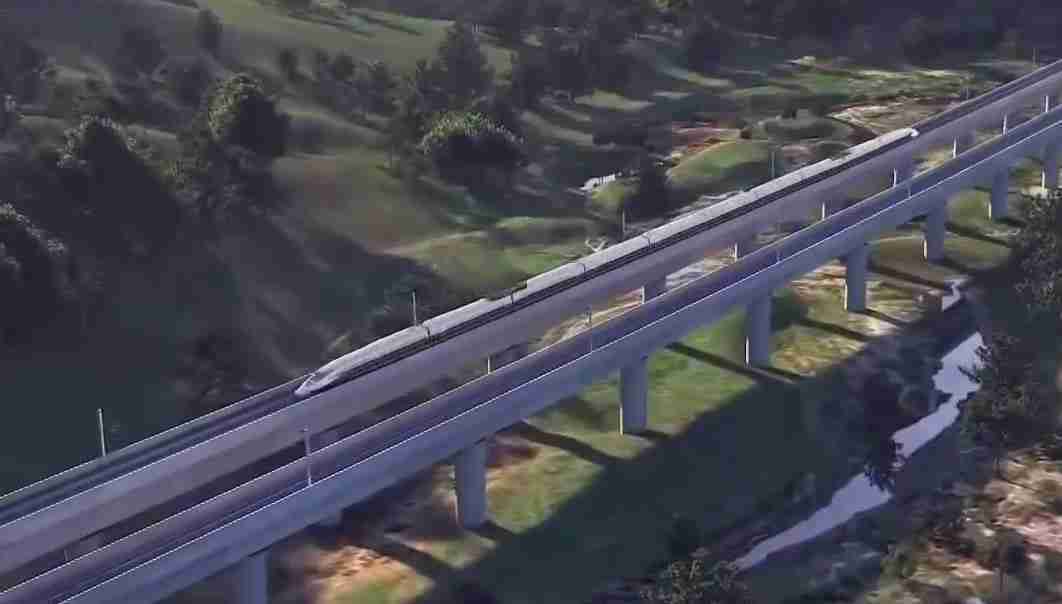
California revises high-speed rail plan, warns price tag could top $128 billion and full line may not finish until 2039
California leaders unveiled a revised high-speed rail plan that raises total cost estimates to as much as $128 billion and adopts phased delivery, targeting Merced–Bakersfield by 2032 and a full San Francisco–Los Angeles connection by 2039.
- Phased delivery: an Initial Operating Segment (Merced–Bakersfield) by 2032, Palmdale–Gilroy by 2038, full SF–LA service by 2039 (California High-Speed Rail Authority; CBS Sacramento).
- Cost risk: new statewide estimates range from $120 billion to $128 billion, with the Palmdale–Gilroy stretch alone estimated near $87 billion (ABC7; CBS Sacramento).
- Funding is unresolved: plan depends on long-term financing, possible redirection of cap-and-trade revenues and state legislation such as SB 545 (CBS Sacramento).
- Construction today: only the Central Valley segment (~171 miles, >50 major structures) is actively under construction (Governor’s office; Wikipedia).
Project scope and timeline
State officials issued a 2025 Supplemental Project Update Report that reframes delivery to produce useful, revenue‑producing segments sooner. The immediate objective is an Initial Operating Segment (IOS) between Merced and Bakersfield by 2032, extending to Gilroy and Palmdale by about 2038, and a full San Francisco–Los Angeles connection by 2039 (California High-Speed Rail Authority; CBS Sacramento).
Officials emphasize the timeline is intentionally conditional: it assumes securing new funding sources and attracting private-sector partners to make the system commercially viable and to accelerate connections to major population centers (California High-Speed Rail Authority).
Cost to complete: new estimates and what they mean
The revised estimates dwarf the original 2008 projection of about $33 billion for a Los Angeles–San Francisco connection. Current statewide projections place the remaining cost between $120 billion and $128 billion for the full system (ABC7; CBS Sacramento).
A particularly notable figure: the Palmdale–Gilroy corridor is estimated at roughly $87 billion, representing a large share of the remaining price tag and the critical gap needed to link Northern and Southern California (ABC7).
Analysts and officials cite multiple drivers of rising costs: long delays and litigation, inflation, engineering complexity (tunnels, viaducts), and difficult terrain in certain segments (Wikipedia; CBS Sacramento).
Construction status and engineering challenges
At present, only the Central Valley segment is under active construction — roughly 171 miles and more than 50 major structures such as bridges, overpasses and viaducts (Governor’s office; Wikipedia).
“Some planned tunnels — particularly in the Merced–San Jose stretch — are among the most challenging rail tunnels proposed in the U.S., and Bakersfield–Palmdale includes steep grades and multiple tunnels in some plans.”
Engineering constraints — long tunnels, mountainous alignments, and steep grades — are central to cost and schedule uncertainty (Wikipedia).
Funding, politics and risks
Funding remains the critical question. The Supplemental Project Update explicitly ties delivery to long-term financing that makes operations marketable to private investors and reduces taxpayer exposure (California High-Speed Rail Authority).
State leaders are considering redirecting roughly $1 billion annually from California’s cap-and-trade program and are promoting legislation (notably SB 545) to secure more dependable revenue streams for construction and operations (CBS Sacramento).
Federal funding disputes also add volatility: the state previously litigated after several billion dollars in federal funds were pulled, and future federal-state dynamics could materially affect the financing picture (ABC7; Governor’s office).
Private-sector role
Officials acknowledge initial plans underestimated the need for private capital. The revised approach calls for greater private-sector engagement to reduce taxpayer burden while leveraging public funds to reach key milestones and attract investment (CBS Sacramento; California High-Speed Rail Authority).
Advances in permits and environmental review
Officials report environmental clearances have been secured for about 463 of roughly 494 miles in Phase 1, though key gaps remain — most notably the Los Angeles–Anaheim segment, which still needs full approvals and faces significant local and engineering hurdles (Wikipedia).
What these facts mean for local communities
State leaders highlight projected economic benefits: construction and operations jobs, station-area development, and long-term reductions in vehicle emissions if the system achieves its ridership goals (California High-Speed Rail Authority).
Implications for Redding, California
Economic impact: Redding is not on the Phase 1 map, but regional supply chains and specialty contractors in Northern California could see subcontracting opportunities from Central Valley construction and station-area development (California High-Speed Rail Authority).
Budget and tax priorities: Conservative readers in Redding may worry about fiscal trade-offs. Proposed diversions of cap-and-trade funds (~$1 billion annually) and new state financing could reduce flexibility for local priorities like road repairs, public safety, and wildfire response unless new revenues are found (CBS Sacramento).
Alternatives and local value: Some Redding residents favor investments in highways, regional airports, or freight rail that deliver more immediate, locally controlled benefits compared with a multidecade, statewide project carrying substantial cost and schedule risk (ABC7).
Political consequences: The project remains politically charged; ongoing state commitment, potential cap‑and‑trade redirections, and budget decisions may shape local and state races and the broader policy debate (Governor’s office; CBS Sacramento).
Sources
- California High-Speed Rail Authority — 2025 Supplemental Project Update Report news release
- CBS Sacramento reporting on state leaders’ announcement
- ABC7 background on the bullet train and costs
- Governor’s office statement on rail and federal funding disputes
- Summary and technical details (Wikipedia entry)



