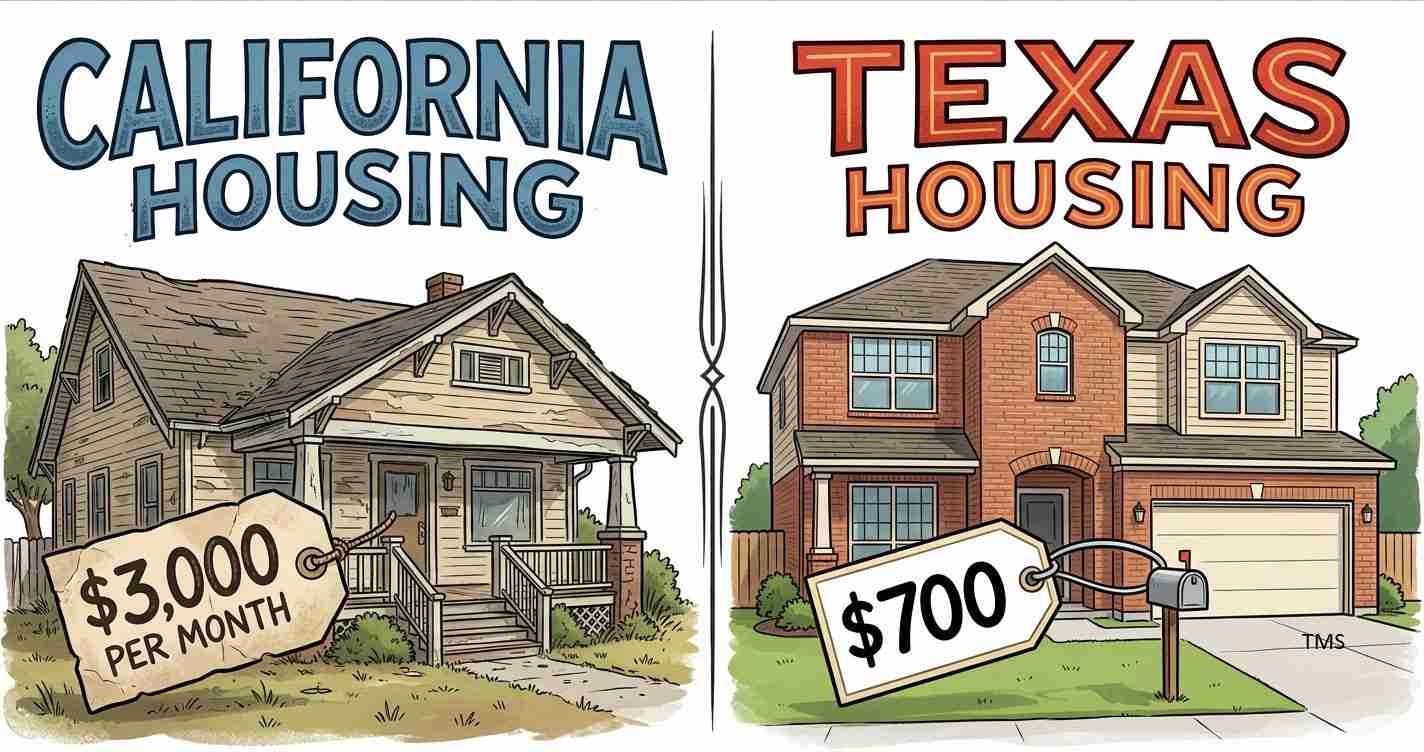
California exodus yields big housing savings, higher homeownership for many who leave state
A California Policy Lab analysis finds Californians who move out of state save on average $672 per month on housing and become 48% more likely to own a home within seven years after relocating to cheaper neighborhoods.
- Average monthly housing savings: $672 lower (from $2,376 to $1,705) for those leaving California.
- Renters: roughly 30% lower rents, about $631 per month saved on average.
- Home-price gap: median homes in destination neighborhoods about $396,000 (≈48%) cheaper, boosting ownership to 60% from 53%.
- Homeownership gains: leaving Californians are 48% (11 percentage points) more likely to own after seven years versus a 27% (6 pp) gain for arrivals to California.
What the data shows
The California Policy Lab tracked anonymous households from 2016–2025 and found consistent patterns: moving out of California usually means landing in markedly cheaper neighborhoods and converting that savings into higher homeownership rates.
Overall housing-cost change: households leaving California saw average monthly housing costs fall by about $672, a figure that includes mortgage or rent, utilities, property taxes and insurance (reported in Fox Business). Renters who moved out experienced about a 30% reduction in rent, ≈$631 per month saved (Fox Business).
Home prices and ownership: destination neighborhoods had median homes about $396,000 cheaper (≈48% lower) than the California neighborhoods people left, helping lift ownership rates to 60% versus 53% in the origin neighborhoods (Fox Business, Realtor.com).
Seven‑year outcomes: those who left California were 11 percentage points more likely to own after seven years — a 48% increase relative to their starting point. By contrast, new arrivals to California saw a 6 percentage point (≈27%) rise in homeownership over the same period (Policy Lab presentation and media segments).
Moves within and into California: internal moves inside California delivered little benefit: monthly housing costs edged up from $2,263 to $2,277. People moving into California from elsewhere faced a sharp rise from $1,754 to $2,418 in average monthly housing costs (Fox Business).
“The price drop is the central reason families can shift from renting to owning after leaving,” said Evan White of the California Policy Lab, highlighting the roughly $400,000 median home price difference that drives relocation decisions.
Where people go
Most Californians relocate to nearby, lower-cost states. The analysis shows the largest net outflows per 10,000 residents annually (2016–2025):
- Nevada: +81 per 10,000
- Idaho: +64 per 10,000
- Oregon: +37 per 10,000
- Arizona: +36 per 10,000
- Other receiving states at smaller net rates: Texas (+11), Tennessee (+13), Florida (+4) (Fox Business).
Why housing affordability drives the move
California’s housing—and broader cost—premiums (groceries, gas, utilities) squeeze household budgets. When families compare those higher expenses to new areas where home prices and rents are far lower, the financial case for moving is often decisive.
Key driver: the roughly $400,000 median home price gap enables some households to transition from renting to owning after relocation, an effect emphasized by Policy Lab researchers and reporters (Fox Business, Policy Lab presentation and media segments).
Policy levers and recommendations
The report highlights supply‑side interventions to reduce housing costs. Recommended actions include:
- Build more housing and expand funding for construction;
- Use building innovations and streamline code enforcement to speed delivery;
- Reduce regulatory barriers that slow new homes reaching the market;
- Design incentives to increase housing affordable to first‑time buyers and workers.
Political and fiscal note: higher housing prices act as both economic burden and political liability — policies that expand supply could retain workers, families and tax revenue while reducing outmigration.
Reporting and data sources
This article is based on the California Policy Lab analysis titled “Priced Out: Relocation Amidst California’s Affordability Crisis,” along with summaries and reporting from major outlets. Key summaries and coverage are available at Fox Business and Realtor.com. Additional findings and expert commentary were presented in a Policy Lab presentation and media segments.
Implications for Redding, California
Economic impact: Redding risks losing middle‑income workers and families to out‑migration, shrinking the local tax base. Conversely, it could gain residents relocating within California from higher‑cost coastal metros seeking affordability.
Economic impact
If residents leave for lower‑cost states, local spending and incomes could decline. Alternatively, in‑state inflows from coastal areas could bolster the economy if Redding captures those households.
Housing and development
Modest increases in local homebuilding, streamlined approvals, smaller‑lot development and affordable construction methods could help Redding retain and attract residents.
Labor market and services
Outmigration may create worker shortages (health care, education, trades), raising wages and costs. In‑state inflows could ease hiring and expand customer bases for local businesses.
Social and political effects
Migration changes community makeup. Local leaders face balancing growth with preserving community values; supply‑focused policies that respect local control may help.
Practical steps for residents and officials
- Track housing demand and plan measured growth aligned with infrastructure.
- Explore incentives for builders targeting first‑time buyers.
- Consider zoning updates to allow modest‑density housing near services and jobs.
- Prioritize workforce housing tied to local employers to retain essential workers.
Data‑driven planning can help Redding capture upside migration while protecting budgets and culture. The California Policy Lab’s findings show that where housing is affordable, more families buy homes and settle — local policy choices will shape Redding’s future as either a losing or gaining community (Fox Business, Realtor.com, Policy Lab presentation and media segments).