
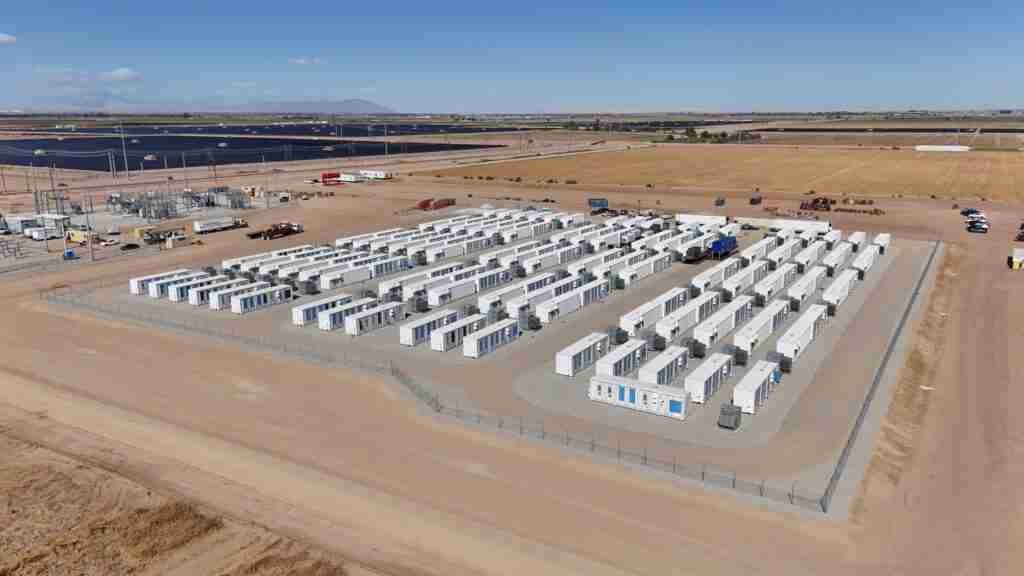
Big Rock Battery Plant Goes Online: 200 MW/400 MWh Energy Storage Starts Serving CAISO Grid
The Big Rock energy storage project in Imperial Valley, California — a 200 MW/400 MWh facility developed by LS Energy Solutions and Gore Street — is fully operational and delivering dispatchable capacity to CAISO under a 12‑year Resource Adequacy contract.
Key takeaways
- Scale: 200 MW / 400 MWh capacity (able to discharge 400 MWh over four hours) built from 137 AiON‑ESS container units.
- Contracted revenue: Currently dispatching 100 MW to CAISO under a 12‑year Resource Adequacy (RA) agreement; RA contract value reported at >$165 million.
- Financing & incentives: Acquisition ~ $110 million; project benefits from a 30% ITC under the Inflation Reduction Act and long‑term credit support from a Goldman Sachs subsidiary.
- Operations: LS Energy Solutions system integration with GridBeyond AI optimization and ongoing phased commissioning.
What went into Big Rock: hardware, contracts and financing
Hardware and site design
Big Rock comprises 137 AiON‑ESS containerized units, each pairing batteries with inverters and sized roughly at 1.5 MW / 3.5 MWh. When all containers are online the plant reaches its nameplate 200 MW / 400 MWh capacity. The modular design ties each container into medium‑voltage transformers and uses more than 1,300 AiON‑SIS string inverters, simplifying installation and grid connection. Reporting and developer materials document these equipment details via Power Engineering and Power Magazine.
Operations, dispatch and contracts
Operationally, Big Rock is contracted under a 12‑year Resource Adequacy (RA) agreement designed to guarantee capacity for the CAISO system and to meet a standard four‑hour RA deliverability profile. Developers report the plant is currently dispatching 100 MW to the CAISO grid while full operational testing and phased commissioning continue. Industry reports outline the dispatch profile and commissioning status (Power Magazine; Solar Power World).
Financial and market structure
Ownership and financing: Gore Street Energy Storage Fund acquired the project from Avantus in February 2023 for roughly $110 million. The RA contract is reported to have a fixed‑price structure valued at more than $165 million across 12 years, with guaranteed payments backed by a Goldman Sachs subsidiary, reducing merchant exposure. The plant will also earn energy arbitrage and ancillary service revenues. Trade reporting and analysis emphasize how long‑term contracts plus federal incentives make large storage projects bankable (AI Invest; WIP Magazines).
Technology and operational support
LS Energy Solutions serves as the primary system integrator and will provide long‑term commissioning, preventive and capacity maintenance, extended warranties, and remote monitoring. GridBeyond supplies AI‑driven optimization software to manage dispatch dynamically and maximize revenues across energy and ancillary markets. Developers note the AiON‑ESS modular approach shortens construction timelines and simplifies replication at other sites (Power Engineering; AI Invest).
Why Imperial Valley?
Imperial County’s flat land, proximity to transmission corridors, and available interconnection capacity have made it a hub for large‑scale battery storage. Big Rock adds to more than 5.6 GW of storage on the CAISO system, reflecting rapid statewide buildout of battery assets. Developers and planners point to the region’s grid access as a key reason projects cluster there (Power Engineering; WIP Magazines).
Grid reliability, wildfire risk and CAISO
California’s grid faces heat‑driven demand spikes, generator retirements, and wildfire‑related safety rules that can disrupt flows. Storage projects like Big Rock provide short‑term bulk power during evening peaks and fast‑response ancillary services to smooth supply and demand. The RA contract supports CAISO reliability plans by guaranteeing deliverable capacity during stressed conditions (Power Magazine; Solar Power World).
Safety, lifecycle and environmental questions
Big Rock uses tier‑1 lithium‑ion cells along with monitoring and safety systems; developers cite extended warranties and preventive maintenance programs overseen by LS Energy Solutions. Still, lifecycle concerns—battery degradation, replacement costs, end‑of‑life recycling, and fire‑risk management—will draw regulatory and local scrutiny. Officials are expected to monitor safety compliance, recycling plans, and emergency response as the plant ages (Power Engineering; Power Magazine).
Key questions this investigation raises
- How will the RA contract and fixed‑price structure perform if wholesale prices or market rules shift? Industry reporting suggests the RA reduces merchant exposure (AI Invest).
- What are the long‑term plans for battery replacement and recycling, and who bears those costs? Developers cite extended warranties and maintenance contracts (Power Engineering).
- Will output scale beyond the current 100 MW dispatch level, and what tests remain before full‑rated performance is routine? Press reports note phased commissioning continues (Power Magazine; Solar Power World).
Implications for Redding, California
Economic impact: Although Big Rock sits over 500 miles south of Redding, the project exemplifies a trend that can alter statewide market dynamics—potentially lowering peak prices and reducing volatility, which may benefit Redding businesses and ratepayers. Northern contractors and suppliers could capture future work if similar projects expand across California (Power Magazine; AI Invest).
Grid reliability and wildfire preparedness: Big Rock’s fast‑response capacity and ancillary services are a model for supporting areas at risk of wildfire‑driven outages. Local utilities, emergency planners and officials in Redding and Shasta County may consider large‑scale storage as part of resilience planning.
Policy and taxpayer considerations: Big Rock benefited from a 30% investment tax credit (ITC) under the Inflation Reduction Act, which reduced upfront costs and improved returns. The RA contract, backed by a large financial firm, shows how public policy and private capital combine to build grid assets without direct local government spending (AI Invest).
Local jobs and supply chain: Direct construction jobs were centered in Imperial County, but the broader growth of storage in California could spur hiring across engineering, operations, maintenance, and supply chains that northern contractors and labor markets might capture (WIP Magazines; Power Magazine).
Practical takeaways for residents
Projects like Big Rock aim to reduce the risk of sudden shortages during heat waves and emergencies, potentially resulting in fewer rolling outages and more predictable energy bills if markets and policies support dependable capacity. Citizens should seek clear safety practices, transparent contracting, and local inclusion of storage in wildfire and grid resilience plans (Solar Power World; Power Magazine).
Reporting note and sources
This article draws on reporting and technical briefings from industry outlets and developer statements. Primary reporting and technical details are from Power Engineering, Power Magazine, Solar Power World, AI Invest, and WIP Magazines.
Full source links:
Power Magazine;
Power Engineering;
Solar Power World;
AI Invest;
WIP Magazines
Reporting by Times Media Service



