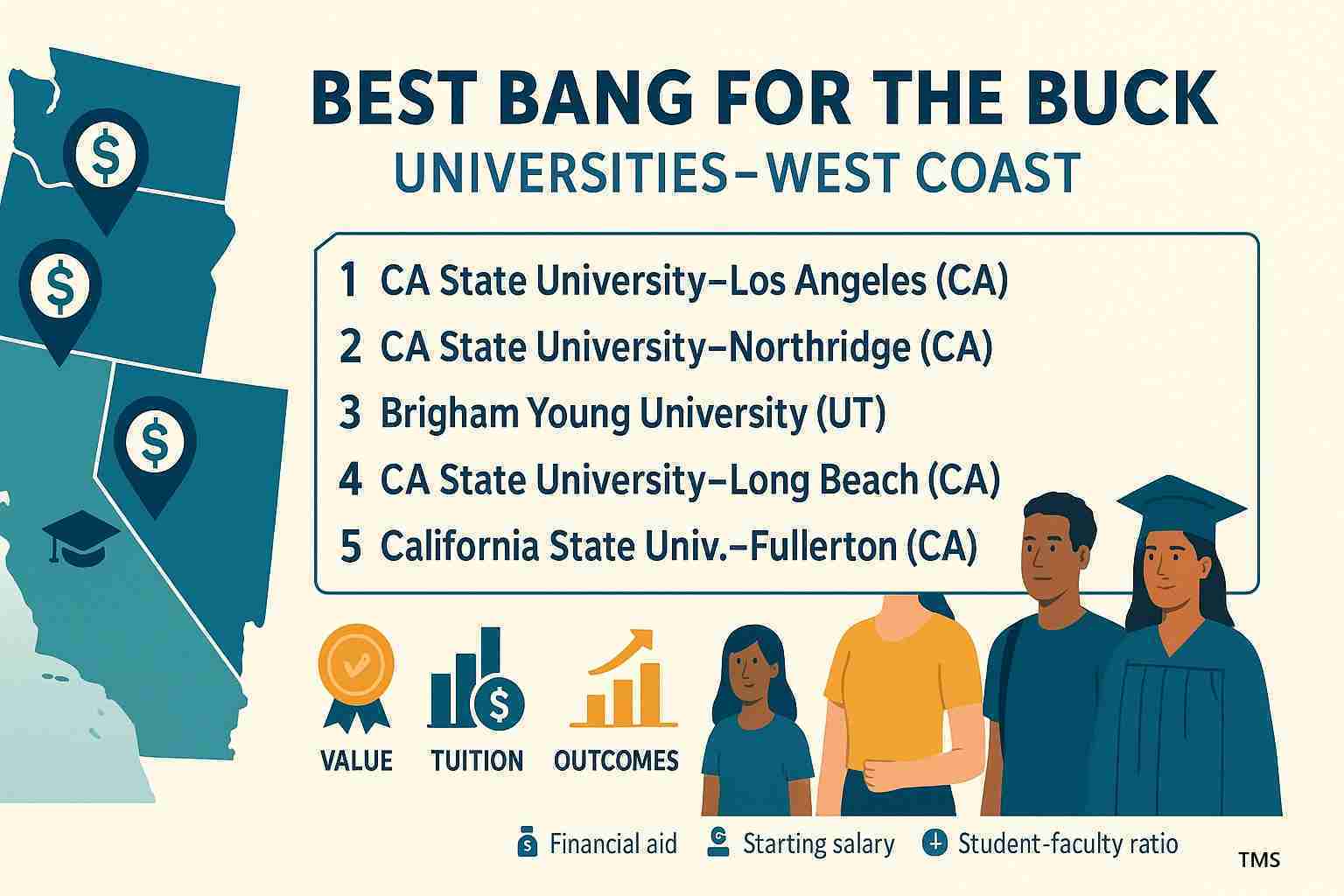
Best colleges in the West: These California universities offer the most bang for the buck
When choosing higher education in the Western United States, students increasingly seek institutions that combine strong academic reputation, graduate earnings and affordability. This guide highlights elite Western universities and California State University campuses offering the best ‘bang for the buck’.
Key takeaways
- Value: “Bang for the buck” mixes academic reputation, graduate earnings and net price after aid.
- Elite universities lead on reputation but generous aid and outcomes can narrow net cost gaps.
- CSU campuses often deliver high social mobility and low net prices for California residents.
- Local pathways: community college-to-CSU transfers and in‑state tuition are critical cost-savers for West Coast students.
Why value matters now
College costs remain a top concern. For conservative voters and fiscally minded families, return on investment, lower student debt, and workforce readiness are central. Choosing schools with solid reputation and low net price can cut lifetime costs and speed entry into the job market.
Top-ranked Western universities and what they offer
Elite private and public research universities across the West remain attractive for academic quality, alumni networks and outcomes. Sticker price alone is not decisive—many top schools provide institutional aid that lowers net price for qualified students.
- Stanford University (Stanford, CA): A top private research university with world-class programs. Tuition is high, but substantial institutional aid can reduce net price for many students.
- Claremont McKenna College (Claremont, CA): Elite liberal arts college known for social sciences and strong job placement; high sticker price but significant aid available.
- California Institute of Technology (Caltech, Pasadena, CA): STEM-focused, small classes and strong research output; generous aid offsets tuition for some families.
- UCLA and UC Berkeley (Los Angeles and Berkeley, CA): Large public research universities with national reputations; in‑state costs and outcomes make them high-value for California residents.
- USC (University of Southern California, Los Angeles, CA): Private university with strong career outcomes and alumni networks; tuition is high but placement is notable.
- Brigham Young University (Provo, UT): Private university often singled out for lower tuition and strong value metrics.
Why public schools often deliver better value
Public universities, especially state systems, can deliver high-quality education at lower net cost for residents. They tend to show strong return rates for students who stay in-state and feed local workforces. Value rankings typically weigh net price after aid, graduates’ earnings and loan repayment, graduation rates, and student supports.
CSU campuses singled out for value
Several California State University campuses are repeatedly highlighted by value-focused outlets for affordability and outcomes—particularly for students from diverse and lower-income backgrounds.
- CSU Dominguez Hills (Carson, CA): Noted for serving diverse populations and supporting students with financial need. Average tuition listed around $6,941.
- CSU East Bay (Hayward, CA): Recognized for business and health programs and affordable tuition near $6,890.
- CSU Los Angeles (Los Angeles, CA): A regional workhorse with strengths in engineering, business and health fields; tuition listed about $6,781.
These CSU campuses score well on metrics tied to social mobility, low net price, and graduation outcomes for lower-income students.
More affordable, high-quality options across the West
Beyond California, Western public universities and smaller state schools can deliver strong value at lower tuition levels.
- Weber State University (Ogden, UT): Broad program range with low tuition listed at $5,956.
- University of Oregon (Eugene, OR): Recognized in national rankings for academics and reasonable in-state costs.
- The CSU system overall: Many campuses combine moderate tuition with solid academics and strong regional reputations.
How “bang for the buck” rankings are built
Value rankings use a mix of measures, not just sticker price. Common factors include:
- Net price after financial aid
- Graduate earnings and loan repayment rates
- Graduation rates and time to degree
- Student support services and career placement
- Diversity and social mobility measures
Different ranking organizations emphasize reputation, outcomes and cost differently. See coverage from Times Higher Education, Niche, College Consensus and Money for methodology differences.
What conservative-minded students and families should watch for
For fiscally minded families, three practical checks matter:
- Net cost: Average net price after grants; sticker price can be misleading when aid offsets cost.
- Career outcomes: Earnings and loan repayment; schools that place graduates quickly reduce lifetime cost.
- Transfer and local pathways: Community college-to-CSU pathways cut costs—California’s system provides many affordable routes.
Implications for Redding, California
Local students from Redding can gain direct savings by using in-state tuition at UCs and CSUs or by following community college transfer pathways. Employers in Redding’s health care, construction, manufacturing and tech-adjacent sectors benefit from graduates who are ready to work immediately.
- Direct savings: In-state fees and CSU value colleges reduce costs for Shasta County families.
- Workforce ties: CSU applied programs supply job-ready workers to local employers.
- Transfer opportunities: Shasta College and other community colleges feed CSUs affordably.
- Retention: Affordable local pathways improve the chance graduates stay or return home, supporting the tax base and small businesses.
- Veterans & nontraditional students: Many CSUs provide flexible scheduling and supports important in regions with veteran populations.
Support for family planning and debt control
Conservative families often emphasize fiscal prudence. Choosing high-value public colleges in the West—especially affordable California universities and CSUs—reduces student debt and allows graduates to start families, buy homes, or invest locally sooner.
Sources and further reading
- College Consensus, Best Colleges in the West
- Money, Best Colleges in the West
- Great Value Colleges, Affordable Western U.S. Colleges
- Times Higher Education, Best Universities in the United States
- Niche college rankings
Final note
Selecting the best college for value depends on residency, field of study, family finances and career goals. For many in the West—and particularly students from Redding—CSU value colleges and select public research universities offer practical paths to degrees that pay off without heavy debt.