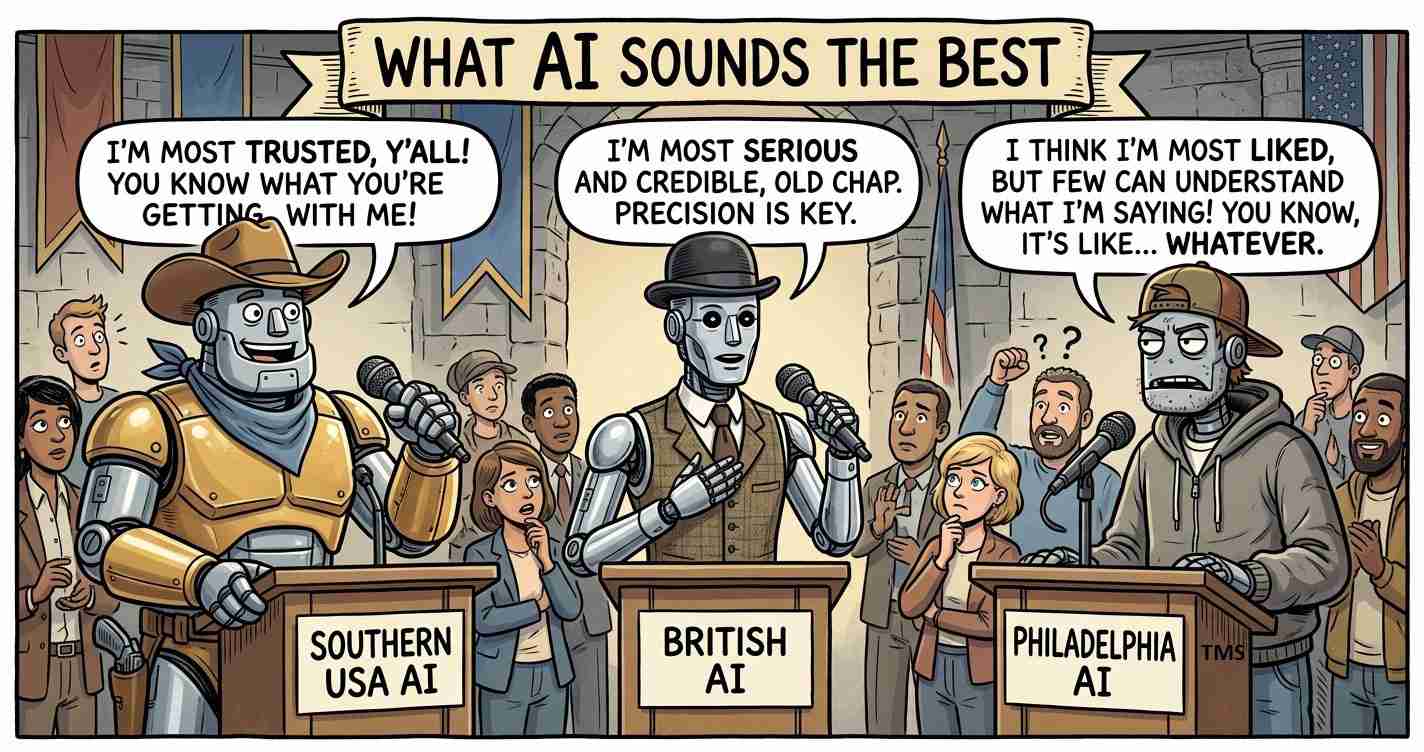
Survey of 3,023 Users Finds Southern Accent Tops List as Americans Prefer Human, Regionally Warm AI Voices
Dateline: United States (Times Media Service) — A nationwide survey of 3,023 users by The Word Finder found Americans overwhelmingly prefer humanlike, regionally warm AI voices—especially a Southern accent—indicating voice style strongly shapes trust, emotional connection and how people interact with technology. Source
Key takeaways
- Regional warmth wins: Americans prefer voices that sound like a neighbor with character rather than a monotone machine.
- Southern accent ranked #1: Praised for being gentle, reassuring and carrying “calm authority.” Source
- Consistency matters: 73% want one consistent accent per device/platform; 75% prefer human-sounding speech; only 2% want voice cloning. Source
Survey results and national snapshot
The Word Finder surveyed 3,023 users nationwide and found a clear shift: respondents chose regional AI accents that “carry personality” — from the calm authority of the South to the crisp reliability of Midwestern neutrality. The findings suggest voice is becoming as important as content for building trust and emotional connection with AI. Source
Top voices and what they convey
Respondents ranked specific regional voices and described the emotional impressions each conveys:
- Southern (Ranked #1): Described as gentle, reassuring and resonant with “calm authority” — approachable and slightly theatrical. Imagery used by respondents included a friendly librarian or a Matthew McConaughey–style persona. Source
- New York City: Signals confidence and efficiency — the no-nonsense, get-things-done tone.
- BBC English: Associated with trust and intelligence — the familiar expert voice many respect.
- New England: Noted for realism and blunt charm — straightforward and a little gruff.
- SoCal/Valley: Conveys relaxed friendliness — casual, upbeat and easygoing.
- Texas drawl: Gives storytelling confidence — warm, swaggering narration that draws listeners in. Source
Regional flavor extends beyond the top picks: New Jersey brings a feisty edge, Philadelphia offers gritty heart, Chicago adds Midwest muscle, and Louisiana provides Cajun spice — all illustrating how accent choices shape emotional connection. Source
Follow-up findings and nuance by topic
Additional analysis revealed important nuances:
- Trust and intelligence: Southerners were rated the most trusted voices and nearly tied with British accents for sounding the smartest.
- High-stakes topics: For finance and other serious areas, the Midwestern or “neutral American” accent led in perceived trustworthiness — the voice people would trust with their 401(k). Source
“Voice shapes emotional connection to technology,” said Praveen Latchamsetty, founder of The Word Finder. He called voice the “secret sauce” that turns a tool into something you feel comfortable with — a pal rather than a device. Source
What people want from AI voices
Survey numbers highlight clear preferences:
- Consistency: 73% want one consistent accent across a device or platform.
- Humanlike delivery: 75% prefer human-sounding speech over synthetic monotone.
- Reluctance toward cloning: Only 2% want their own voice cloned for AI use — a strikingly low appetite for voice cloning. Source
These figures underline that users prize consistency, humanlike delivery, and regional adaptation more than eerie personalization.
Implications for Redding, California
Local stakeholders in Redding could apply these findings across economic, political, social and cultural areas:
- Economic impact: Local businesses and call centers may gain an edge by adopting regionally tuned AI voices that match customer expectations — imagine county services sounding warm and familiar, improving satisfaction and lowering call-backs.
- Political consequences: Regionally adapted voices can reinforce credibility in local government messaging and civic outreach for conservative-leaning audiences that value trust and clear communication.
- Social effects: Humanlike, locally flavored voices can strengthen outreach to older residents and rural communities, improving telehealth and utility communications.
- Cultural relevance: Redding’s values — straightforwardness, neighborliness, practical common sense — align with the survey’s favoring of warm, trustworthy voices. A Southern or Midwestern-leaning tone may resonate locally.
- Practical applications: Emergency alerts, transit updates, utility notifications and customer service can all benefit from voice choices that reduce anxiety and increase compliance.
In short, regionally familiar voices may make smart-home devices and public services feel less foreign, increasing adoption and effectiveness. Source
Conclusion
Takeaway: As machines get smarter, how they sound can be as influential as what they say — shaping trust, warmth and personality in everyday interactions. Developers, brands and local agencies should consider regional voice design when building AI-driven experiences. Source