
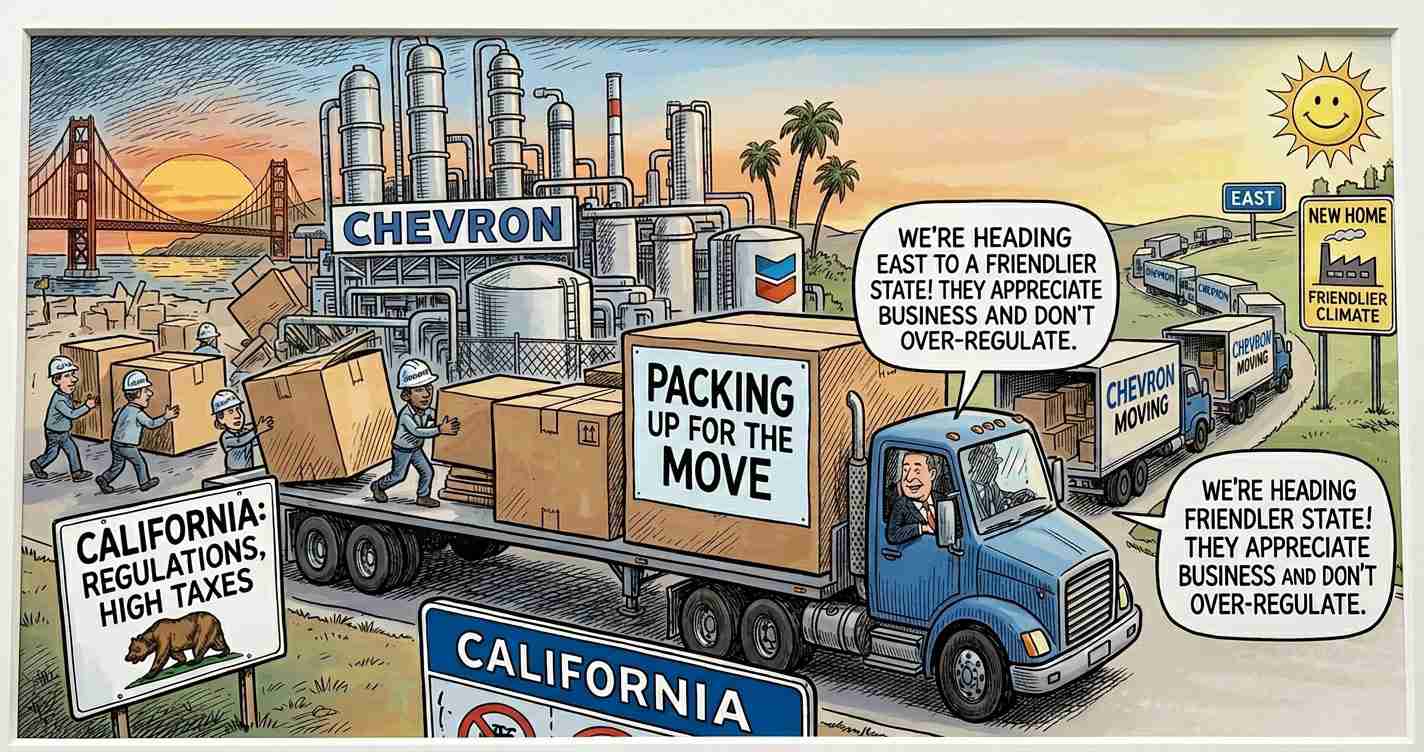
Chevron California warning: Company says strict rules, taxes could trigger refinery closures and fuel shortages
Chevron warns California’s strict emissions rules, new taxes and rising compliance costs could force the company to quit refining in the state within ten years, risking fuel shortages, steep job losses and higher gas prices for residents.
- Chevron says tighter emissions rules, added taxes and higher compliance costs could make refining in California unsustainable and drive the company out within 10 years — source: Insurance Journal.
- Proposed changes to the Cap-and-Invest program could remove many carbon allowances and raise long-term emissions targets, increasing refinery costs — source: Fox Business.
- Chevron estimates roughly $500 million in additional costs to California refineries over five years if new rules proceed — Insurance Journal.
- A shutdown of Chevron refineries could cut California’s refining capacity by about 34%, elevating the risk of shortages — Insurance Journal.
Chevron’s warning and the message to Gov. Newsom
Chevron President Andy Walz wrote that the company faces an “adversarial” policy environment that threatens refining’s future in California. In his letter he urged state leaders to “abandon the tax on refineries or they won’t have any refineries in 10 years.” The company also warned proposed Cap-and-Invest changes would raise costs and weaken reliability — Insurance Journal.
“If it stays that way — Chevron will be gone in 10 years for sure. We won’t be able to make it.” — Andy Walz, Chevron president
Chevron argues that recent local, regional and state policies have eroded economic and national security benefits provided by domestic refining and that proposed regulations “threaten to destroy” the industry’s foundation — Insurance Journal.
How much would new rules cost?
Chevron estimates tighter emissions caps and compliance demands could add about $500 million in operating costs to the state’s refineries within five years. The company says those costs would be passed to consumers as higher California gas prices — Insurance Journal.
Chevron also warned the policy changes could put more than 536,000 industry jobs at risk statewide and could lift retail gasoline prices by more than $1 per gallon by 2030, with lower-income households disproportionately affected — Fox Business.
Supply vulnerabilities and reliance on imports
California imports a meaningful share of refined fuels from Asia; roughly 20% of refined fuels serving the state come from refineries in China, South Korea and Singapore. Disruptions — such as shipping lane issues related to the Iran war and Strait of Hormuz tensions — have strained those sources and forced operational workarounds — Insurance Journal.
Walz called dependence on overseas fuel “a dangerous game,” noting Chevron has rerouted Gulf Coast oil through the Panama Canal to fill shortfalls, adding cost and complexity for California-bound supplies — Insurance Journal.
California’s “energy island” problem
California is largely isolated from the national pipeline network; more than 90% of the gasoline used in the state is refined inside California. That isolation means any major local refinery closure or outage — such as losing Chevron’s two largest refineries — could reduce statewide capacity by ≈34% and trigger immediate supply tightness — Insurance Journal.
Regulatory changes under consideration
Regulators have proposed tougher Cap-and-Invest amendments intended to accelerate emissions cuts. Reported measures include removing 118.3 million carbon allowances from the market between 2027 and 2030 and raising the long-term carbon reduction goal to roughly 90% by 2045. Regulators say the changes are necessary to meet climate targets; industry groups and Chevron warn of sharply higher costs for refineries — Fox Business.
The debate is framed as a tradeoff between ambitious emissions goals and the practical need to keep fuels affordable and secure. State officials and environmental advocates counter that stricter limits are essential to reach climate commitments.
Recent closures and long-term decline
California’s oil production and refining capacity have declined over decades. Operators cite rising regulatory and business costs for refinery retirements, leaving the state more vulnerable to outages and price shocks. Chevron’s warning arrives amid that long-term decline and heightened geopolitical risk — Insurance Journal.
National security concerns and federal moves
Walz cautioned a fuel shortfall could create national security risks in a state that hosts more than 30 military bases and depends on jet fuel for military and commercial aviation. The federal government has already taken emergency steps, including authorizing Sable Offshore Corp. to restart offshore production under wartime powers to shore up supply — Insurance Journal.
Implications for Redding, California
Economic impact and jobs: Redding and Shasta County would feel pressure from a major refinery closure. Local workers in construction, transport, trucking and maintenance support refining and fuel distribution; Chevron’s warning that hundreds of thousands of jobs statewide could be at risk highlights possible layoffs that would ripple through local goods and services sectors — Insurance Journal, Fox Business.
Gas prices and daily life: Loss of refining capacity could push California pump prices higher; Chevron projects >$1/gal increases by 2030. Rural commuters, farmers and delivery services in the Redding area would be particularly affected — Fox Business.
Supply reliability and emergency planning: Redding’s emergency services and regional airports depend on reliable fuel. The state’s “energy island” status limits easy imports from other U.S. hubs; local leaders may need to revisit stockpiles, delivery routes and contingency plans if capacity continues to shrink — Insurance Journal.
Political and policy angles: For conservative-leaning local voters, Chevron’s warning underscores tensions between climate policy and economic security. Expect pressure on officials to seek regulatory relief, incentives for domestic refining, or alternative local measures. The debate could influence upcoming elections and policy reviews — Insurance Journal, Fox Business.
Practical effects on businesses and residents: Higher fuel and transportation costs could raise prices for goods in Redding. Small businesses reliant on delivery or tourism may see margins squeezed; households already facing high costs of living could see steeper monthly budgets. Local chambers and industry groups may lobby Sacramento for support — Insurance Journal, Fox Business.



