
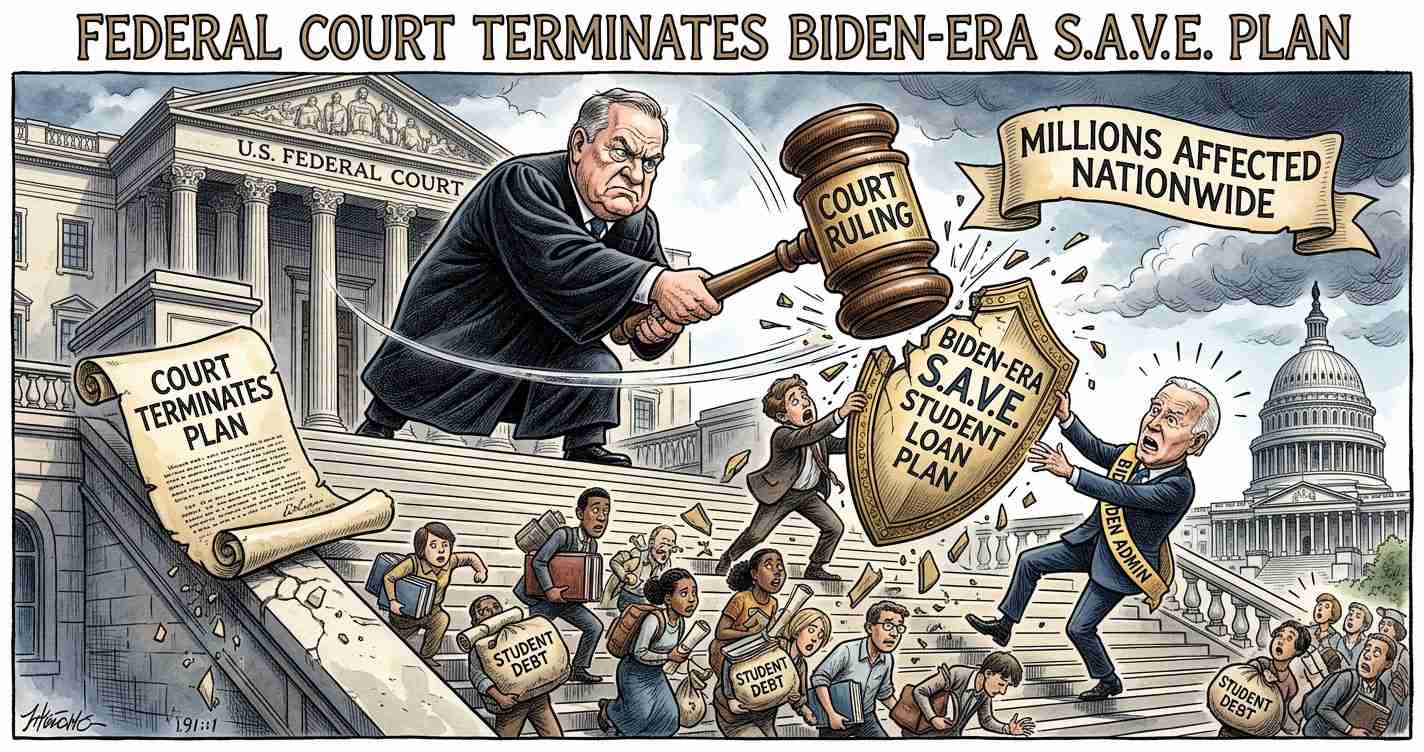
8th Circuit formally ends SAVE student loan plan, forcing more than 7 million borrowers to switch repayment programs
The U.S. Court of Appeals for the 8th Circuit ended the Saving on a Valuable Education (SAVE) plan on March 9, 2026, affecting over 7 million borrowers and prompting immediate transitions to other federal repayment programs and options.
- Court order ends SAVE: The 8th Circuit reversed a lower-court dismissal and finalized the termination of SAVE on March 9, 2026.
- Millions affected: SAVE had enrolled more than 7 million borrowers and subsidized 100% of unpaid monthly interest for qualifying loans.
- Immediate choices: Borrowers should consider Income-Based Repayment (IBR) now or the Repayment Assistance Plan (RAP) beginning July 1, 2026.
- Local impacts: Redding-area public employees and households may face higher bills and should verify PSLF credits and servicer communications.
Background: what the SAVE plan did and why it mattered
Launched in 2023, the SAVE plan was promoted as the most affordable federal repayment option, preventing loan balances from growing by subsidizing 100% of unpaid monthly interest for qualifying borrowers. Supporters said it cut monthly costs for millions and could speed progress toward forgiveness under income-driven programs. Critics argued it exceeded legal authority and posed major fiscal costs to taxpayers; the Department later described it as an “illegal student loan bailout.”
The legal fight and the 8th Circuit decision
Republican-led states, including Missouri, sued to stop SAVE. A February dismissal by U.S. District Judge John Ross briefly clouded SAVE’s future, and borrower advocates warned the dismissal required the department to resume benefits and process forgiveness claims. On March 9, 2026, the U.S. Court of Appeals for the 8th Circuit reversed that dismissal and finalized the end of SAVE, making the termination a court-ordered outcome rather than an administrative phase-out.
“The appeals court action means SAVE is ended by court order,” coverage by The College Investor.
Settlement and Education Department actions
Before the appeals decision, the Department of Education under the Trump administration negotiated a December 2025 settlement with Missouri that:
- Stopped new SAVE enrollments and denied pending SAVE applications;
- Directed transition of current SAVE enrollees to other legally authorized plans;
- Started negotiated rulemaking to remove SAVE language from federal regulations.
The department has urged borrowers to prepare for transition, using tools such as the Loan Simulator, and emphasized the need to pick lawful repayment paths in outreach led by senior officials.
What borrowers face now: student loan repayment options
With SAVE ended, borrowers must evaluate alternatives. Key options and timing:
- Income-Based Repayment (IBR): Sets monthly payments at about 10%–15% of discretionary income over 20–25 years. Available now and appropriate for many borrowers, especially with pre‑2026 loans (TCNJ Financial Aid).
- Repayment Assistance Plan (RAP): Created by the One Big Beautiful Bill Act (OBBBA, 2025), RAP uses a 1%–10% sliding scale of AGI and requires 30 years of payments; available July 1, 2026 and becomes the primary option for post‑2026 loans (TCNJ Financial Aid).
- Standard, Graduated, Extended plans: Fixed-payment options remain for pre‑2026 loans and may be higher but predictable.
Note: Borrowers who do not actively select a plan may be auto-enrolled by servicers, but auto-enrollment may not yield the lowest payment. Use the Loan Simulator and contact your servicer to compare options.
Public Service Loan Forgiveness and frozen credit months
Public Service Loan Forgiveness (PSLF) remains available. Borrowers who were on SAVE and pursuing PSLF should:
- Verify PSLF status with their servicer;
- Submit or refile Employment Certification Forms to request credit for months when SAVE protections may have frozen progress;
- Document and retain records of payments and communications to preserve eligibility timelines.
Forbearance and short-term relief
Some borrowers remain in temporary forbearance, but rules now generally limit continuous forbearance benefits to 9 months within any 2‑year period. Many will see payments resume or feel urgent pressure to choose a plan within months. The department has pledged outreach and resources to help affected borrowers transition.
Legislative context: OBBBA and the future of income-driven plans
Congress passed the One Big Beautiful Bill Act (OBBBA) in 2025, establishing a statutory timeline to phase out SAVE, ICR, and PAYE by July 2028 and creating RAP. The 8th Circuit ruling accelerates the phase-out for SAVE specifically and reshapes the landscape of income-driven relief going forward.
Practical steps for borrowers
- Visit the federal Student Aid Loan Simulator to compare repayment plans and estimate payments.
- If pursuing PSLF, submit an Employment Certification Form and check servicer records for qualifying payments (Student Loan Planner).
- Consider IBR for lower payments now; consider RAP when it becomes available on July 1, 2026.
- Monitor communications from the U.S. Department of Education and your servicer, and keep records of all correspondence.
Implications for Redding, California
Economic impact
Redding-area borrowers who relied on lower SAVE payments may face higher monthly bills and restored balances, potentially reducing discretionary spending and affecting local housing, small businesses, and household budgets in Shasta County.
Political consequences
Conservative voters in Redding who supported the Trump administration and OBBBA may view the decision as a victory for fiscal accountability and legal limits on executive authority. Local officials and candidates are likely to reference the ruling in debates over federal overreach and taxpayer spending.
Social effects
Public employees (teachers, firefighters, municipal workers) should immediately verify PSLF status and submit Employment Certification Forms. Reclaiming frozen credit months that may have accrued under SAVE could be essential to preserving forgiveness timelines.
Practical applications for Redding residents
- Log into your federal student aid account and servicer portal; use the Loan Simulator.
- Public service employees should file or refile PSLF Employment Certification Forms and document months credited under SAVE (Student Loan Planner).
- Attend local outreach events; contact loan servicers and nonprofit counselors for one-on-one assistance.
- Save all communications from the Department of Education and servicers.
Sources and further reading
- The College Investor: “SAVE student loan plan officially ended by court order”
- Student Loan Planner: “SAVE Plan timeline & change”
- U.S. Department of Education press release: agreement with Missouri to end SAVE
- TCNJ Financial Aid: “Update on federal loan changes beginning in 2026”
Bottom line: The March 9, 2026 8th Circuit decision ends SAVE by court order, affecting over 7 million borrowers who must now act to choose or confirm new repayment plans, track PSLF progress, and consult federal tools and servicers for next steps.



