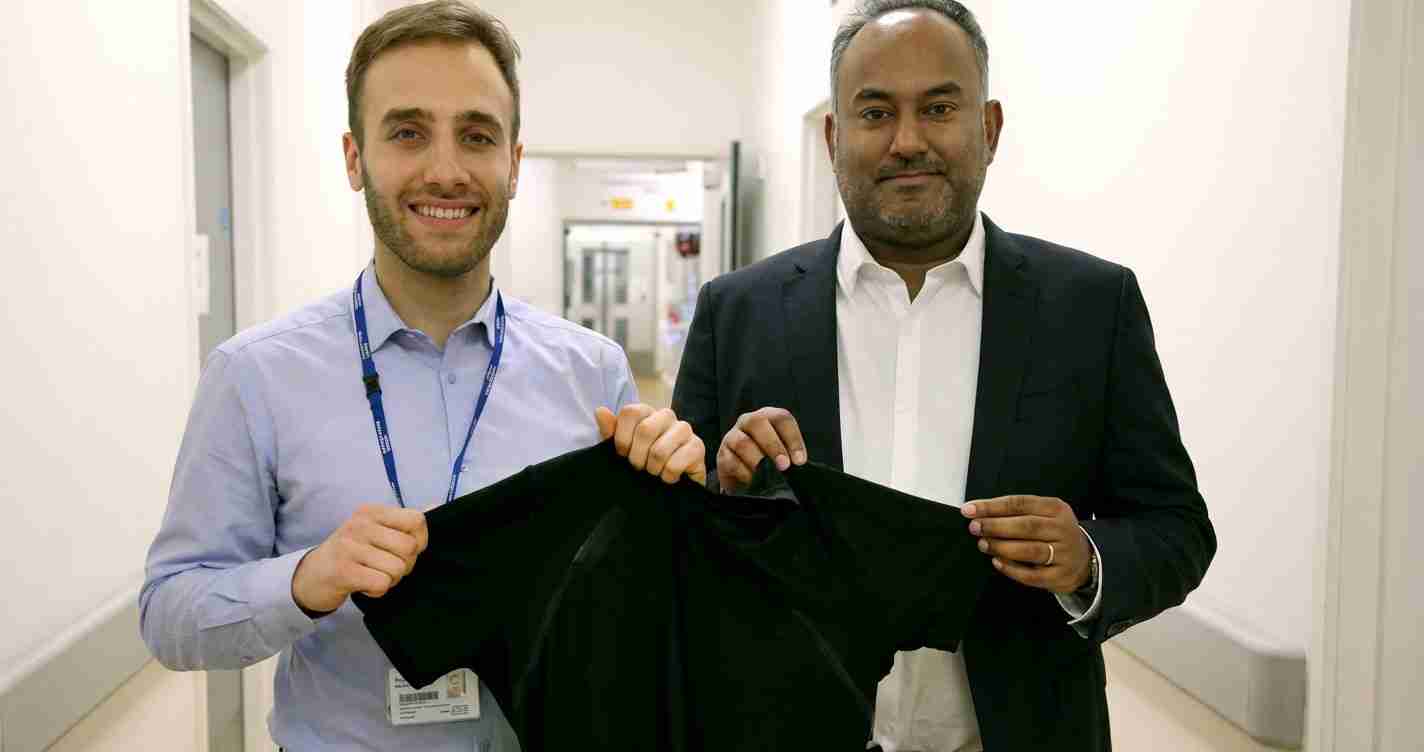
Your next heart test might start in your dresser drawer — AI smart T-shirt aims to catch hidden inherited heart rhythm disorders
Researchers at Imperial College London have developed an AI-assisted smart T-shirt with up to 50 woven ECG-style sensors that records continuous heart signals for days or weeks, using machine learning to spot intermittent inherited rhythm disorders often missed by short clinic ECGs.
- Innovative wearable: A comfortable sportswear-style T-shirt embeds up to 50 ECG-style sensors to collect long-term heart data for everyday use.
- AI analysis: An algorithm trained on ECGs from more than 1,000 people will screen days or weeks of recording to flag inherited rhythm patterns such as Brugada syndrome.
- Trial and timeline: Roughly 200 volunteers will wear the shirt for up to three months; if trials and regulation succeed, clinical use could follow in about five years.
- Funding: The project is led by Professor Zachary Whinnett at Imperial College London and is supported by the British Heart Foundation with a grant of more than £340,000.
Why short ECGs miss dangerous inherited conditions
Standard electrocardiograms (ECGs) performed in clinics provide only a minutes-long snapshot of the heart’s electrical activity. That brief recording often detects common abnormalities but can miss intermittent and inherited rhythm disorders that appear only briefly.
Researchers note many dangerous patterns are transient: if the ECG is taken during a quiet phase the test can appear normal even when a risk is present. Imperial’s team highlights the stakes: about 340,000 people in the U.K. have an inherited heart condition that increases risk, and such conditions are linked to the deaths of roughly 12 people under 35 each week in the U.K. (Imperial College London: AI T-shirt could improve heart monitoring).
How the AI smart T-shirt heart monitoring system works
Unlike adhesive leads or short clinic checks, the AI smart T-shirt is constructed like high-end sportswear. Up to 50 thin, ECG-style sensors are stitched into soft fabric, with wiring woven into the garment so the shirt can be worn under clothes, washed, and reused.
It is designed to be comfortable enough for sleeping, working and daily tasks so it can collect extended stretches of data — in some early tests for up to a week at a time and in the volunteer phase for up to three months. Continuous recording provides clinicians with a richer dataset so subtle irregularities and short-lived episodes can appear as clear patterns.
The AI analyzes those multi-day or multi-week signals to identify signatures of inherited disorders such as Brugada syndrome, flagging findings for physician follow-up (AI T-shirt could improve heart monitoring).
Training the algorithm and the testing plan
The AI is being trained on a mixture of ECG data from more than 1,000 people, including patients with known inherited rhythm disorders and healthy volunteers, enabling the system to learn to distinguish normal variation from signals indicating elevated risk.
Next, roughly 200 patients and volunteers will wear the smart T-shirt continuously for up to three months. The research team will compare the AI’s detections to clinical assessments to evaluate accuracy and reliability in everyday, out-of-hospital settings. The British Heart Foundation is supporting early development and testing (British Heart Foundation news release).
Safety, regulation and realistic timelines
Researchers estimate the device could reach clinical practice in about five years if trials are successful and regulators approve it. That period covers formal clinical trials, regulatory review, and validation to ensure the AI performs safely across diverse populations and settings.
Initial testing focuses on adults; any expansion to children would follow only after strong evidence of safety and effectiveness. The team emphasizes rigorous trials and regulatory clearance as essential before routine clinical use (Imperial College London: AI-assisted smart T-shirt development).
Professor Zachary Whinnett: “Far too many people die from inherited heart conditions which could be treated if they were identified earlier… We hope our AI-assisted t-shirt will provide a practical and comfortable solution, allowing us to carry out longer-term scanning that could improve diagnosis.”
Questions for patients, doctors and policymakers
Conservative readers who value personal responsibility and practical solutions should weigh several issues as the technology develops:
- Access and cost: Will insurers and health systems cover long-term wearable monitoring? Wider use may reduce downstream costs by preventing deaths, but upfront payment and reimbursement rules will affect adoption.
- Privacy and data control: Continuous monitoring generates large streams of personal health data. Clear rules are needed to protect patient privacy and to limit secondary uses of AI-analyzed data.
- Local capacity: Rural and community hospitals will require access to specialists who can act on AI alerts and established management pathways for inherited conditions.
- Regulation and safety: The AI must prove reliable across different groups and avoid false alarms that could cause anxiety or unnecessary procedures.
The research team and funders say these topics will be addressed throughout testing and the approval process (Imperial College London development page).
Broader potential beyond inherited conditions
While the current focus is inherited rhythm disorders like Brugada syndrome, the approach could be adapted to detect other arrhythmias such as atrial fibrillation. Comfortable, continuous monitoring may enable population screening, remote tracking of treatment effects, and noninvasive, home-based care models that appeal to many clinicians and patients (Imperial College London: AI T-shirt could improve heart monitoring).
Implications for Redding, California
- Health access in rural areas: Shasta County’s widely spread population could benefit from home-based monitoring that reduces travel to specialists and speeds diagnosis for those who otherwise wait months.
- Detecting inherited risks in families: Extended home monitoring could help local clinicians identify at-risk relatives sooner and enable targeted interventions to protect younger family members.
- Local costs and insurance: Hospitals and insurers in conservative communities will evaluate upfront costs versus long-term savings if early detection prevents emergencies or deaths.
- Emergency response and care pathways: Local emergency services and hospitals will need protocols to handle AI-flagged findings and clear referral routes to electrophysiology centers.
- Privacy and local values: Any rollout should emphasize patient ownership of data, strict privacy protections, and transparent use policies to align with community expectations.
- Practical next steps: Clinicians in Redding could monitor Imperial’s trial outcomes, engage in pilot programs, and plan referral relationships with regional specialists while community groups provide education on inherited heart risks.
Sources and further reading
- Imperial College London: AI-assisted smart T-shirt development (Feb 2026)
- Imperial College London: AI T-shirt could improve heart monitoring
- British Heart Foundation: Smart T-shirt could reveal heart conditions in danger of being missed
- Coverage summarizing the project and public interest perspective — Fox News
Researchers emphasize that rigorous trials, careful regulation and clear policies on cost and data privacy will determine whether the AI smart T-shirt becomes a practical clinical tool. The coming months of testing will indicate whether a garment pulled from a drawer can help catch silent, inherited threats before they turn fatal (Imperial College London coverage).