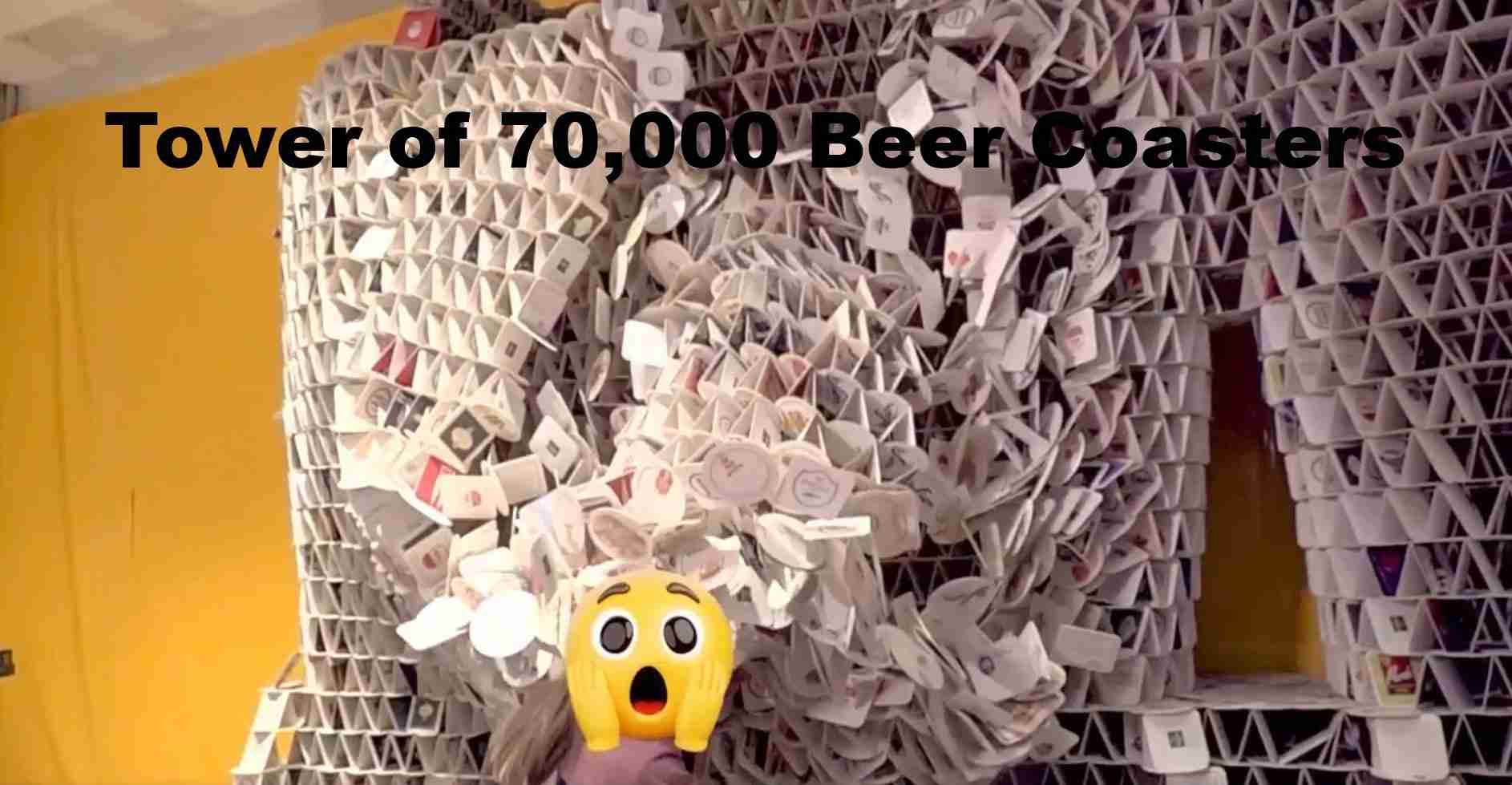
63,000 beer coaster tower collapses after girl pulls single piece in Cologne viral video
A viral January 10, 2026 video from Cologne shows a young girl pull one beer coaster from an installation of roughly 63,000 mats by artist Benjamin Klapper — triggering a dramatic collapse that drew millions online.
- Quick facts: The installation, named Inside, used about 63,000 coasters and took Klapper roughly 120 hours to build; earlier structural failure meant the attempt could not be certified.
- Viral clip: A child removing a single horizontally placed coaster set off a cascading collapse filmed at the Rhein‑Center; the clip spread widely across social platforms and news sites.
- Sources & further viewing: Coverage and video appear on Tribune (Pakistan), Fox News, and Newsflare.
Building “Inside”: an ambitious attempt
Benjamin Klapper, a 49-year-old German artist who runs MuVi 3D GmbH, has worked with beer coasters for years and treated Inside as both a craft demonstration and a public performance. Klapper said he spent about 120 hours building the structure between Oct. 31 and Dec. 8, 2025, using roughly 63,000 circular paper mats commonly found under beer glasses.
He intended to break the Guinness World Record for the largest coaster tower, but an early partial failure altered the plan. Video posted by news outlets and users earlier shows sections sagging and sliding as evidence the installation was under structural stress before public interaction (Newsflare).
“The piece was meant to be public and performative,” Klapper said, emphasizing the building process as central to the artwork.
Partial collapse and the decision to invite the public
Reports indicate the tower partially collapsed under its own weight two days before completion, which disqualified the attempt from Guinness verification. Rather than dismantle the remaining sections, Klapper turned the damaged work into an interactive exhibit at the Rhein‑Center, inviting visitors to remove coasters one by one until the structure ultimately failed.
That choice shifted the project from a controlled record attempt to a public show, leading to numerous on-site recordings and the eventual viral footage shared widely online (Tribune; Fox News).
The viral moment: one pull, millions of views
The widely shared clip shows a small girl reaching forward and removing a single horizontally placed coaster. Immediately, a large section lost balance and the entire structure tumbled in slow, wave-like cascades — a spectacle viewers compared to a house of cards collapsing.
Witnesses’ audible reactions range from laughter to disappointment. News coverage notes the child was the daughter of one of Klapper’s helpers; she was participating in the interactive game and succeeded on her first try (Tribune).
Public reaction and questions about authenticity
The video generated diverse responses: admiration for the spectacle, sympathy over the failed record attempt, and skepticism about whether the footage was genuine or digitally altered. Commenters asked whether the clip could be AI-generated, while earlier video of a partial collapse provided context that the structure was already vulnerable (Newsflare).
Artist’s view and reaction
Klapper framed the outcome as part of the piece’s life cycle: creation, public engagement, and collapse. He described both the labor involved and the unpredictability of public interaction, accepting the viral moment as an extension of the work rather than a purely competitive failure (Fox News).
Implications for Redding, California
The Cologne episode offers practical lessons for local organizers in Redding across economic, political and social dimensions.
Economic impact
- Local events and attractions: Low-cost, high-visibility installations can draw foot traffic to malls, downtown areas, and festivals. Redding groups could stage interactive art or record-attempt stunts to boost shopping and tourism.
- Costs vs. benefits: Organizers should weigh the 120+ hours of labor and material costs against potential returns; sponsorships, volunteer labor, and clear clean-up plans reduce public expense.
Political consequences
- City role: Partnerships with private businesses can promote events without heavy taxpayer spending.
- Safety and liability: Permits, insurance and safety plans are essential when the public interacts with fragile structures.
Social effects
- Family engagement: Simple, family-friendly activities can strengthen community ties and provide low-cost entertainment.
- Media & reputation: Prepare messaging that emphasizes local values — craftsmanship, volunteerism and public safety — should a local event go viral.
Cultural relevance
The story highlights hands-on craft and dedication. Redding stakeholders could use similar projects to promote vocational training, maker spaces, and community workshops.
Practical applications for residents
- Event checklist: Safety assessments, volunteer training, signage, crowd control and clean-up plans; prefer private funding and sponsorships.
- Education: Use coaster-based builds to teach geometry, physics and design in schools and trade programs.
- Media readiness: If a local moment goes viral, have a short statement ready thanking volunteers, clarifying funding, and highlighting safety.
Reporting note & sources
This account draws on international coverage and video documentation. Primary references include:
Dateline: Cologne, Germany — Times Media Service. For video and further context see the links above.