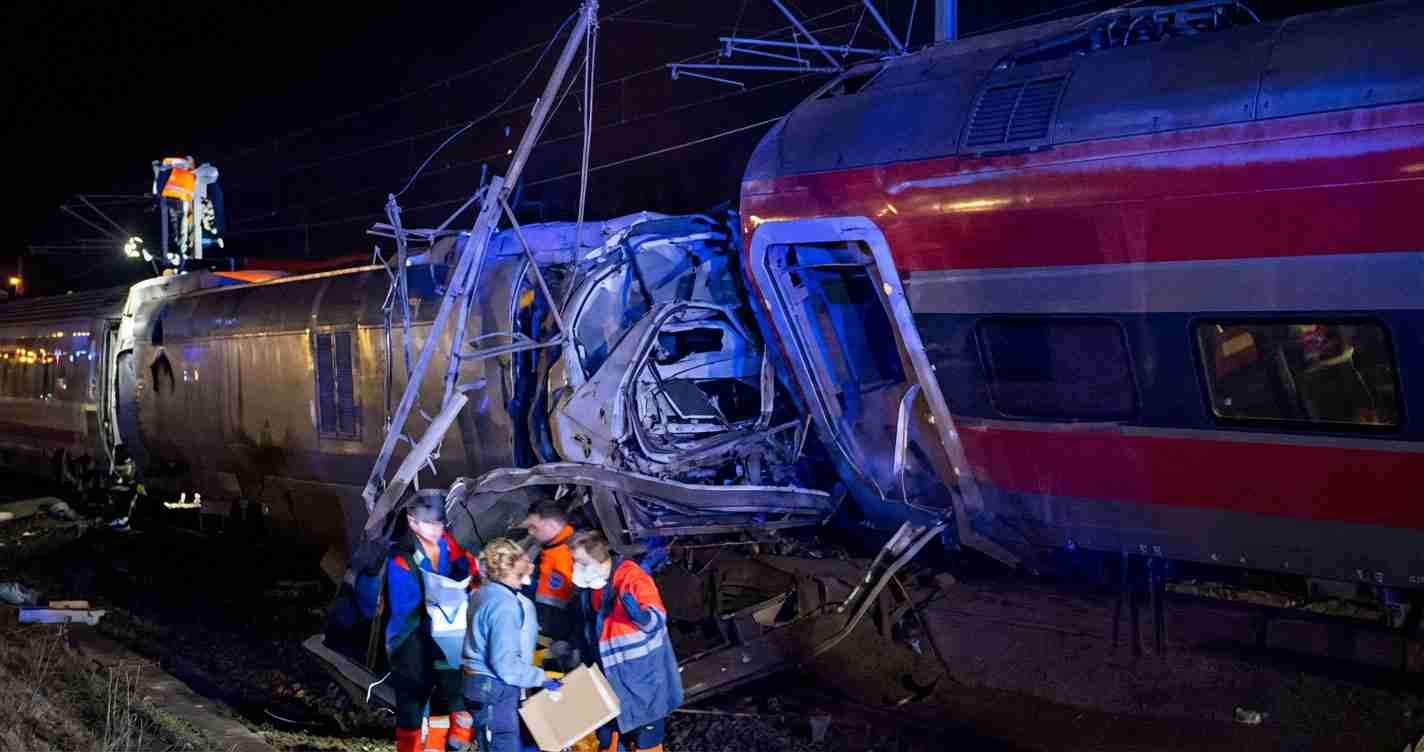
High-speed train collision near Adamuz kills at least 39; 245 injured
On Jan. 18, 2026, near Adamuz in Córdoba, southern Spain, a collision between Iryo 6189 and a Renfe Alvia killed at least 39 people and injured 245; rescue teams continue searching while authorities open a formal investigation.
Key takeaways
- Crash details: An Iryo 6189 derailed and crossed onto the opposite track, striking a Renfe Alvia on the Madrid–Andalusia corridor; the Renfe’s first two carriages fell down a ~4‑meter embankment.
- Casualties and passengers: At least 39 dead, 245 injured, about 15 critical, roughly 400 passengers aboard both trains combined.
- Investigation: Cause unknown — officials call the derailment “really strange” given recent renovations; Transport Minister Óscar Puente is overseeing a probe that may take about a month for a preliminary report.
- Sources: Initial reporting compiled from The Independent, WGLT, and an ongoing Wikipedia compilation.
Details of the crash
When: Shortly before 7:40 p.m. local time on Jan. 18, 2026. Where: Near Adamuz, Córdoba province, southern Spain.
Reports indicate the Iryo 6189 (Málaga to Madrid) derailed while passing over a switch on a straight, flat section of track, then crossed onto the opposite track and collided head-on with a Renfe Alvia (Madrid to Huelva). Police and local media said the impact forced the Renfe’s first two carriages off the track and down a roughly 4‑meter (13‑foot) embankment, complicating rescue operations.
Early reporting puts the Renfe train’s speed at about 200 kph (≈125 mph) before impact. Many fatalities occurred in the Alvia’s first two carriages, which carried 37 and 16 people respectively on preliminary manifests. One train driver — a 27‑year‑old operating the Madrid-to-Huelva service — was among those killed.
Scene conditions and rescue
Rescuers worked through the night on a difficult scene. Spain’s Civil Guard, local civil defense teams and the Military Emergencies Unit were deployed; the defense ministry sent 15 vehicles and 40 personnel. The Spanish Red Cross opened a help center in Adamuz, and ADIF set up support spaces at major stations — including Atocha, Seville, Córdoba, Málaga and Huelva — for relatives of victims.
High-speed service on the Madrid–Andalusia corridor was suspended at least through Jan. 19 as authorities secured the scene and search-and-rescue operations continued.
Why investigators are puzzled
Rail officials and independent observers described the derailment as “really strange” because it occurred on a straight, flat section of track that had been renovated in May 2025 and was said to be in “perfect condition” after a €700 million investment. That contrast has focused attention on:
- the condition and operation of the switch at the derailment site;
- maintenance records and contractor oversight following the recent renovation;
- possible mechanical failure on the Iryo train (wheelsets, brakes, suspension);
- any role of human error or signaling faults.
Transport Minister Óscar Puente is leading oversight of the inquiry and warned a preliminary report could take about a month.
What we know about the trains
Iryo is a private high‑speed operator running Madrid–Málaga routes; the Renfe Alvia was a national operator on the Madrid–Huelva service. Preliminary passenger counts estimate about 300 people on Iryo 6189 and roughly 100 aboard the Renfe service, totaling around 400 travelers.
The Renfe train sustained the worst damage. Investigators will inspect both trains’ black boxes, maintenance logs and the switch equipment at the site as part of a full technical examination.
Official response and political fallout
Spain’s prime minister, Pedro Sánchez, cleared his schedule to address the crisis. National and regional leaders pledged cooperation with investigators and support for victims’ families. Opposition politicians and watchdog groups have already demanded detailed accounting of maintenance practices, contract oversight and safety checks given the recent investment and the reported good condition of the corridor.
Implications for Redding, California
Although this tragedy occurred overseas, there are clear lessons for local officials and taxpayers in Redding and Shasta County:
Economic and infrastructure oversight
High-profile crashes quickly raise questions about maintenance, contracting and oversight. The Adamuz accident demonstrates that large spending (e.g., the reported €700 million) must be paired with transparent audits, independent inspections and strict contract enforcement.
Public safety and emergency preparedness
Rescue difficulties — steep embankments, crushed carriages, access complications — underscore the need for mass‑casualty plans, interagency coordination, pre‑positioned equipment and trauma center surge capacity. Local leaders should review mutual aid agreements and realistic drills.
Fiscal accountability and public confidence
Taxpayers and officials must demand independent verification that projects meet safety goals, not only completion targets. Public confidence in transport systems depends on clear reporting of maintenance, safety checks and contractor performance.
Policy lessons
- Require third‑party audits for major infrastructure projects.
- Maintain clear, accessible maintenance logs and public reporting.
- Regularly test emergency response with realistic, multi‑agency drills.
- Budget for ongoing oversight and performance auditing, not just upgrades.
Questions investigators must answer
- Why did the Iryo train derail on a straight, renovated section of track?
- Did the switch fail, or was there a fault in the train’s wheelsets, brakes or suspension?
- Were signaling systems functioning and providing correct information to both drivers?
- Were maintenance logs and contractor oversight up to standard after the May 2025 renovation?
- Did human error play any role, and what did the drivers know in the minutes before the derailment?
Sources and ongoing reporting
Key reporting and ongoing updates are available from The Independent, a WGLT summary at WGLT, and the evolving Wikipedia compilation. Authorities have not released a full technical report; journalists and investigators will watch for black box data, maintenance records, signaling work logs and surveillance footage.
Note: This article preserves original reported figures and source links as of initial reporting; casualty and investigative details may be updated as authorities release new information.