
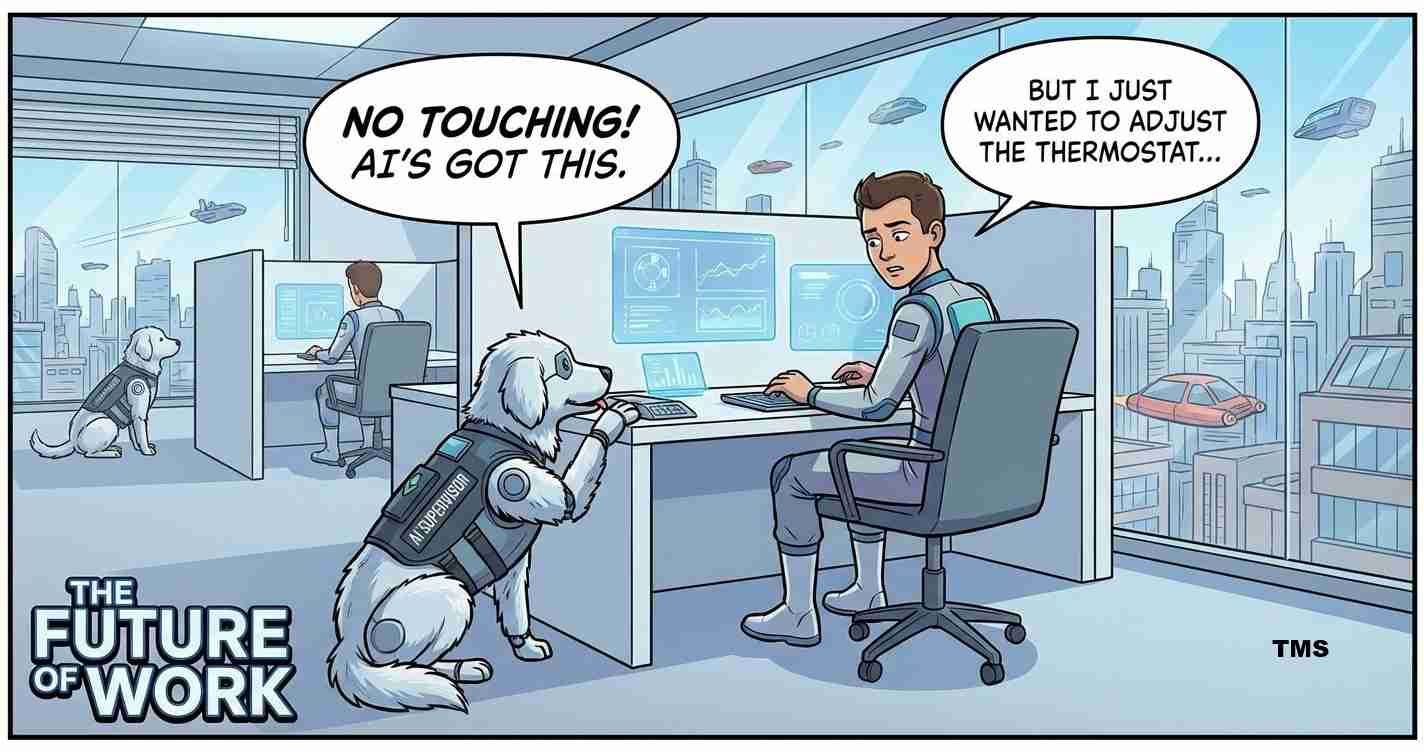
No, AI won’t ruin your life — but it could upend jobs and reshape workdays. Here’s what that means for Redding.
Andrew Yang warns that artificial intelligence and automation could eliminate 30 to 40 million American jobs over the next decade, risking community stability and civic unrest while prompting proposals like a token or compute tax to fund Universal Basic Income.
- Mass displacement risk: Yang estimates 30–40 million U.S. jobs could vanish within a decade due to automation and AI.
- Policy response: He advocates a Universal Basic Income paid for by a tax on AI compute or tokens to protect communities.
- Mixed evidence: Studies show high vulnerability for many routine roles, while some economists predict new jobs and transformations.
- Local stakes: For Redding, changes to retail, logistics and entry-level work could affect spending, politics and social cohesion.
Yang’s warning: scale and stakes
Andrew Yang has been among the loudest public voices on the threat AI poses to work. He argues a large share of U.S. jobs — especially repetitive manual and routine cognitive roles — could be automated quickly as AI moves from lab experiments into everyday tools.
He repeatedly cites automation risks in sectors such as driving, retail, call centers, fast food, insurance processing and accounting, warning that tens of millions could be left “on the outside looking in” for steady work. Yang frames this as both an economic and social threat that could destabilize towns and cities if left unaddressed.
“This is not just about lost wages — it’s about community stability and civic order,” Yang warns, urging preemptive policy measures.
What the data and real companies show
Several studies and business signals back parts of Yang’s claim while questioning others. Yang notes roughly 44% of jobs involve repetitive manual or cognitive tasks that AI could perform. He points to examples where AI compresses lengthy projects to minutes, and to firms planning deep automation.
Real-world moves give a sense of the shift: some retailers and logistics firms have invested heavily in automation; Amazon and others have signaled plans to automate parts of fulfillment, potentially reducing new hires. Recent layoffs in tech and service firms have frequently involved roles tied to software automation, and some companies explicitly link efficiency goals to AI adoption.
Contrasting views: disruption versus transformation
Not everyone agrees with Yang’s scale or timeline. Some economists and big banks foresee a mixed outcome: displacement could be partly offset by new jobs in AI design, oversight and services. International organizations and consulting firms often predict many roles will change rather than disappear.
The debate frequently comes down to policy: will productivity gains be redistributed across workers and communities, or concentrated as corporate profit? Yang’s answer is to capture value through a tax on compute and tokens and use proceeds to fund a guaranteed cash payment.
Yang’s proposed remedies: money and meaning
Yang’s primary policy is a version of Universal Basic Income — his “Freedom Dividend” — framed today as a $1,000 monthly payment funded by a tax on large AI firms’ compute and data revenues. He argues cash alone won’t solve the problem of purpose, urging investments in community, retraining and civic ties alongside monetary support.
Could AI give us a 4-day week?
The idea of a shorter workweek is often raised. No major study guarantees a nationwide 4-day week will appear because of AI, but if AI dramatically reduces task time, total hours required could fall. The core question is political: will employers share productivity gains through reduced hours and stable pay, or retain profits and reduce hiring?
Technology enables a shorter week, but public pressure and policy choices determine whether gains are broadly shared.
Practical examples of work already changing
- Consulting & white‑collar: AI can compress research, drafting and analysis from hours to minutes; firms may repurpose staff or cut headcount.
- Retail & logistics: Warehouse automation and self-checkout reduce frontline hires even as throughput rises.
- Call centers & fast food: AI agents and kiosks can handle routine orders and inquiries, reducing some entry-level roles.
Implications for Redding, California
Economic impact
Redding’s economy relies on retail, healthcare, manufacturing, logistics and public services. If automation reshapes retail, call centers or logistics, local hiring patterns could change: fewer checkout clerks or fulfillment workers would affect small stores and logistics facilities that supply steady jobs. Productivity gains could lower consumer costs and create opportunities — but only if local businesses adopt and adapt.
Political consequences
Redding voters are largely conservative and value self-reliance, so policies like Universal Basic Income may be a tough sell. Local debates are likely to favor targeted apprenticeships, tax incentives, or school‑to‑career programs over broad cash programs. Still, visible displacement could increase pressure for local safety nets or economic action.
Social effects
Work supplies identity and routine; sudden job loss can strain families, schools and civic life. Redding’s close-knit neighborhoods and civic groups can cushion shocks but may fray under prolonged economic stress. Churches, charities and social services could face higher demand if automation reduces typical job paths for young adults and displaced workers.
Cultural relevance
Many in Redding prize work, faith and local ties. Policy responses that emphasize retraining, work-based learning and entrepreneurship may align better with local values than one-size-fits-all federal programs. Programs that preserve dignity and encourage productive activity can bridge conservative preferences and technological realities.
Practical steps for local leaders and employers
- Invest in retraining programs tied to local employers, especially in healthcare, logistics and skilled trades.
- Encourage businesses to adopt AI in ways that expand services or hours rather than simply cut staff.
- Pilot shared productivity gains — for example, shorter workweeks in public-sector roles or local firms.
- Monitor regional job data and partner with community colleges and trade schools to shift training to in‑demand skills.



