
Federal judge blocks Trump National Guard Portland deployment, ruling move may exceed presidential authority
A federal judge has issued a temporary restraining order blocking the Trump administration’s immediate federalization of 200 Oregon National Guard troops to Portland, saying the deployment may exceed presidential authority while the court reviews legal challenges.
- Judge halts deployment: U.S. District Judge Karin Immergut issued a temporary restraining order while the court reviews whether the president exceeded statutory authority; see the court order report.
- White House action contested: A White House memo authorized the immediate federalization of 200 Oregon National Guard members to Portland for 60 days to protect federal property near the ICE facility; read the White House memo coverage.
- State leaders sued: Governor Tina Kotek, Attorney General Dan Rayfield and Portland Mayor Keith Wilson sued, arguing the move exceeded federal authority and lacked state consent; see Oregon’s lawsuit report.
Immediate deployment and White House rationale
The White House issued a memo authorizing what officials described as the immediate federalization of 200 Oregon National Guard troops to Portland for up to 60 days to secure federal property and personnel near the U.S. Immigration and Customs Enforcement facility. The administration framed the action as necessary to protect federal sites amid ongoing protests; President Trump called Portland a “war-ravaged city” in public statements defending the move. For reporting on the authorization, see the OPB story and related coverage in India Today.
Oregon’s legal challenge and the TRO
State leaders quickly filed suit in federal court, arguing the administration’s invocation of Title 10 to federalize the Oregon National Guard violated federal statutes and the Constitution because it lacked the governor’s consent and the conditions that permit such federal action. The complaint asserts the administration overstated threats to justify seizing control of state troops and improperly sought to use military forces in civilian law-enforcement roles. See coverage of the state lawsuit.
On Saturday, U.S. District Judge Karin Immergut issued a temporary restraining order halting the deployment while the court considers the legal arguments, concluding the plaintiffs demonstrated a likelihood that the president’s action may exceed his authority under federal law. Read the initial TRO report from India Today.
Judicial assignment and recusal
The case was first assigned to U.S. District Judge Michael Simon, who later recused himself after the administration criticized public comments by his wife, a member of Congress, about the deployment. That reassignment added procedural layers and heightened public attention on judicial handling of politically charged disputes.
Local response and on-the-ground protests
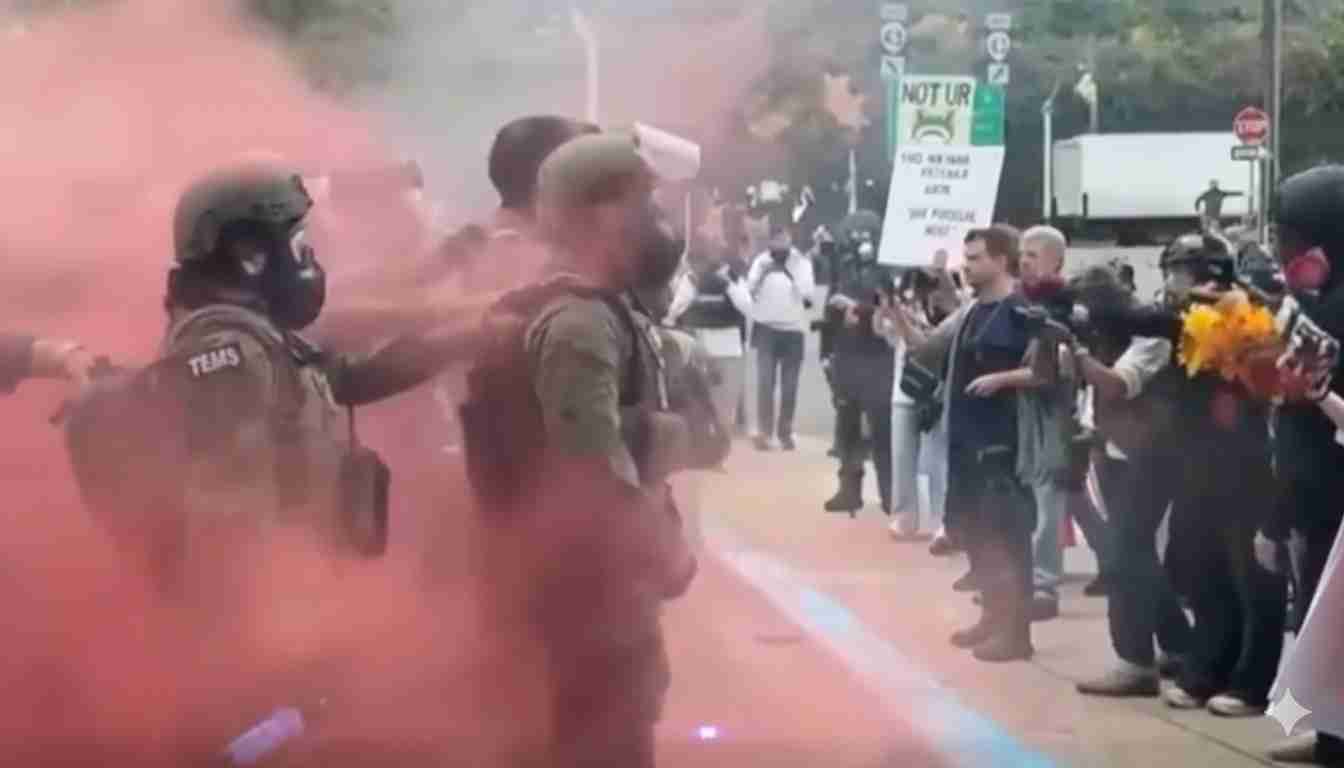
Authorization prompted immediate demonstrations outside the ICE building. Hundreds gathered to oppose what protesters called federal overreach; clashes with counter-protesters and federal agents followed, and authorities reported two arrests for assault. Portland and Oregon leaders pushed back against the White House portrayal of disorder, saying the rhetoric overstated threats that would justify military intervention. See reporting on the protests and local reaction in the OPB story.
“War-ravaged city” — the phrase used publicly by the president to describe Portland and defend the decision to federalize troops.
Legal context: presidential power and the Guard
At stake is the question of when the president can federalize a state National Guard without a governor’s consent. Federal law permits certain uses under Title 10, but the statutes and constitutional principles delineate federal and state control. Oregon’s lawyers argue the present circumstances do not satisfy statutory exceptions and warn that allowing unilateral federalization could erode state sovereignty and expand executive authority in domestic matters. The TRO underscores the judiciary’s role in resolving these statutory and constitutional disputes.
Why the dispute matters to conservatives
For conservative readers and local officials in places like Redding, this case raises familiar priorities: a strict reading of constitutional limits, protection of state sovereignty, accountability in the use of force, and the rule of law. Some conservatives favor strong federal action to protect federal property and enforce immigration laws; others caution against expanding executive power in ways that could be repurposed in future domestic conflicts. This case sits at the crossroads of those competing concerns.
Implications for Redding, California
Economic impact
Deployments such as this can shift budgetary responsibilities. If federal agencies increasingly rely on federalized military forces to protect federal buildings, costs and obligations could move between federal and state accounts. Redding taxpayers could feel indirect effects if state budgets must adjust for legal fees or litigation-related expenses.
Political consequences
The dispute spotlights tensions between state and federal authority that resonate in California politics. Local leaders in Redding and Shasta County may view the case as precedent-setting on the limits of presidential power without state agreement. The outcome could influence future coordination between local officials and federal agencies.
Social effects
The Portland protests and the federal response demonstrate how local demonstrations can escalate into national debates. Community leaders in Redding should monitor how federal and state actors communicate during tense demonstrations to avoid escalation and preserve public safety; both sides should plan for lawful, peaceful protest and clear interaction with law enforcement.
Cultural relevance
Characterizations of Portland and the push to secure ICE facilities touch on cultural and political fault lines familiar to Redding readers: public order, immigration policy, and responses to protests. The ruling spotlights the tension between protecting property and upholding legal limits on federal power.
Practical applications for residents
- Watch the case: Local officials and residents should follow proceedings because the legal outcome could shape federal agency operations during protests near federal facilities.
- Plan for coordination: Emergency response and interagency planning may change depending on whether courts limit or permit broader federalization of state Guard units.
- Emphasize lawful protest: The episode is a reminder to community groups to plan for lawful, peaceful demonstrations and clear communication with law enforcement.
Relevant sources and further reading
- Oregon Public Broadcasting: Trump administration authorizes Oregon National Guard for deployment in Portland
- Oregon Public Broadcasting: Oregon, Portland sue Trump administration over deployment
- India Today: U.S. judge halts Trump administration from deploying National Guard in Portland
The court’s temporary restraining order leaves the disputed Oregon National Guard deployment in limbo while judges weigh statutory limits and constitutional principles. The case will be closely watched for what it may mean for federal authority, state sovereignty, and responses to protests near federal facilities.


