
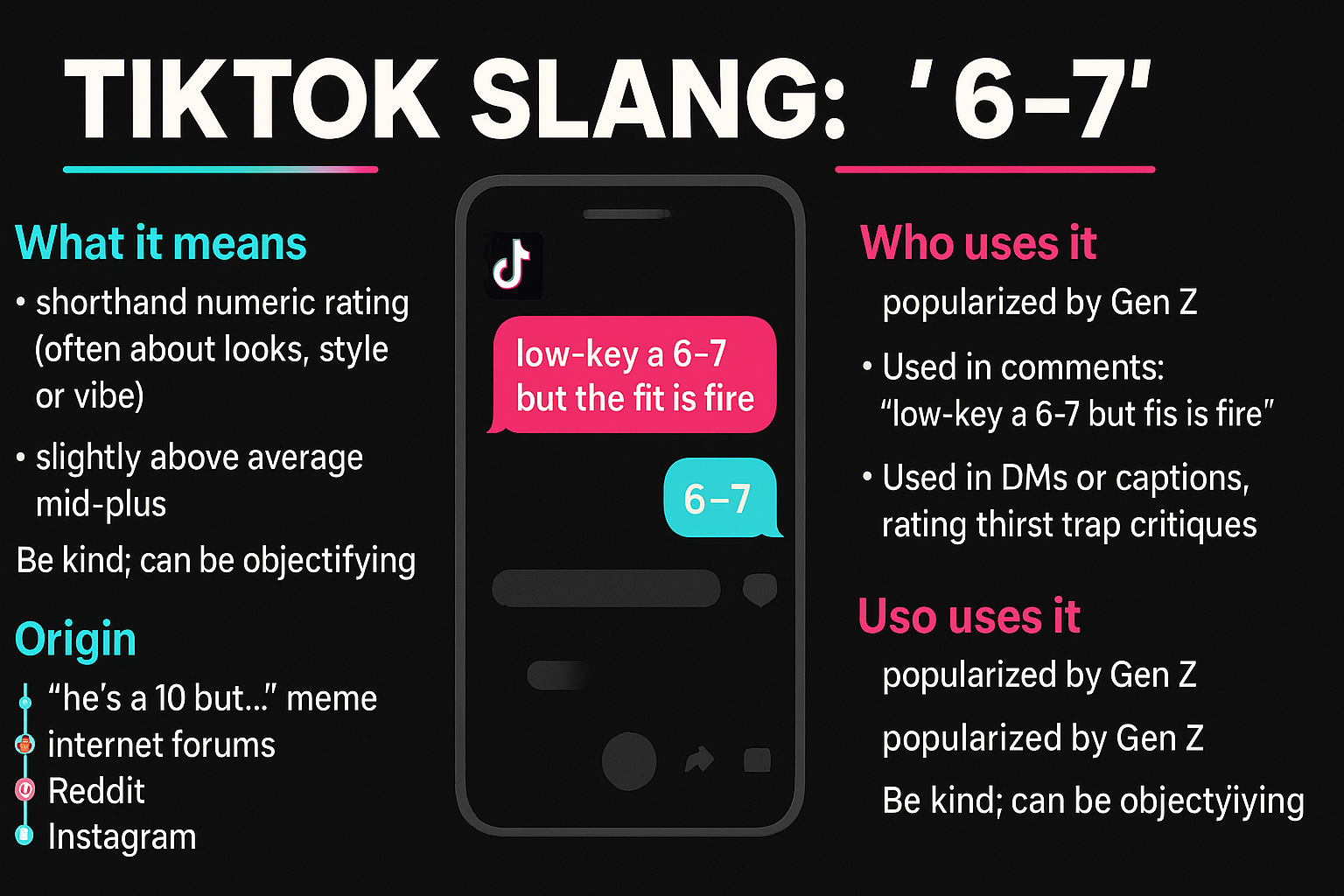
What Does “6‑7” Mean? How a Skrilla Hook Became TikTok’s Latest Inside Joke — and Why Redding Parents Should Pay Attention
A viral TikTok catchphrase, ‘6‑7’ sprang from Skrilla’s hook in ‘Doot Doot (6 7)’, becoming a Gen Z/Gen Alpha inside joke and meme across platforms nationwide — often nonsensical, sports-linked, and signaling online belonging among teens.
Key takeaways
- Origin: The phrase rose from Skrilla’s repeating hook in the song Doot Doot (6 7) and spread via short audio loops.
- Usage: Primarily a playful, often nonsensical meme used on TikTok, Instagram, Discord and more, sometimes tied to 6’7″ athletes like LaMelo Ball.
- Local relevance: For Redding parents and educators, it’s a cue to discuss media literacy, online circulation, and safe social media habits.
Origin and meaning: Skrilla, a hook and a number
Short answer: there mostly isn’t a single, stable meaning. The meme originated from a repeating lyric in Skrilla’s song Doot Doot (6 7), released in late 2024 and widely circulated in early 2025. The repetition and rhythm made the clip ideal for short-loop platforms, where sound snippets drive remix culture.
Some creators give it a literal spin — pointing to athletes listed at 6’7″, notably LaMelo Ball — while others treat it as a nonsensical tag or inside joke. Observers generally agree the number’s virality is rooted in rhythm and replay rather than a hidden message (Wikipedia — 6-7 (meme); FindMyKids — What does 6-7 mean (slang)).
How “6‑7” spread on social media
The mechanics are familiar: a short audio hook becomes sticky, creators remix it into edits and parodies, and platform algorithms amplify clips that trigger replays and engagement. TikTok sparked the trend; it then migrated to Instagram Reels, Snapchat, Discord, and private group chats where teens repurpose the sound for challenges and captions.
“6‑7” functions more as a meme-format than a defined word — a musical shorthand that signals participation.
Coverage and explainers document this trajectory: see Parade — What does 6-7 mean and regional reporting that tracks the hashtag’s use (NorthJersey — 6-7 slang term meaning and use on TikTok).
Who is using “6‑7”
Primary adopters: middle and high school students — Gen Z and Generation Alpha — who are highly active on short-form platforms. Teachers, parents, and commentators sometimes reuse the phrase when explaining youth culture to older audiences.
Social function: the term signals belonging and online savvy. Saying or typing 6‑7 can mark someone as part of the in-group, similar to earlier numeric memes like “21” or “1738” (see FindMyKids — What does 6-7 mean (slang)).
Cultural impact and actual use
In public content — TikTok posts, sports edits, hallway laughter — the phrase is entertainment. In private chats it can act like a short joke or password. While largely harmless, the speed of spread highlights how short musical hooks become cultural markers that move faster than traditional media cycles.
Scholars and journalists note that soundbite-driven trends reshape attention economy dynamics: the seed (Skrilla’s hook) plus fertile digital culture produces rapid, wide diffusion (Wikipedia — 6-7 (meme)).
Gen Z memes explained: context matters
Key point: many Gen Z memes are less about literal definition and more about participation, editing skill, and shared humor. 6‑7 exemplifies a meme built from music, used in sports content, adapted to challenges, and kept alive as an in-joke among peers (see Parade — What does 6-7 mean).
Implications for Redding, California
While the direct economic or political impact on Redding is minimal, the trend matters locally for media literacy, school policy, and community engagement. Short-form audio clips influence how local creators, schools, and businesses communicate and how teens socialize online.
For conservative parents and community leaders, the relevant conversations center on responsible social media use, age-appropriate content, and how schools teach digital literacy.
Practical applications: guidance for parents, teachers and local organizations
- Ask to see the trend: request your child show the videos — watching together builds trust and context.
- Use it as a teachable moment: discuss online circulation, copyright issues around audio clips, and permanence of posts.
- For local businesses: tasteful short TikTok clips using trending audio can boost engagement, but align content with community standards.
- For schools: incorporate media literacy modules explaining how hooks become memes and how to navigate online interactions safely.
Reporting sources
This account draws on online explainers and news coverage. See full references below:
- Wikipedia — 6-7 (meme)
- FindMyKids — What does 6-7 mean (slang)
- Parade — What does 6-7 mean
- NorthJersey — 6-7 slang term meaning and use on TikTok
Who to contact locally
Redding parents and educators seeking guidance can contact school district media coordinators, youth counselors, or the public library for media literacy resources. For safety concerns or if a trend escalates into harassment, consult local law enforcement or school resource officers.



