Treasury moves to bar undocumented immigrant tax benefits from refundable federal tax credits, Bessent says
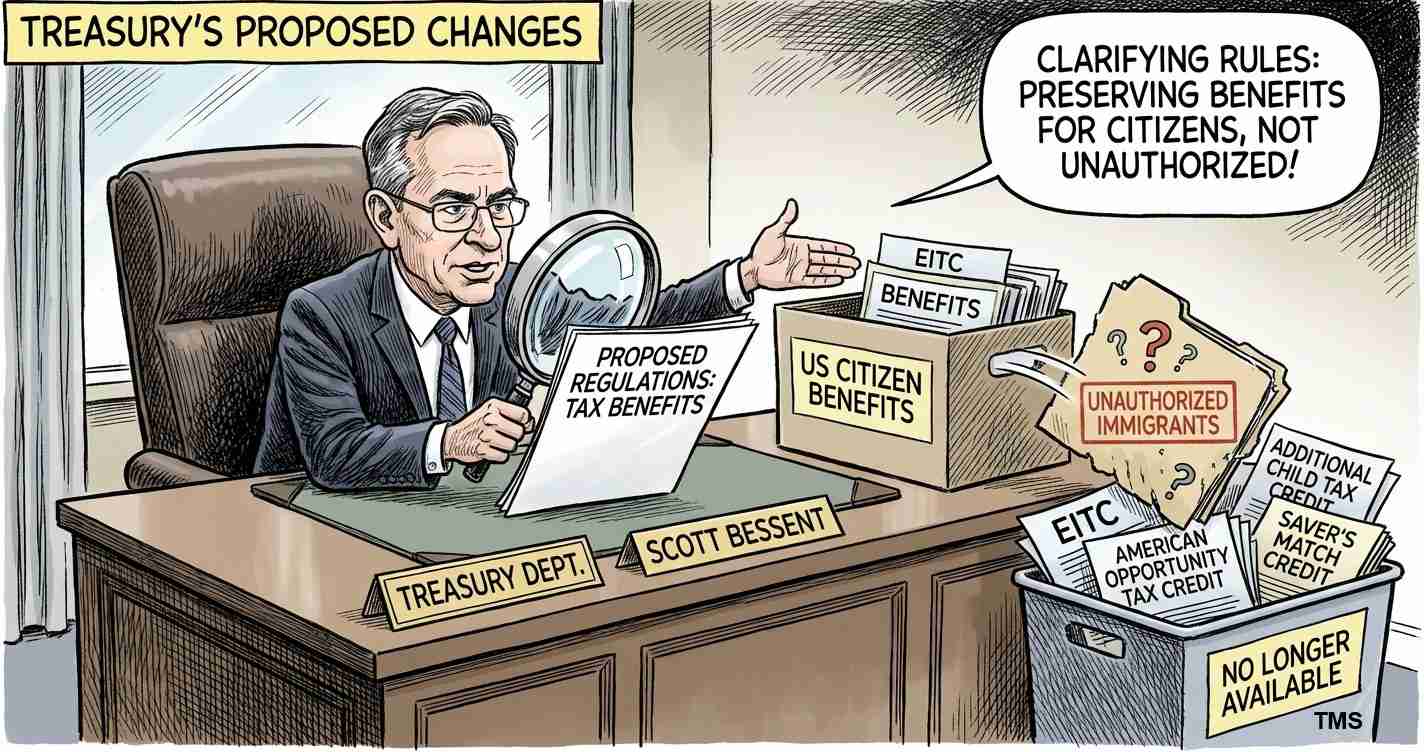
The Treasury Department, led by Secretary Scott Bessent, on Nov. 20, 2025 proposed rules to bar undocumented and non‑qualified aliens from receiving refunded portions of several federal tax credits, citing DOJ guidance and PRWORA restrictions.
Key takeaways
- Treasury proposed regulations clarify refunded portions of four credits are not available to undocumented or other non‑qualified aliens, per the department’s press release: Treasury Department press release.
- The affected credits are the Earned Income Tax Credit, Additional Child Tax Credit, American Opportunity Tax Credit, and the Saver’s Match.
- Treasury relies on a DOJ Office of Legal Counsel opinion treating refundable portions of these credits as federal public benefits under PRWORA (8 U.S.C. §1611).
- The rules are expected to take effect beginning with tax year 2026; the Saver’s Match restrictions align with its statutory start for tax years after Dec. 31, 2026.
Policy announcement: what Treasury said
Treasury Secretary Scott Bessent characterized the proposed rules as enforcement of existing law and a measure to protect American taxpayers. The department said Treasury’s Office of Tax Policy and the Internal Revenue Service collaborated on drafting the proposed regulations to implement the change. See the department statement: Treasury Department press release.
“Under President Trump’s leadership we are enforcing the law and preventing illegal aliens from claiming tax benefits intended for American citizens,” Bessent said in the Nov. 20 statement.
The department listed four refundable tax credits whose refunded portions it would restrict for undocumented and other non‑qualified aliens: the Earned Income Tax Credit (EITC), the Additional Child Tax Credit, the American Opportunity Tax Credit, and the Saver’s Match Credit. Treasury described the initiative as protecting the integrity of federal tax policy and ensuring limited taxpayer resources go to those legally entitled to benefits.
Legal basis and timeline
Treasury’s action rests on an opinion from the Department of Justice’s Office of Legal Counsel that treats refundable portions of the listed credits as “federal public benefits” under the 1996 Personal Responsibility and Work Opportunity Reconciliation Act (PRWORA), codified at 8 U.S.C. §1611. Under PRWORA, non‑qualified aliens are generally barred from federal public benefits; Treasury says the OLC analysis supports applying that bar to refundable tax offsets.
Treasury plans to publish proposed regulations and implement the rules beginning with tax year 2026. The Saver’s Match program, created by the SECURE 2.0 Act, already contains explicit language excluding non‑resident aliens; Treasury’s guidance will align other credits with that exclusion where applicable.
Further context and department materials are available in the official release: Treasury Department press release.
Political context and immediate catalyst
The policy rollout occurred hours after a shooting in Washington, D.C., involving two National Guard members and a 29‑year‑old Afghan national, an incident that renewed debate over immigration enforcement. The announcement followed public criticism from President Trump on social media and has been linked in media coverage to broader administration priorities on immigration and border security. See coverage in Times of India coverage of the announcement and related events.
Debate and legal concerns
Tax and immigration law experts are divided on the scope and legality of Treasury’s reinterpretation. Critics contend that for decades refundable tax credits were treated as distinct from public benefits governed by PRWORA, and that denying credits may conflict with the tax code and longstanding administrative practice.
Brandon DeBot, policy director at the NYU Tax Law Center, warned the move could wrongly deny credits to many lawfully present immigrants — including people with DACA and TPS statuses and visa holders such as H‑1B, H‑2A, and student visa categories — arguing that explicit congressional action would be required to change access to tax credits.
Supporters — including conservative groups and some lawmakers — argue the change closes a loophole and protects taxpayer resources. Treasury framed the initiative as necessary to preserve tax system integrity.
For analysis on Saver’s Match and related regulatory guidance, see the ASPPA summary: ASPPA summary and analysis on Saver’s Match and related guidance.
Practical effects on filing and enforcement
If finalized, the change will affect processing of refunded federal tax credits for filers using an Individual Taxpayer Identification Number (ITIN) or otherwise lacking “qualified alien” status. The IRS and tax preparers will need to update guidance and systems to screen eligibility under PRWORA standards, which may increase scrutiny of returns, prompt documentation requests, and raise compliance costs for preparers and the IRS.
Treasury said its Office of Tax Policy and the IRS have been coordinating implementation efforts to minimize disruption. Official materials and notices will appear through Treasury and IRS channels, beginning with the department release: Treasury Department press release.
Implications for Redding, California
Local effects in Redding and Shasta County could be meaningful across economic, political and social dimensions, especially for households and employers that rely on seasonal and immigrant labor.
Economic impact
Redding’s economy—driven by small businesses, agriculture, construction and services—includes workers who may file using ITINs. Limiting refundable credits could reduce household disposable income, with knock‑on effects for local businesses and increased administrative burdens for tax preparers and community organizations.
Political consequences
In conservative‑leaning Shasta County, the move is likely to resonate with voters who prioritize law and order and border security. Local elected officials emphasizing fiscal responsibility may publicly support the policy, and the issue could surface in campaign debates and town halls.
Social effects
If refundable credits are denied or delayed, affected families could face short‑term financial strain. Nonprofits and faith‑based groups that provide tax assistance may see increased demand as residents navigate documentation and eligibility issues.
Cultural relevance
For communities valuing self‑reliance and stewardship of taxpayer dollars, the Treasury action may align with local cultural priorities. Messaging that frames the change as closing a loophole and prioritizing citizens and lawful residents is likely to find an audience among many Redding readers.
Practical applications for residents
- Tax season prep: Monitor IRS guidance and Treasury proposed regulations to learn what documentation will be required for refundable credits. Refer to the official release: Treasury Department press release.
- Assistance resources: Organizations offering free or low‑cost tax preparation may require updated training and resources to advise clients correctly.
- Employers and payroll: Businesses employing workers without Social Security numbers should consult tax advisors about withholding and reporting changes that may follow.
- Public discussion: Local officials and community leaders should prepare to answer questions on family impacts and the local labor market.