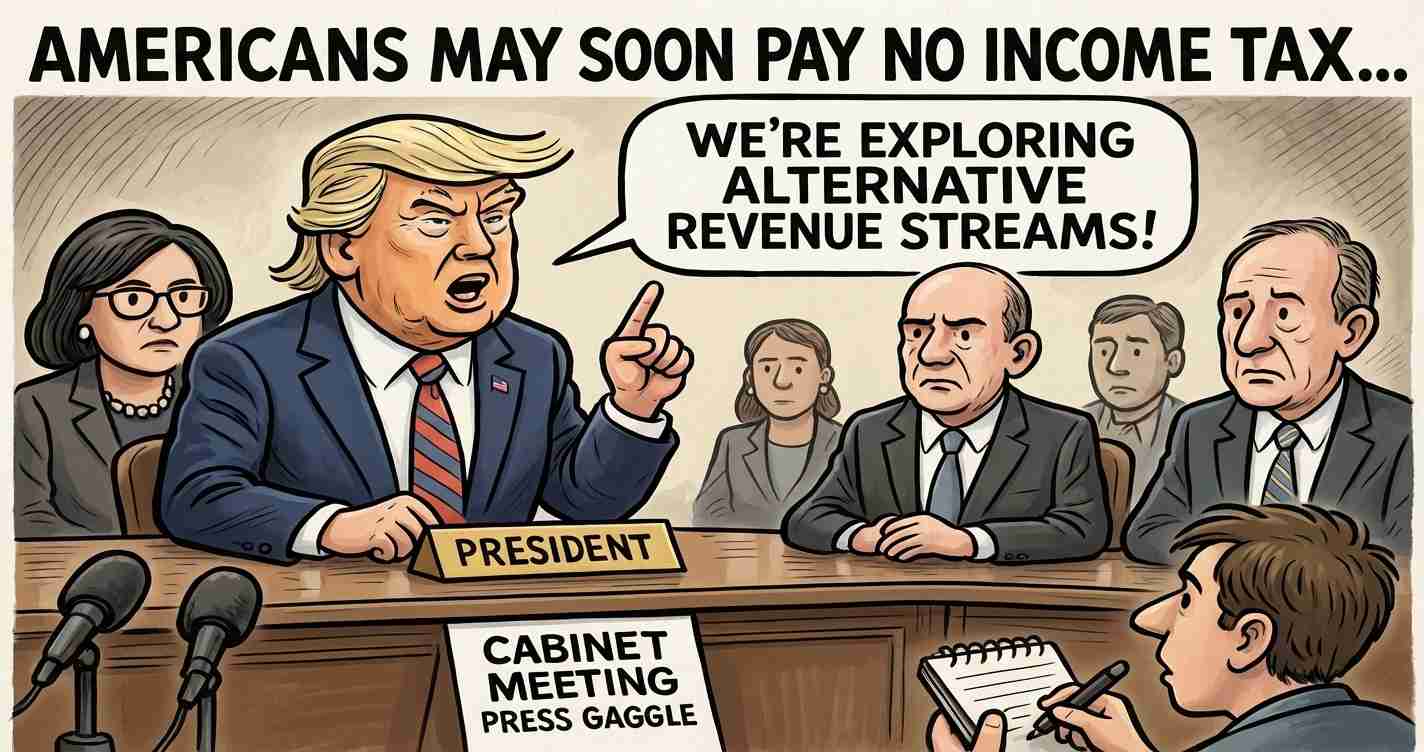
Trump pushes radical tariff-driven plan that could end federal income tax, promising refunds as White House explores alternatives
President Donald Trump unveiled a proposal to eliminate federal income taxes in favor of tariff revenue, suggesting refunds from surplus collections; economists warn the plan may leave a massive budget shortfall and trigger higher consumer prices and trade retaliation.
Key takeaways
- Tariff-driven proposal: Trump says income taxes could end within years as tariff receipts surge — source: CPA Practice Advisor.
- Administration exploring alternatives: The White House is considering a tariff revenue plan to fund targeted relief — source: Fox Business.
- Large revenue gap: Income taxes bring ~$2.7T annually vs. ~ $258.1B from tariffs in 2025 — analysis cited by CPA Practice Advisor.
- Legislative alternative: The FairTax Act of 2025 would replace income tax with a national sales tax and dismantle the IRS — text: Congress.gov.
TRUMP’S BOLD VISION FOR TAX REFORM
President Trump told Cabinet members that tariff receipts are “so great… so enormous” and suggested federal income taxes could be eliminated within “two, three, four years,” with the possibility of refunds from surplus tariff collections. The administration’s pitch: use tariffs to shift the tax burden from Americans to foreign exporters. (Source: CPA Practice Advisor)
“We’re going to be giving back refunds out of the tariffs because we’re taking in literally trillions of dollars.” — President Donald Trump (CPA Practice Advisor)
Trump framed the approach as a trade-first tax policy, arguing “instead of taxing our citizens to enrich foreign nations, we should be tariffing and taxing foreign nations to enrich our citizens.” Earlier remarks proposed eliminating income tax for households earning under $150,000 as part of a broader trade-focused strategy. (Source: Fox Business)
REVENUE GAP AND ECONOMIC CONCERNS
Economists warn the arithmetic is stark: federal income taxes brought in about $2.7 trillion annually (roughly 54% of total government revenue), while tariffs generated only about $258.1 billion in 2025 — a small fraction of what’s needed to sustain current spending levels. (Source: CPA Practice Advisor)
Dean Baker of the Center for Economic and Policy Research estimates that replacing income tax receipts with tariffs alone could increase the annual deficit by about $2.3 trillion, potentially lifting the deficit to roughly $4 trillion (≈13% of GDP) unless paired with major spending cuts or new revenue sources. (Source: CPA Practice Advisor)
Broader economic risks include higher consumer prices on imported goods, supply-chain disruptions, and potential retaliatory tariffs from trading partners that could harm U.S. exporters — risks that may fall heaviest on middle- and lower-income households unless policymakers design strong offsets. (Source: analysis and data cited in CPA Practice Advisor)
ADMINISTRATION’S ALTERNATIVE APPROACH
Treasury Secretary Scott Bessent has suggested a narrower, more targeted use of tariff receipts rather than a wholesale elimination of income tax. Proposed items under discussion include:
- Exempting tips from income tax
- Exempting Social Security benefits from taxation
- Removing tax on overtime pay
- Restoring interest-deduction rules for American-made cars
Those measures could be easier to sell politically, but they still require credible revenue estimates: tariff collections can fluctuate with trade volumes, exchange rates, and global growth, so Treasury would need to demonstrate reliable revenue streams. (Source: CPA Practice Advisor)
LEGISLATIVE CONTEXT: FAIRTAX ACT AND POLITICAL HURDLES
On Capitol Hill, the FairTax Act of 2025 proposes abolishing the federal income tax, replacing it with a national sales tax administered primarily by states, and dismantling the Internal Revenue Service. Full text: FairTax Act of 2025 (Congress.gov).
Even with a White House push, passage would face steep hurdles: divided lawmakers, intra-party disagreements, and the practical need to secure 60 votes in the Senate to overcome a filibuster make a sweeping overhaul a difficult lift. (Source: Fox Business)
IMPLICATIONS FOR REDDING, CALIFORNIA
Economic effects
- Grocery and retail prices: Higher tariffs could push up prices on electronics, clothing and other imported goods, reducing household buying power even if income taxes fall. (See tariff vs. income tax revenue: CPA Practice Advisor)
- Local businesses: Shasta County firms that rely on imported parts or export goods could face higher input costs or retaliation — although some domestic manufacturers might benefit from protection. (Source: economic analysis and tariff data: CPA Practice Advisor)
Political consequences
- Local leaders will weigh tax relief against potential cuts to federally funded programs (education, infrastructure, disaster relief) if revenue gaps emerge. (Source: CPA Practice Advisor)
- Conservative voters may support lower income taxes; fiscally conservative locals may demand guardrails to avoid ballooning deficits. (Source: analysis and FairTax Act text)
Social and community effects
- Retirees and wage earners: Exempting Social Security benefits or easing taxes on tips/overtime could raise after-tax income for seniors and service workers in Redding. (Source: CPA Practice Advisor)
- Cost of living: Any tariff-driven price inflation could strain households facing high rents and mortgage costs, increasing demand for local services.
PRACTICAL APPLICATIONS FOR RESIDENTS
- Tax planning: Residents should monitor guidance from the IRS and Treasury; targeted exemptions would have immediate withholding and paycheck implications.
- Businesses: Small firms should review supply chains and pricing strategies to prepare for potential tariff-driven cost shocks.
- Civic leaders: County and city officials should engage with congressional staff to track grant and disaster-aid implications if federal revenue shifts occur.
POLICY TRADEOFFS THAT WILL MATTER LOCALLY
For Redding, the central question is whether reduced income taxes will outweigh higher consumer prices or diminished federal support. The outcome depends on the scale and stability of tariff revenue, potential trade retaliation, and congressional choices on spending. Residents and local officials will need precise Treasury estimates and independent analysis before endorsing sweeping change. (See tariff vs. income tax revenue comparison: CPA Practice Advisor)