Trump Calls Viral White House Window Clip “AI-Generated” as Officials Say It Was Maintenance
Donald Trump dismissed a viral clip showing an object tossed from a second-floor White House window as “AI-generated” and fake, contradicting a White House statement that attributed the footage to a contractor performing routine maintenance.
- President vs. press office: Mr. Trump labeled the clip fake/AI-generated while officials said it showed routine maintenance.
- Video ambiguity: The short, grainy clip shows a person in white pants dropping a dark object from a second-floor windowsill, with no clear identifying markers.
- Public concern: The discrepancy fueled speculation, conspiracy theories and debate about digital forgeries.
What the viral video shows
A short social-media clip — widely circulated on platforms such as TikTok — appears to show a person wearing white pants standing or climbing on a second-floor windowsill of the White House and then dropping or tossing a dark object down the facade. The footage is brief, grainy and lacks clear identifying details about who the person is or what the object contains, leaving viewers to draw competing conclusions.
Visible in the clip: a person on a second-floor sill and a dark object falling down the building’s front; no clear face, insignia or other identifying markers.
White House explanation: maintenance contractor
Within hours of the video spreading, White House officials told reporters the footage showed a contractor conducting routine maintenance while the president was away from the residence. The administration framed the scene as normal worksite activity captured and shared on social platforms rather than a security incident.
(Reported account: The Independent)
Trump calls it fake, points to sealed windows
At public events and during press interactions, Mr. Trump said he had not initially seen the clip but, when shown it, called the footage fake and likely AI-manipulated. He argued that White House windows are “heavily armored and bulletproof,” weighing roughly “about 600 pounds,” and cited extensive security-camera coverage as evidence the clip could not be genuine.
(On the president’s remarks: New Republic, Times Now)
Press exchange and follow-up
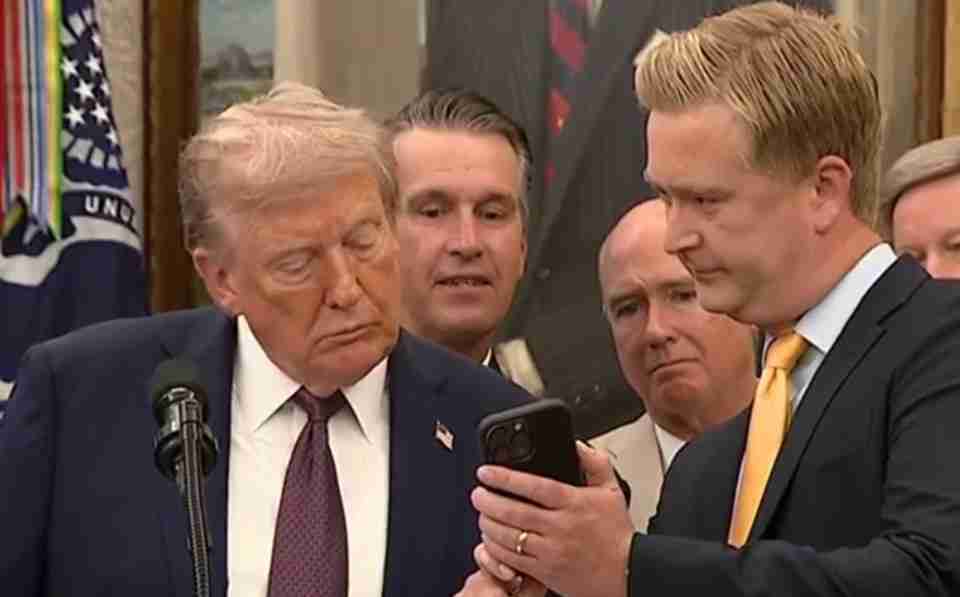
Reporters pressed Mr. Trump during a White House briefing — including Fox News’ Peter Doocy, who showed the president the clip — and Mr. Trump reiterated that it was fake and pointed to security-camera footage as contradictory evidence. That public exchange highlighted a gap between the president’s dismissal and the White House’s maintenance explanation, which intensified media attention.
(See a public showing of the clip during a briefing: Viral clip (example upload on YouTube))
Authenticity concerns and the AI debate
The timing of the clip and Mr. Trump’s immediate suggestion of AI manipulation fed a broader conversation about the reliability of short social videos. In an era of increasingly convincing deepfakes, journalists and the public debated whether the footage was genuine or digitally altered. The contrasting accounts — an administrative maintenance explanation versus the president’s claim that windows cannot open — left observers uncertain.
Public reaction and conspiracy theories
On social platforms the clip inspired a wide range of reactions: some users speculated about a health or security issue inside the residence; others focused on whether the windows could be opened; many raised the possibility of AI fabrication. The rapid spread illustrates how a brief clip can catalyze partisan narratives and conspiratorial speculation.
Why the discrepancy matters
The disagreement matters beyond optics. When a president publicly dismisses a widely shared clip while the White House staff provides a mundane explanation, it raises questions about internal communications, consistency in public messaging and who speaks authoritatively for the administration on security matters. It also underscores public concerns about digital forgeries and the need for verifiable facts.
Implications for Redding, California
Economic impact: The clip likely has no direct economic effect on Redding, but viral national stories can alter local consumer attention and social-media dynamics. Small businesses that rely on social platforms should reinforce vetting processes to avoid amplifying misleading content.
Political consequences: For conservative readers in Redding, the incident spotlights skepticism of mainstream narratives and concerns about information integrity; the president’s AI claim may be viewed as cautionary by some and as mixed messaging by others.
Social and cultural effects: The episode reinforces how fast rumors can proliferate. Redding community leaders and groups may consider media-literacy events to help residents spot manipulated videos and better evaluate official statements.
Practical steps for residents: verify sources before sharing, follow primary-source statements from officials, and prepare rapid-response messaging to correct misinformation when needed.
Reporting notes and source links
Journalistic standards followed
Reporting in this article draws on on-the-record remarks by the president, official White House comments and widely circulated social footage. Where accounts conflict, both explanations are presented and the continuing uncertainty about the clip’s authenticity is noted. Readers are encouraged to review the primary sources linked above for full context.