
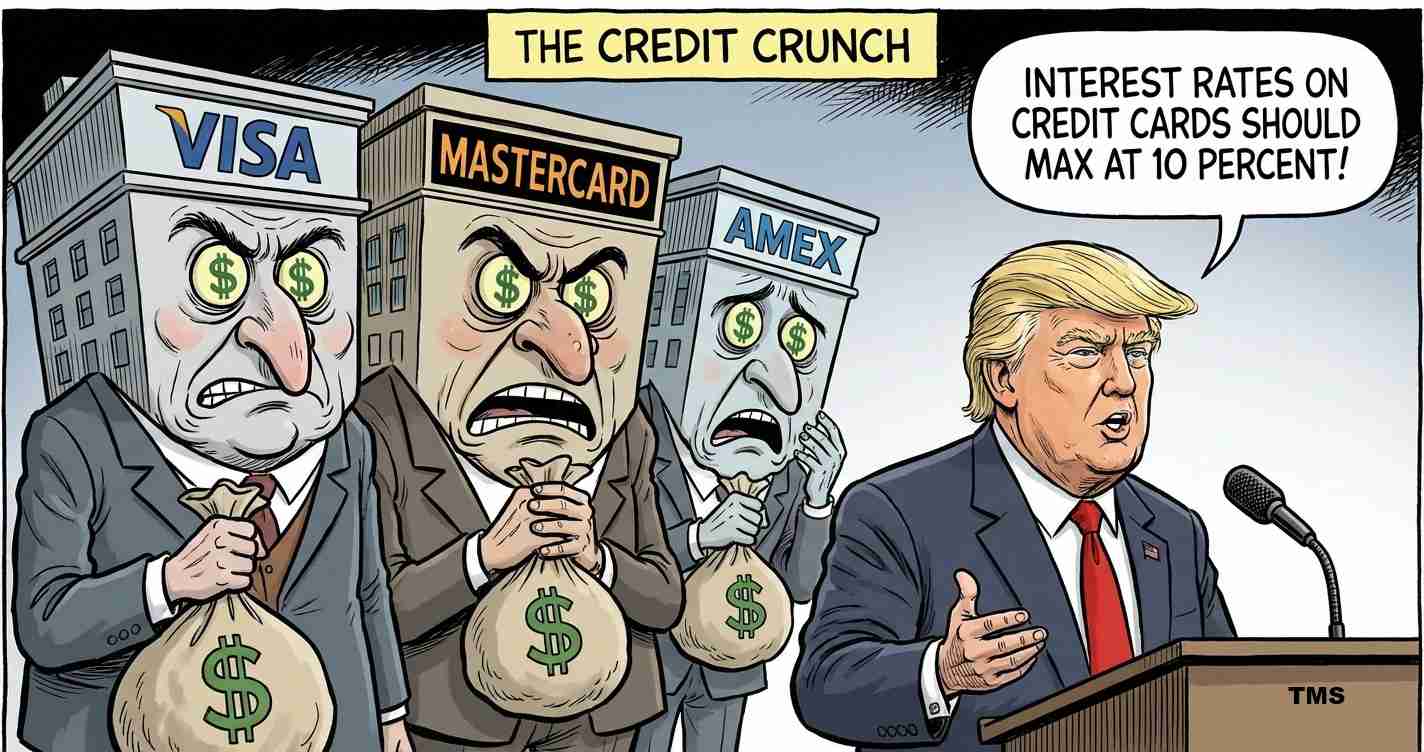
Trump calls for one-year, 10% nationwide cap on credit card interest rates, blames Biden administration as legal path remains unclear
Donald Trump proposed a one-year, 10% nationwide cap on credit card APRs starting Jan. 20, 2026, blaming the Biden administration; legal authority for a presidential cap is unclear and has sparked debate among experts and industry groups.
Key takeaways
- A Truth Social post said Americans are being “ripped off” and announced a one-year, 10% cap effective Jan. 20, 2026.
- Average credit card APRs above 20% mean a 10% cap would sharply lower borrowing costs for many households.
- Legal experts say a president likely cannot impose a nationwide cap alone; Congressional or statutory action is likely required.
- Industry warnings: Banking groups say a flat cap could reduce credit access and push higher‑risk borrowers toward higher-cost alternatives.
What Trump said and why
In a late Friday post on Truth Social, Trump wrote that Americans will “no longer let the American Public be ripped off by Credit Card Companies that are charging Interest Rates of 20 to 30%, and even more, which festered unimpeded during the Sleepy Joe Biden Administration.” He added: “AFFORDABILITY Effective January 20, 2026, I, as President of the United States, am calling for a one year cap on Credit Card Interest Rates of 10%.”
The announcement is part of a broader affordability message. His team has signaled other measures aimed at lowering borrowing costs, including proposals related to mortgage-backed securities and public pressure on the Federal Reserve to reduce benchmark rates; Trump also said he would appoint a Fed chair who would be “honest with interest rates.” Sources reported these themes alongside the announcement (CBS News; Business Insider).
Economic context: how big a change would 10% be?
Federal Reserve data cited by news outlets show average credit card APRs are above 20% today, meaning a 10% cap would roughly cut common rates in half for many borrowers and reduce interest costs substantially for households that carry balances month to month (CBS News).
Supporters say large card issuers are highly profitable and could operate at lower rates while easing strain on families. The idea has garnered bipartisan backing in Congress — Senators Josh Hawley (R‑Mo.) and Bernie Sanders (I‑Vt.) introduced a bill last year to impose a 10% national cap, and Representatives Alexandria Ocasio‑Cortez (D‑N.Y.) and Anna Paulina Luna (R‑Fla.) have a similar House proposal (CBS News).
Legal feasibility and limits of presidential power
While the announcement sets a political target, the path to enforce a 10% APR is unclear. Legal experts note a president cannot unilaterally impose a nationwide interest-rate cap on consumer credit without express statutory authority or new legislation from Congress. Reporting describes the move as likely political pressure rather than an immediately enforceable rule (Business Insider; CBS News).
It remains unknown whether the administration will send specific legislation to Congress, attempt regulatory action under existing statutes, or depend mainly on voluntary rate cuts and market pressure (CBS News; Business Insider).
Industry warnings and potential side effects
Banking and credit industry trade groups — including the American Bankers Association and the Bank Policy Institute — strongly oppose a flat 10% cap. They warn it would force issuers to cut credit or tighten standards, reducing access for many consumers and small businesses (CBS News).
The BPI estimated a 10% cap could cause more than 14 million U.S. households that rarely pay in full to lose or see major reductions in card credit; critics argue restricting card lending to low‑risk borrowers could push others toward less-regulated, higher-cost alternatives such as payday loans (CBS News).
Political framing and audience reactions
Trump framed the effort as a crackdown on corporate profiteering and a correction of what he described as inaction under the Biden administration. For conservative voters focused on pocketbook issues, the announcement is positioned as a populist effort to rein in big business (Fox Business; Business Insider).
At the same time, free-market critics and industry groups caution that price controls can have unintended effects, including reduced lending to higher-risk consumers and harm to small businesses that rely on card liquidity (CBS News).
Where this stands in Congress and policy debates
The 10% idea has advocates on Capitol Hill but faces uncertain prospects. Bipartisan bills by Senators Hawley and Sanders and a House pairing of Reps. Ocasio‑Cortez and Luna show cross-party interest, but passage would require lawmakers to weigh consumer relief against industry warnings about credit contraction (CBS News).
Regulatory options exist if the administration identifies statutory authority under federal banking or consumer-protection laws, but scholars caution that a broad White House-imposed, economy-wide interest-rate control faces constitutional and statutory limits (Business Insider).
Numbers and examples: what a cut could mean for borrowers
Example: a household carrying a $5,000 balance at a 22% APR pays roughly $183 in interest over six months (simplified). Dropping the rate to 10% would reduce that interest roughly by half, freeing monthly cash flow for many who carry revolving balances. Industry studies warn, however, that higher-risk borrowers could lose cards or face much lower limits under a strict cap (CBS News).
Status: what is known and what remains unclear
Known:
- Trump has publicly called for a one-year, 10% nationwide cap on credit card APRs starting Jan. 20, 2026, tied to his “AFFORDABILITY” theme (Fox Business).
- Average credit card APRs are above 20%, so the proposed cap would represent a major reduction (CBS News).
- Bipartisan interest in a 10% cap exists on the Hill, though measures have not become law (CBS News).
Unclear:
- Whether the White House will send legislation, attempt regulatory action, or depend on voluntary cuts by issuers (Business Insider).
- How Congress would respond given industry pushback and competing views on credit access (CBS News).
Implications for Redding, California
Economic impact: Many households in Redding carry credit card debt. If a 10% APR were enforced, local families with revolving balances would likely see lower monthly interest charges and more breathing room for household budgets, potentially boosting consumer spending at downtown and neighborhood businesses.
Credit access and small business: Local small-business owners who use cards for working capital could benefit from lower rates, but nationwide issuers narrowing credit could reduce available card options or limits. Community banks and credit unions serving Shasta County might play a larger role if national issuers scale back local lending (CBS News).
Political consequences: Redding’s conservative-leaning voters may be receptive to a message that frames lower credit costs as putting money back into family budgets and restraining corporate pricing. Local officials could face pressure to weigh in on congressional action or alternative reforms.
Social effects and practical concerns: For residents relying on credit for emergencies or medical bills, a 10% APR could reduce cost-of-living strain. Yet higher-risk consumers could see cards closed or limits cut, potentially pushing some toward payday lenders unless community lenders step in; policymakers should consider outreach and consumer education (CBS News).



