
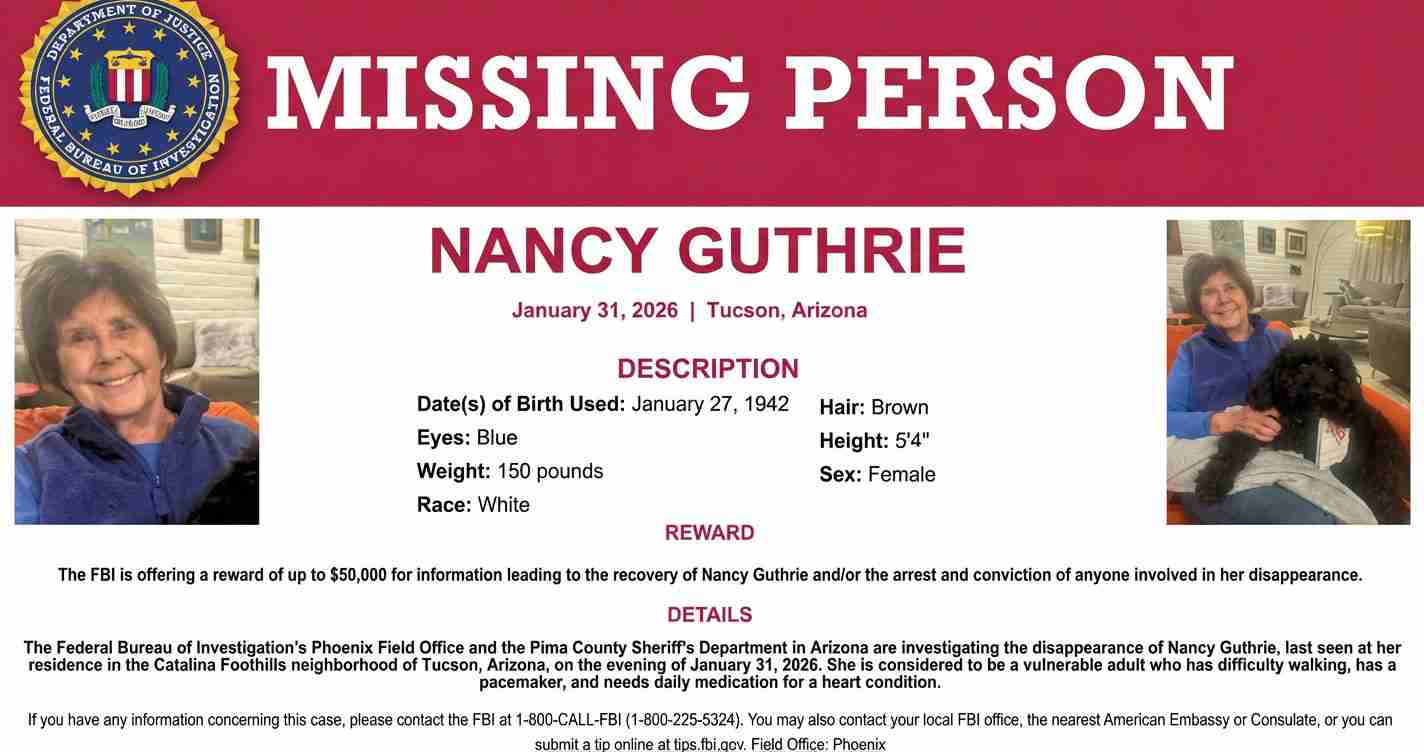
Pacemaker Data Gives Investigators a Precise Window in Nancy Guthrie Tucson Kidnapping Investigation — But Devices Can’t Track Location
Pacemaker connectivity data gave investigators a narrow timestamp in the Nancy Guthrie Tucson kidnapping probe: the monitoring app showed a disconnect at 2:28 a.m. on Feb. 2, aligning with recovered surveillance and shaping the focused search.
Key takeaways
- Precise connectivity timestamp: Guthrie’s pacemaker app disconnected at 2:28 a.m. Feb. 2, giving investigators a narrow window to examine other digital and physical evidence (KATV reporting, KOMO/Komonews).
- Device function vs. connectivity: A disconnection stops remote monitoring alerts but does not stop the implanted pacemaker from pacing the heart.
- Location limits: Pacemakers can log cardiac events and connectivity status but cannot provide GPS-style location data.
- Combined evidence matters: Residual backend footage, doorbell and surveillance data, phone records and physical evidence were all used to build the timeline.
What the pacemaker data revealed in the Tucson kidnapping investigation
Pima County investigators said the pacemaker’s monitoring app on Nancy Guthrie’s phone showed a loss of connectivity at 2:28 a.m. on Feb. 2. That timestamp became a pivotal focal point, lining up with recovered camera backend data and other surveillance indicators to narrow the period when suspicious activity occurred. (Sources: KATV reporting, KOMO/Komonews.)
“The connectivity timestamp is investigative value, not a location beacon,” investigators and device-clinic experts stressed, noting the device itself continued functioning after the app disconnect.
How pacemakers work — and what they can’t do
Pacemakers are implanted, battery-powered devices that prevent dangerously slow heart rhythms by delivering pacing pulses when needed. They can log cardiac events and show whether pacing occurred; clinics receive alerts only while devices remain connected to phone apps or home monitoring units.
Crucial limitation: pacemakers do not provide GPS or location tracking of the wearer. Past cases have used device logs to establish timelines of medical events — not to locate a person’s movements.
Amy Kleinhans, lead nurse practitioner for the electrophysiology group and clinical manager for the device clinic at HonorHealth Heart Care, explained that remote monitoring supports timely alerts for serious cardiac events so long as connectivity persists; when monitoring is cut, outside clinics stop receiving immediate warnings even though the implant continues to operate.
Timeline built from multiple data points
- Evening Feb. 1: Guthrie had dinner with her daughter Annie Guthrie and was dropped off near 9:45 p.m.; the garage door closed about 9:50 p.m. (Sources: KATV reporting, KOMO/Komonews).
- 1:47 a.m. Feb. 2: The home doorbell camera disconnected, cutting off live feed; investigators later recovered backend data indicating activity near the camera. (Sources: KATV, KOMO).
- About 2:12 a.m.: Surveillance software flagged movement; recovered backend frames showed a gloved hand blocking the camera and a person approaching with a backpack. (Sources and released footage: KATV, KOMO, released footage).
- 2:28 a.m.: Guthrie’s pacemaker disconnected from the monitoring app on her phone — a pivotal time noted by Pima County officials. The implant itself would have continued pacing; only remote alerts stopped. (Pima County timeline reported by local outlets: KATV, KOMO).
- Morning Feb. 2: Family noted Guthrie missed a virtual church service; calls were unanswered. A 911 call at 12:03 p.m. led deputies to arrive at 12:15 p.m., where they found blood on the porch and signs consistent with an abduction. (Sources: KATV, KOMO).
Other developments in the investigation
The FBI has joined the probe and offered a $50,000 reward for information. Family members and local outlets reported ransom demands seeking $6 million in bitcoin by Feb. 9. Federal and local agents released recovered doorbell footage, and a person of interest was briefly detained during a traffic stop in Rio Rico (about 60 miles south of Tucson) but released without charges after questioning. The search has involved hundreds of agents across multiple agencies. (Sources: KATV, KOMO).
What investigators can and cannot get from device data
Device data can be a powerful investigative clock: it can show when monitoring stopped, record abnormal heart rhythms or pacing events, and sometimes store logs retrievable from manufacturers or clinics. However, it cannot act as a GPS tracker to follow a person’s movements, so detectives combine device records with video, phone records and physical evidence when building a case. Cybersecurity checks on the home camera’s backend supported the official timeline, even though continuous video was not available.
Implications for Redding, California
- Law enforcement practices: Redding agencies should note how device connectivity can narrow investigative windows and develop clear protocols for requesting device records from clinics and manufacturers.
- Community safety and preparedness: Residents with implanted cardiac devices should verify app and home monitoring setups, keep software updated, and discuss backup plans so clinics can receive alerts promptly.
- Privacy and legal considerations: The Guthrie case highlights the balance between medical privacy and public safety; local leaders should review policies and legal procedures for obtaining device data in criminal investigations.
- Technology use and home security: The recovery of residual data from a lapsed home camera subscription in Tucson is a reminder to Redding homeowners to review subscriptions and cloud backup strategies if continuous footage is important.
- Political and civic response: For conservative communities, the case underscores the value of robust law enforcement resources, federal-local cooperation, and timely access to technical evidence to protect seniors and vulnerable neighbors.
Source links for reporting and footage
- KATV reporting on timeline, pacemaker disconnection, and recovered footage
- KOMO/Komonews coverage of events and timeline
- Released video and analysis (examples): Video clip — recovered camera frames and Video clip — timeline analysis
Reporting includes statements and timelines from the Pima County Sheriff’s Department, material released by investigators, and medical-device context from clinical experts.



