
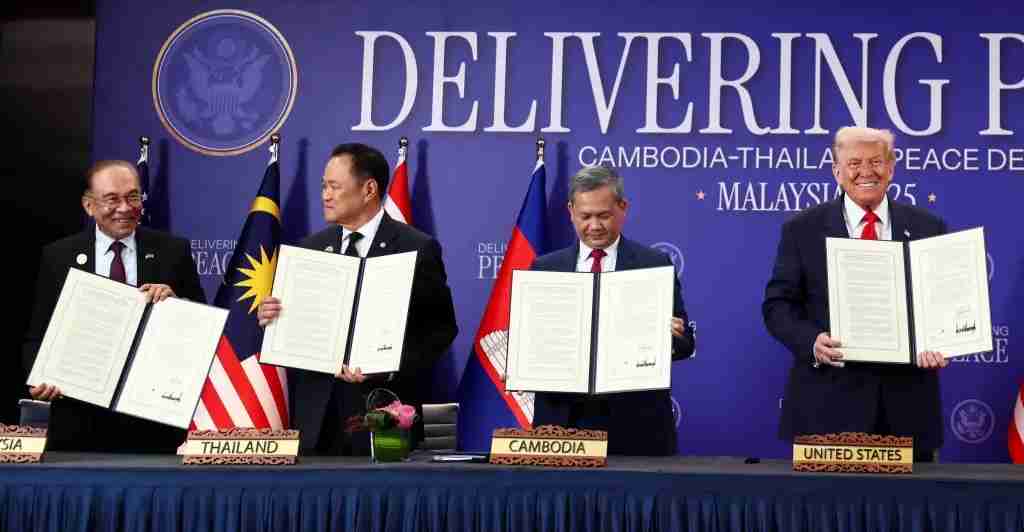
Trump Presides Over Expanded Cambodian-Thai Peace Agreement, Ending 2025 Border Crisis
Former U.S. President Donald Trump presided over the signing of an expanded Cambodian–Thai peace agreement on Oct. 26, 2025, formally ending the 2025 border crisis after months of diplomacy and international mediation led by Malaysia, the U.S. and China.
- Historic signing: An expanded ceasefire was signed on Oct. 26, 2025, with former President Donald Trump attending as a witness and regional leaders present.
- Ceasefire origins: An initial ceasefire began July 28, 2025, following talks hosted in Malaysia and ongoing international mediation.
- Agreement goals: Commitments include ending hostilities, removing heavy weapons, joint demining, and restoring cross-border trade.
- Open questions: Full legal text and verification mechanisms were not publicly released at signing, leaving enforcement details unclear.
Background: how the crisis unfolded
The dispute began in early 2025 as a contested border demarcation between Cambodia and Thailand that escalated into armed clashes, displacement of families and disrupted trade routes. The situation raised regional alarm over potential wider conflict.
Malaysia hosted early talks in late July that brought delegations together in Kuala Lumpur and produced an unconditional ceasefire effective at midnight on July 28, 2025. International envoys, including Malaysia’s prime minister and ambassadors from the U.S. and China, joined the process.
(See public background reporting on the 2025 Cambodian–Thai border crisis.)
How negotiations continued
Despite the July ceasefire, reports of violations and renewed tensions required additional diplomacy. Subsequent meetings included informal sessions in Shanghai and follow-up talks in Kuala Lumpur. Negotiators prioritized: removing heavy weapons, creating joint demining teams, and reopening designated crossings for trade.
Negotiators stressed verification, civilian protection and gradual normalization of economic activity as central to any durable agreement.
The expanded ceasefire signed Oct. 26
On Oct. 26, 2025, Prime Minister Hun Manet (Cambodia) and Prime Minister Anutin Charnvirakul (Thailand) signed an expanded ceasefire agreement. The ceremony, presided over by former U.S. President Donald Trump, was attended by regional leaders and international representatives; the event is visible in video of the signing ceremony.
Available summaries indicate the expanded agreement reiterates commitments to:
- End hostilities permanently and avoid military provocations near the border.
- Protect civilians and prevent displacement.
- Remove heavy weapons from frontline areas within a set timeframe.
- Establish a joint committee to coordinate landmine clearance and border security.
- Restore daily life in affected communities and resume controlled cross-border trade.
A video record of the ceremony is available as the video of the signing ceremony.
Who helped broker the deal
Malaysia is credited with initiating the diplomatic process and hosting early talks. The United States and China acted as co-facilitators, and U.S. diplomatic officials participated in follow-up negotiations. Observers noted that shared engagement by major powers helped sustain the talks.
Trump’s role and the Nobel nomination
Cambodia formally nominated Donald Trump for the Nobel Peace Prize on Aug. 7, 2025, citing his reported role in restoring stability at the border. The nomination and Trump’s presence at the Oct. 26 signing drew widespread international attention and political debate.
Investigative notes: what remains unclear
Public reporting and available documents did not disclose the full legal text of the “expanded” accord at the time of signing. Key unresolved questions include precise timelines, verification measures, troop withdrawal schedules and enforcement mechanisms.
Analysts and lawmakers are likely to press for answers on: who verifies weapons removals, how demining will be funded, and what enforcement steps exist if either side resumes aggressive actions. International partners — Malaysia, the U.S., and China — may play monitoring roles, but the mechanics were not spelled out publicly.
Regional and global significance
The accord averted a prolonged war between two Southeast Asian neighbors and demonstrated a mix of regional mediation and great-power engagement. Diplomats view the process as a potential template for resolving territorial disputes without full-scale conflict, encouraging negotiated settlements elsewhere.
Implications for Redding, California
Economic impact: While Redding’s direct trade links with Southeast Asia are limited, regional stability supports global supply chains and reduces risks of shipping delays or price spikes that can affect local businesses and agriculture.
Political consequences: For conservative audiences in Redding, the signing underscores a U.S. role in diplomacy framed as promoting stability with limited troop commitments. The Trump-backed mediation and Nobel nomination may influence local political narratives about effective foreign-policy approaches.
Social effects: Reduced refugee flows and improved regional stability lower the likelihood of sudden increases in asylum seekers and help families return to affected communities, easing long-term humanitarian needs.
Cultural relevance & practical applications: Civic organizations, veterans groups and schools in Redding may use the accord as a case study in diplomacy, international law and the role of U.S. citizens abroad; local businesses may welcome the decreased risk to global supply chains.
Sources and documents
- 2025 Cambodian–Thai border crisis — Wikipedia
- video of the signing ceremony (October 26, 2025) — YouTube
Reporting notes
This article draws on publicly available reporting and archived material current at the time of publication. The signing ceremony on Oct. 26 and summaries of the 2025 negotiations are confirmed by the sources listed above. The full legal text of the expanded accord was not publicly available in the consulted repositories.
Questions remain about verification and enforcement; readers and officials are encouraged to review primary documents when they are released and monitor official statements from Cambodia, Thailand, Malaysia, the United States and China for updates.



