
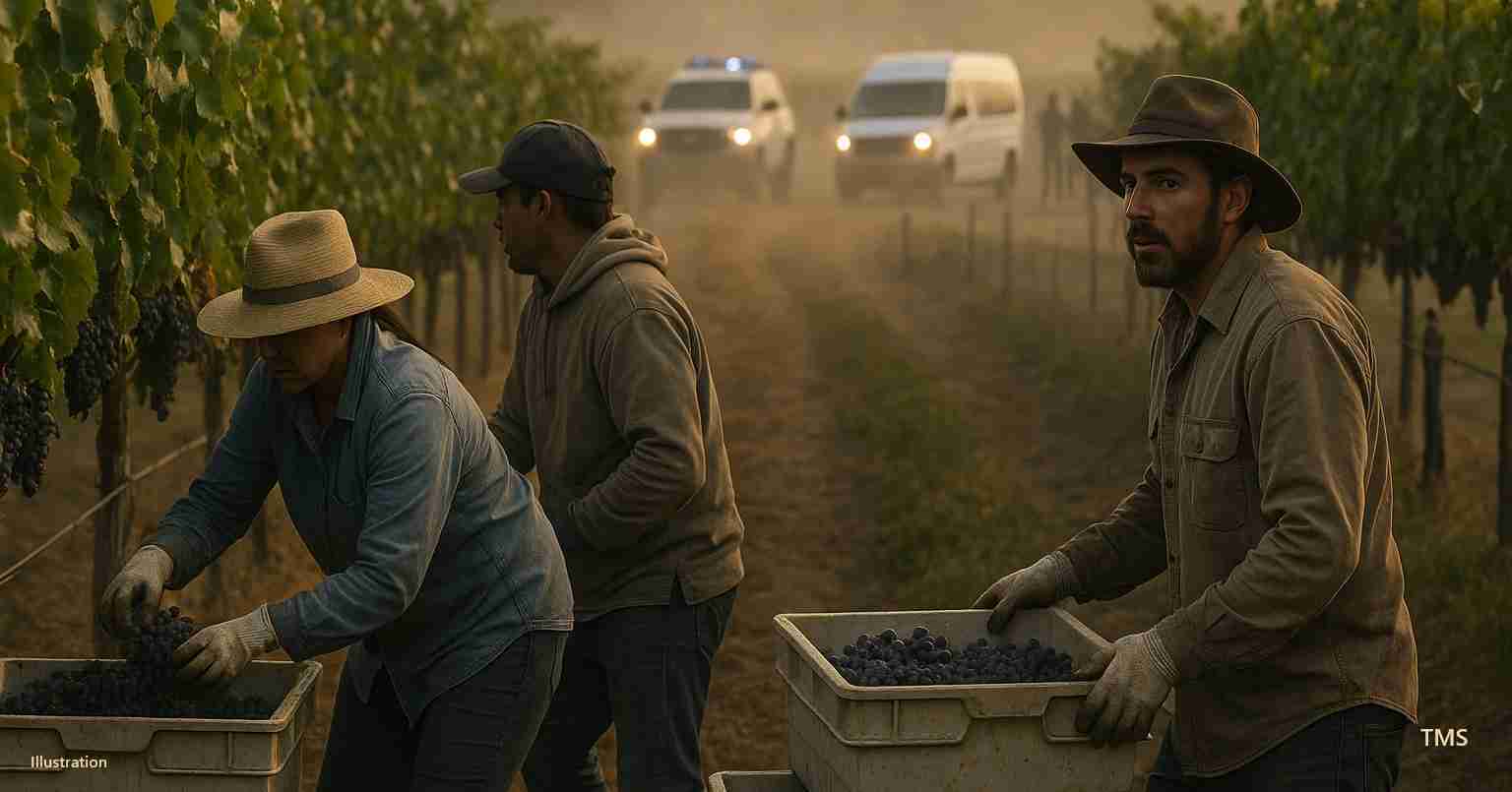
As 2025 Grape Harvest Nears, California Wineries Brace for Possible ICE Raids and a Devastating Vineyard Worker Shortage
As California’s 2025 grape harvest approaches, vineyard owners and workers fear increased Immigration and Customs Enforcement raids could spark a widespread labor shortage, jeopardizing the state’s multi‑billion‑dollar wine industry and deeply affecting immigrant communities regionally.
- Visible harvests increase risk: Busy fields make crews highly visible during peak picks, raising fears of targeted enforcement.
- Enforcement funding rise: The administration’s boost to immigration enforcement has fueled anxiety about broader operations (KRCB).
- Labor dependency: Immigrants comprise a large share of farmworkers — roughly 70% nationally and 73% in Napa County — with many estimated undocumented (Decanter; Napa Valley Focus).
Harvest timing: why vineyards fear ICE raids in vineyards
The grape harvest is the busiest, most visible season for wine country: crews swell, trucks move, and workers labor from dawn until dusk. That visibility is the central reason growers worry operations could be targeted when crews cannot be easily moved or hidden.
“We’re the most active and visible when grapes come in. That’s when crews are out in numbers. If ICE shifts focus to vineyards, the damage would be immediate,” said one regional grower.
This concern is echoed across reporting on wine regions (Decanter).
Federal enforcement and local uncertainty
The federal government’s ramped-up immigration enforcement — supported by an administration increase in funding — has injected broad uncertainty into agricultural communities. Growers report that prior assurances agriculture would be spared large-scale crackdowns now seem unreliable, prompting last-minute contingency planning across ranches and wineries (KRCB).
Who works the vines: scale of the labor issue
California’s wine sector is the nation’s largest and relies heavily on seasonal, largely immigrant labor. Industry reporting places the immigrant share of farmworkers at roughly 70% nationwide; local data show similar or higher shares in key counties. In Napa County, for example, 73% of agricultural workers are foreign‑born, with about one‑third estimated undocumented (Decanter; Napa Valley Focus).
Growers stress that field labor is not interchangeable: the work is physically demanding, seasonal, and often cannot be replaced by local civilian labor at scale (Wine‑Searcher).
Economic and human costs already visible
Where enforcement has occurred in crops like strawberries and citrus, communities reported immediate attendance drops of 25–75%. Some managers said they lost nearly half their crews after raids, producing swift economic effects and severe human consequences (Napa Valley Focus).
Beyond lost labor, workers who remain fearful avoid public spaces, change routines, and sometimes stop showing up for work. Detentions can separate families, remove breadwinners, and strain community services — effects that ripple through local economies and social systems (Decanter).
Protective steps by vineyards
Vineyards are taking a range of defensive measures: increased onsite security, locked gates, and “No Trespassing” signs; employee workshops on legal rights; expanded access to counsel; and coordination with industry groups to monitor developments (KRCB; Wine Business).
Operational changes include staggering shifts, altering pickup locations, and contingency plans to reallocate crews quickly if sites lose workers. Some wineries are also experimenting with mechanization where terrain allows, though many steep slopes and delicate varietals still require hand labor.
Industry advocacy and public messaging
Wine industry groups and local advocates are making the economic case against mass deportations during harvest, arguing that vineyard labor is specialized and harvest timing is fixed by crop needs. Advocates warn that mass detentions would impact suppliers, restaurants, tourism operators, and local governments that rely on wine revenues (KRCB; Napa Valley Focus; Wine‑Searcher).
Targeting patterns and unpredictability
High‑profile operations have often focused on strawberries, citrus, workplaces, churches, and car washes, creating cross‑sector anxiety. That unpredictability heightens fear that vineyards — especially during peak harvest — could be next (Wine‑Searcher; Decanter).
Contingency options are limited
Growers emphasize the practical reality: field labor is difficult to replace. While some operations pursue mechanization, many sites require hand labor due to terrain and varietal sensitivity. Even short disruptions during the 2025 harvest could mean lost grapes, damaged vintages, and substantial financial loss (Wine‑Searcher).
Sources and reporting
This article draws on reporting and local coverage from Decanter, KRCB, Napa Valley Focus, Wine‑Searcher, and industry reporting.
Implications for Redding, California
Economic impact: Shasta County and the Redding area have smaller wine operations but are connected to statewide supply chains. A broader workforce shortage could raise labor costs, make grapes harder to secure, and reduce tourism tied to wine and agri‑tourism.
Labor market and jobs: If coastal labor pools shrink, migrant workers could shift inland toward places like Redding seeking steady work, altering local labor dynamics. Conversely, stronger enforcement could make workers avoid travel, tightening labor availability for seasonal agriculture.
Public safety and community strain: Increased ICE operations statewide may strain local law enforcement and social services. Nonprofits and county agencies in Redding should prepare for more requests for legal aid, family services, and emergency assistance.
Business and supply chains: Local wineries, restaurants, and hospitality services that procure goods or services from coastal regions could face delays or price increases. Farmers competing for the same seasonal workforce may find recruitment and retention more difficult.
Political and civic response: Local leaders may balance enforcement priorities with protecting property rights and businesses, and could press for stable federal guidance that acknowledges agricultural timing and economic risk.
Practical steps for Redding stakeholders: Review contingency staffing plans, coordinate with county services and legal aid providers, cross‑train employees, and use business associations and chambers of commerce to share real‑time updates on labor availability and legal developments.
Note: All factual claims and source URLs in this article are preserved and linked to the original reporting for further verification and context.


